|
Formation of Children
Isabella of Castile’s Childhood: An Example for Our Days
Marian T. Horvat
What would happen to my children if they were taken from me by the government?”
This is a question that until some years ago one would expect to hear only in a Communist country, where the State police intrudes upon the life of the family to control what parents teach their children. But this problem is becoming increasingly common in our country as well, the so-called “land of liberty.”
Indeed, I have heard this question asked more than once recently from concerned Catholic mothers whom I know. A fear hovers in the air that State officials - acting on information that parents are religious radicals, teaching intolerance, preaching hate, withholding vaccines, or any number of these “new crimes” – could take their children from them.

Americans are increasingly threatened by state invasion into their private lives |
Every day such biased accusations become more and more likely to be applied against any Catholic family that teaches traditional moral doctrine to their children.
We Catholics should fight against these communist laws that are being introduced. At first they can appear to protect children at risk. In fact, they aim to destroy the parents’ power in the home and permit the State to assume control over the formation of their children. I encourage Catholic parents to be very vigilant regarding such laws and oppose them.
I also encourage parents to continue teaching their children Catholic doctrine, especially the pure and healthy norms of Catholic Morals, so contrary to the modern pedagogy and mentality.
A Catholic father or mother naturally worries that if their children are introduced into a modern environment, they could abandon the faith. Wouldn’t it be impossible for them to uphold different standards and principles from those they see around them?
I provide you a beautiful historic example to show such resistance is possible, as well as to reinforce the importance of a strong Catholic formation of youth. Isabella of Castile and her brother Alfonso offer us a beautiful example of children who remained faithful to Catholic teaching when placed in an extremely hostile environment.
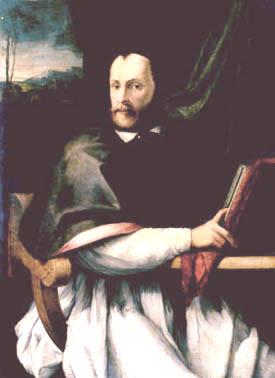
Cardinal della Casa by Pontormo |
The good formation given by Queen Isabella of Portugal
After the death of her husband King Juan II of Castile, Queen Isabella of Portugal saw the son of his first marriage - her step-son Enrique IV - crowned King of Castile. Realizing the dangers for herself and two young children at this court of intrigues and vice, she withdrew with her two children to the small Castle of Arévalo in Old Castile. At that time, the Infanta Isabella was a self-assured little girl of three years and her brother, Infante Alfonso, was a newborn in the cradle.
The valorous and pious Queen Isabella of Portugal, overcome by melancholy and ill health, turned to religion for solace. (1) She had never fully recovered from a suspected poisoning at court some years earlier that had affected her mental facilities. Nonetheless, she did her best to form her two children well. One of Isabella’s strongest memories of their mother was seeing her in the chapel, kneeling in reverence before the Holy Eucharist. (2)
Within the walled gates of the secluded castle, the children played games, learned their Catechism, received their First Communions in the chapel. Outside the walls, they took long outings on horseback, and Isabella became an excellent rider and skilled huntress. Her brother Alfonso learned to handle a sword and tilt with lances. Despite the very troubled times, it was a relatively serene and pious environment for the young Infante and Infanta.
At the court of King Enrique IV the Liberal, as he was called, it was a different story. His unorthodox opinions and conduct scandalized the Catholic nobles and people. His chosen companions were Moors, Jews and Christian renegades; his private guard was composed of Moors – to the outrage of the Catholic nobles. At his table, blasphemies against the Faith and obscene jokes were welcome. Further, the King was familiar with all vices, natural and unnatural. The stench of vice from this court – with scandals too numerous and vile to record – was sickening all of Castile.
The stories and rumors found their way even to the out-of-the-way Castle of Arévalo where Queen Isabella of Portugal had retreated with her children, who were next in line to the throne.
One day, King Enrique, desiring a closer hand on the lives of his half-siblings, sent a message to Queen Isabella of Portugal. He ordered the Infanta Isabella and the Infante Alfonso to come to the Royal Court at Madrid without delay to take up permanent residence in that den of iniquity and intrigue. Ironically, the King pretended the children would be more virtuously brought up at his court under his personal care. Isabella was 11-years-old, and her bother was 8.
There was nothing to do but obey. Broken-hearted, the pious Queen Isabella sent off her children to face an impious court with untold dangers. She turned to prayer as her consolation, asking Our Lady to guide and protect the young Isabella and Alfonso.
At the Court of Enrique IV
The life the two children entered at Alcazar of Segovia was very different from the austere and sheltered existence they had experienced up to then. Every day there were new blasphemies, new whispers of Queen Juana’s love affairs, new jokes about King Enrique’s impotence and fondness for young men. The young women of the court were famous for their skills in the art of seduction, their lascivious costumes and audacious speech.
Infanta Isabella and her brother turned their backs on the debauched court life. Alfonso learned the skills of a knight, studied with a tutor and tried to fulfill the obligation his mother had given him to be Isabella’s knight and protector. Isabella was instructed in music, painting, poetry, sewing and grammar. She spent a long time every day in prayer, beseeching the Blessed Virgin to keep her and Alfonso safe and without sin.
The following incident offers a poignant picture of the fidelity of these two valiant youth to the upright customs and morals they learned from their mother.
When Isabella reached age 16, Queen Juana attempted to induce her to join the Court debaucheries. Isabella fled in tears to her brother.
Alfonso buckled on his sword and strode to the Queen’s apartment. One can imagine the picture. The stern-faced 14-year-old youth told the Queen she had spoken more like a harlot than a queen, and forbade her to mention any further evil to his sister. The bemused Queen received his impassioned speech with an ironic smile – after all, one had to be careful in crossing the next to line to the throne. Next, he visited the ladies-in-waiting and forbade them under pain of death to speak to his sisters of depraved things. They held back their laughter until he left. After that, however, Isabella was left alone.
Thus, amid a corrupt, scheming and debauched court, Isabella and her brother Alfonso emerged unscathed by the scandals and faithful to the teachings of the Catholic Faith. It was a triumph of grace that even in this putrefied environment two strong pure Castilian roses prospered and blossomed, fortified by the prayers of their mother and the benefits of her early formation.
The fates of the Alfonso and Isabella
Alfonso later became involved in a plot with Catholic nobles who were fed up with Enrique’s unnatural vices and corrupt court and wanted to depose him and make Alfonso the king. Adding fuel to the fire was the fact that Queen Juana gave birth to a daughter – also named Juana – who was said not to be the daughter of King Enrique, but rather the offspring of the Queen’s favorite, Bertrand de la Cueva.
After a military confrontation between the two factions at the Battle of Olmedo in 1467 that ended in a draw, a truce was reached. To appease the rebellious nobles, Enrique agreed to name Alfonso as his heir. Shortly afterward, however, Alfonso became violently ill and died at age 15. Was it an attack of the summer fever or poisoning, as his supporters suspected? No one can say for sure. The nobles then turned to Isabel to take her brother’s place at the head of their rebellion. But she refused and settled instead with Enrique IV. In an official agreement, she and the nobles accepted him as King, and he named her as his official heir. In 1474, Isabella became Queen of Castile at age 26. She was a key character in completing the Reconquista, establishing the Spanish Inquisition, sponsoring Columbus' voyages that led to the discovery of America, and laying the foundations of the Spanish Empire. Throughout her reign, she upheld and defended the Catholic Faith that she had preserved as a child in a court very different from the one she would later establish. For their fidelity to the Faith, Pope Alexander VI granted the title of Catholic Monarchs to Queen Isabella and her husband King Ferdinand of Aragon. Thenceforward, the Spanish Monarchs were known by this title of honor. And because of her uncompromising faithfulness, she is known today as Isabel la Católica, Isabella the Catholic.
1. In her earlier years, Queen Isabel’s friendship with Saint Beatrice de Silva, whom she helped to found the order of the Conceptionists, played an influential role in her religious formation.
2. The other facts in this article are from William Thomas Walsh, The Last Crusader: Isabella of Spain (1452-1504), TAN 1930.
Painting depicting Isabella I of Castile, Queen of Castile and León, with her husband Ferdinand II of Aragon.
For those who might object to a Bishop wasting his time addressing the topic of manners, Msgr. della Casa has a ready response: There is nothing less ridiculous or superfluous than things that tend to make us more agreeable to our neighbors in society. While politeness in itself is not really a virtue, he admits, yet it so nearly resembles a virtue as to hardly be distinguished from it.
This treatise became one of the most popular books of its day. The Italian man who hadn’t read Il Galateo, as the Treatise was called, was considered the proverbial ill-bred country bumpkin.
In Part I of this treatise on politeness, there is an interesting story relating the delicate treatment of the Bishop in giving a small reprimand and the gracious reception of the reproof by his houseguest. Instead of having resentment for being corrected, the guest receives the criticism with gratitude as an act of charity. How amiable life would be if we would all give and receive reprimands in this spirit. The story follows.
An instance of delicate reproof
There lived in Verona a very wise and learned Bishop who used to treat all his guests with courtesy and hospitality. One day a nobleman, Count Richard, came to Verona and stayed with Bishop Gilberti and his household. Although the Bishop found much to admire in the count’s manners, he noticed that the count had one small fault. He wanted to bring this failing to the count’s attention without offending him. So Bishop Gilberti sent for one of his discreet friends, Galateo, and instructed him to accompany Count Richard on his departure and to tactfully inform him of his fault.
Galateo engaged the count in pleasant conversation along the way until the moment he judged to be the proper time to convey the Bishop’s message. With a friendly smile Galateo said to the count, “Sir, my lord the Bishop is exceedingly grateful for the honor you have done him by coming to his humble house and staying with him. He has also asked me to make you a gift on his behalf, in recognition of the great courtesy you have shown him. He earnestly begs you to accept it in good heart, and this is what I have to impart to you.
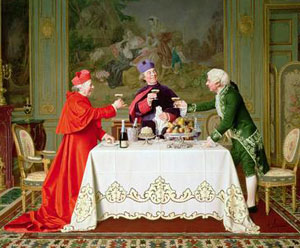
Della Casa stresses table manners
in his book on politeness |
“In the Bishop’s opinion, he has met no man more courteous and mannerly than yourself, and, therefore, he has studied your behavior closely and examined it in every particular. He has found that it is in all points most engaging and commendable, except for this one shortcoming: that when you are eating at table you make a strange noise with your mouth and lips which is very distressing to hear. The Bishop has asked me to draw your attention to it and begs that you should do your utmost to guard against it. In place of a parting gift, he prays you to accept this friendly reproof and admonition, for he is certain that no one else in the world would bestow it upon you.”
Count Richard, who had been unaware of this fault, felt a bit embarrassed by Galateo’s words. On reflection, however, appreciation for the bishop’s instruction eclipsed his loss of composure.
He replied to Galateo, “Please tell the Bishop that men would be far richer than they are, if all the gifts which they exchange were the equal of his. Return to him my unbounded thanks for his great affability and kindness towards me. Assure him that for the future I shall most certainly take the greatest pains to correct this fault. May God be with you!”
To end the chapter, Archbishop Giovanni della Casa asks some questions of his readers. What can we suppose this worthy Prelate (who was disappointed with Count Richard for a trifling) would say to your contemporaries who have such disgusting table manners: the personage Mr. X, who thrusts his snout into his food like a hog and doesn’t lift it until he is finished; the illustrious Mr. Y, with his cheeks inflated as if sounding a trumpet as he hastily devours his food; the well- known Mr. Z, with his hands smeared up to his elbows in grease and his napkin so filthy as to make the dish cloth appear clean?
Such persons, he concludes, do not deserve to be entertained by the noble Prelate, but rather to be banished from the assemblies of the polite.

Posted August 29, 2008

Related Topics of Interest
Table Manners Reveal a Man's Culture
Other Essential Table Manners
Courtesy: An Essential Element of the Catholic Home
Manner make Life Easier
Fast Food is Protestant
Tradition, Stagnation and Progress
Related Works of Interest
|
|
Formation | Cultural | Home | Books | CDs | Search | Contact Us | Donate
© 2002- Tradition in Action, Inc. All Rights Reserved
|
|
|