 |
 |
 |
 |
 |
 |
 |
How Our Lady Gave ‘Good Success’
to the Obregon Brothers
Note: A reader sent us a link to this Book of Histories of various statues of Spain. It tells of the conversion of the founder of the Minim Order, Ven. Bernadino de Obregón, and describes how the statue was found and how Pope Paul V gave it the name Our Lady of Good Success.On a winter morning in the year 1567, a gallant young man of age 27, whose chest already bore the red emblem of the Apostle Saint James, was walking down Postas Street in the town of Madrid, where King Philip II's Court was then located. A poor young man was cleaning the mud from the street and unfortunately splashed some on the elegant cabellero. In the first flash of anger that overcame him, the knight struck a hard blow to the face of the street cleaner.
This account was written by the Count of Fabraquer in 1861. We offer it here to our readers and point out the use of the term ”good success” in the context not of the "event" of the Purification, as some are wrongly claiming today, but of a good outcome, or success, for the Obregon Order.
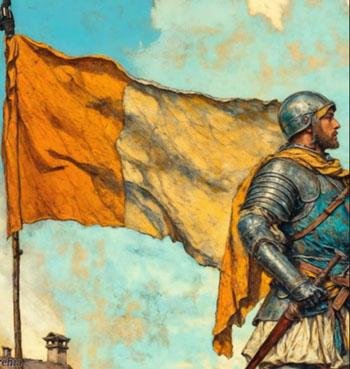
A knight who did great feats in Spain’s wars with Flanders under King Philip II
The knight, a moment before so proud and haughty, was astonished to witness such humility. He was no longer the same man and, hiding his face in his hands, yielded to the sudden change he felt within himself. He fell to his knees and begged forgiveness from that poor man whose revenge had been humility.
Upon rising to his feet, that brilliant proud knight showed by his pale face and uncertain gait that happiness had fled from him, that the butterfly had lost its wings.
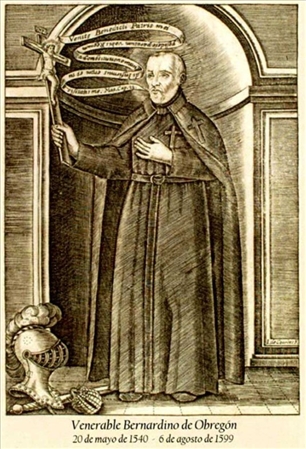
That young man was Don Bernardino de Obregón, who was born in Las Huelgas de Burgos in 1540 into a noble family. He had distinguished himself by his brilliant exploits in the wars of Flanders, and had been decorated by the Order of Santiago. Now, he had come to Court where his merit and comely appearance had won him great favor.
The past, present and future smiled on this youth. The son of rich parents, brave and of noble bearing, there was no whim that crossed his mind that he could not satisfy. In the glittering salons of the Court and among the grandes, where egoism has its throne, everyone rushed to celebrate him and greet him with flattering smiles.
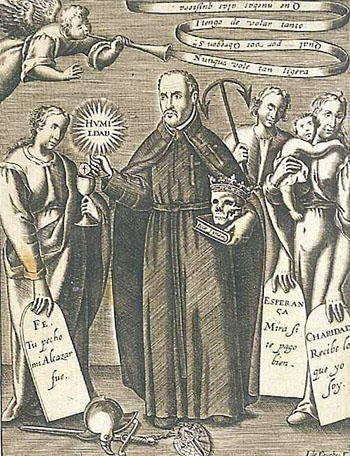
Obregón became the founder of an Order that nursed the sick & poor he had once despised
Returning home, he bemoaned his vanity and contemplated the humility of the Redeemer of mankind stretched out on the vile instrument of his torture. He compared the small offense he had suffered and aroused his anger to those that Jesus Christ had suffered for him before reaching the summit of Calvary. It was a grain of sand next to an immense mountain, a drop of water compared to the unfathomable sea!
Obregón had received a religious education from his parents: The divine faith and the celestial hope that they had instilled in his heart had vanished after succumbing in the battle of the most shameful passions, but the pious memories of childhood remained. The example of the humility of the poor man he had offended was enough for those memories to suddenly rise up powerfully, tearing away the dark veil that concealed from his sight the radiant truth and the new mission to which God destined him on this earth.
That man who had rejected the poor and wretched now resolved to dedicate his life to their service, detesting and cursing pride and vanity as the prophets of old cursed the sinful cities. He left his position in the military and gave away his riches, becoming poor to join the ranks of the poor. Humbling his pride, he dedicated himself to serving the sick in the Royal Hospital, submitting his will to that of its administrator, exchanging his finery in which he had once taken such pride for a coarse black sackcloth.
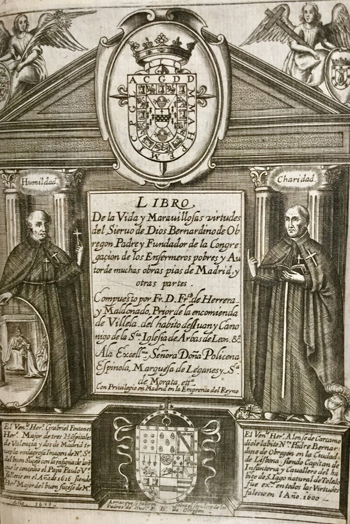
An old biography: The Life & Virtues of the Servant of God Bernadino de Obregón
The number of those who came to enlist in the new army of charity grew day by day. Bernardino de Obregón's zeal knew no bounds: He founded convalescent homes, schools for foundlings, several hospitals, including one in Lisbon, the capital of Portugal, whose Kingdom King Philip II had added to the Crown of Spain. It was Bernardino de Obregón who the Monarch called to his deathbed to assist him in his last moments in El Escorial, where the King died in 1598.
Bernardino de Obregón, so haughty and proud in his youth, suffered with the greatest patience and humility many hard persecutions, from all of which the hand of the Lord delivered him. To the great sorrow of the Court, so edified by his virtues, he died at age 59 on August 6, 1599, and his body was buried in the General Hospital in Spain, which he had founded.
His Order approved by the Pope
Brother Gabriel de Fontanet, who had succeeded him in the governance of the Congregation, accompanied by Brother Guillermo Rigosa, decided to go to Rome to obtain for their Institute the sanction of the Apostolic See, then occupied by Pope Paul V.
They traveled on foot to Valencia, where their Congregation had a hospital and was highly regarded by the holy Patriarch of that Diocese, Archbishop Don Juan de Rivera. They continued on their journey and, after leaving Traiguera, a town in the jurisdiction of Tortosa along the borders of Catalonia, they lost their way, and a terrible storm surprised them during the night.
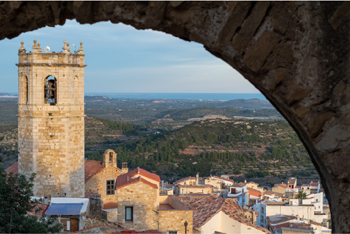
The mountains in the distance seen from the medieval town of Traiguera
From that weak shelter, they then saw a glowing site on a distant hill that at first they thought was but a reflection from the continuous lightning. However, this light remained even after the storm had abated. The climb to the top of that mountain was difficult and arduous, but by taking off their shoes and helping each other, they managed to reach the summit.
In a hollow place inside the rock, they found an exquisitely carved small shrine or chapel, and, as if embedded in the rock face, an image of the Virgin Mary, about half a yard tall. The two Obregón Brothers were astonished, and the words of the Prophet Isaiah came to their minds: Invenerunt qui non quaesierunt me. “I was found by those who did not seek me." (Chap. 65)
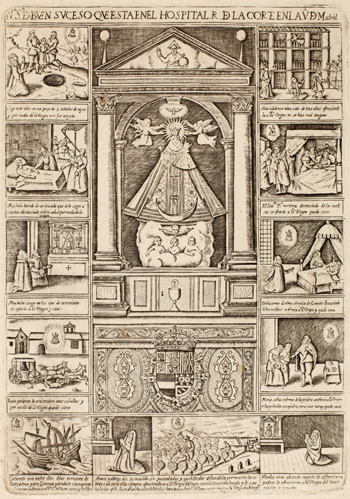
Miracles recorded of cures by the miraculous Image of Our Lady of Good Success discovered by the Obregon Brothers
They decided to take the holy image and the extra gown beside it, which is still piously preserved today, and to make her the intercessor for the petition they were bringing to Rome. Thinking that perhaps the holy statue might belong to one of the nearby towns that placed it in that shrine for veneration and not wanting to steal what belonged to another, they remained in the area for several days, cautiously inquiring amongst the oldest inhabitants of the surrounding towns whether anyone knew of the existence of an image of the Virgin, but always keeping their fortunate discovery a secret.
Finally, they surmised that the image found so miraculously was one of those hidden by Spanish Catholics during the sad days of the Arab domination. This belief was confirmed by the ancient dress they had found next to the image, for the Catholics would also hide the ornaments with the statues, as noted by that genius of poets, the great Lope de Vega:
They enclose the images,
and hide them in the countryside,
With their sacred ornaments,
While from their faces,
They are banished with tears.
(Las imágenes encierran,Y en las campañas las cierran Con los ornamentos sacros, Mientras de sus simulacros Con lágrimas se destierran)
The Statue receives her name
The two Brothers made a wicker basket and lined it with buckram. In it they placed the holy image and took turns carrying on their backs, never leaving it for even a moment until they arrived in Rome.
They presented themselves to kiss the foot of Pope Paul V, who, seeing the so carefully tended basket, curiously asked them what was in it. They told the Pope about their miraculous discovery of the Holy Virgin, to whom they had entrusted the good success of their intentions, which they humbly exposed to him.
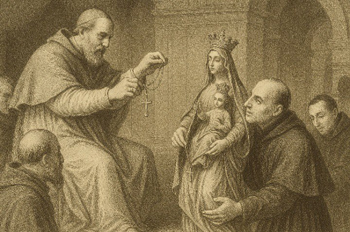
Pope Paul V puts the purple cross on the statue & names her Our Lady of Good Success
He granted many indulgences to this Virgin, and in memory of the gilded enamel cross he had placed upon her, he authorized the Brothers of the Congregation he had just approved to wear a purple cloth cross on their black habits.
Joyful and content, Brothers Fontanet and Rigosa returned to Spain, heading once again to Valencia, because the Pope had entrusted to Archbishop and Patriarch Don Juan de Rivera the organization of the Congregation, which was now established as a Religious Order. Along the way they revisited the place where, on a night of a terrible storm, they had found the miraculous image that had brought such success to their mission.
The plague was then ravaging the city of Valencia, and the Brothers found a vast field in which to exercise their zeal and ardent charity. Of the thirteen Minim or Obregon Brothers who were there, nine had succumbed to the contagion while caring for the poor and infirm.
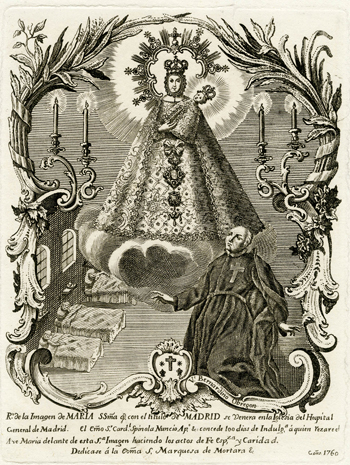
Indulgence given in 1760 for reciting a Hail Mary before the statue & making Acts of Faith, Hope & Charity
But Brother Gabriel de Fontanet did not consider this advisable and left with his companion for Madrid. There they placed their image of Our Lady of Good Success on an altar in one of the rooms of the General Hospital, and they wore their habits and purple crosses for the first time on Corpus Christi Day in the year 1610.
Our Lady of Good Success remained in the General Hospital of Madrid until the Obregon Brothers in charge of the Royal Hospital of the Court transferred her to its infirmary. This is the hospital which was located in Puerta del Sol and sadly was demolished to make way for the expansion of the Plaza.
The body of Ven. Bernadino de Obregón was first interred in a vault of the General Hospital when it was located at San Jerónimo Street, which was originally a shrine founded by the Catholic Monarchs Ferdinand and Isabella for the relief and treatment of sick soldiers. Emperor Charles V expanded it in 1529 and established it as the Royal Hospital of Corle for the treatment of soldiers and employees of his royal household.
King Philip II, so knowledgeable and skilled in architecture, rebuilt the Hospital on the Puerta del Sol in Madrid in 1587. He personally designed the plan of the small church, which was cruciform and of regular shape, will pillars and a dome in the center proportionate to the building. Philip III dedicated this church on July 6, 1611, with the attendance of Queen Margaret and the entire Court.
At that time, the statue of Our Lady of Good Success, which had previously been in the infirmary, was placed in the a chapel of the church.
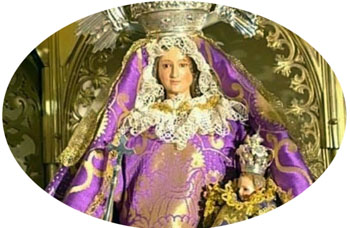
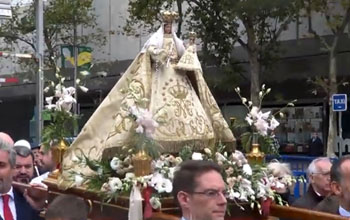
The first statue in Madrid; below each year in October
to commemorate the finding she is processed
through the streets of Madrid



de las imágenes de la Virgen aparecidas en España, 1, Madrid,
Impr. y Litografía de D. Juan José Martínez, 1861, pp. 511-522
Posted January 30, 2026
 2011: Impressions of Our Lady of Good Success The Sadness of Our Lady of Good Success in Quito 2019 Confused Language, Confused Thoughts
Clarity on the Title of
Our Lady of Good Success The Prophecies Approved by the Church The Madrid Statue of
Our Lady of Good Success Introduction to the Novena
to Our Lady of Good Success Our Lady of Good Success or Our Lady of Buen Suceso?
2011: Impressions of Our Lady of Good Success The Sadness of Our Lady of Good Success in Quito 2019 Confused Language, Confused Thoughts
Clarity on the Title of
Our Lady of Good Success The Prophecies Approved by the Church The Madrid Statue of
Our Lady of Good Success Introduction to the Novena
to Our Lady of Good Success Our Lady of Good Success or Our Lady of Buen Suceso? |
 |
 |
 |
 |  |
 |
 |
 |
