Book reviews
 |
 |
 |
 |
 |
 |
 |
The Pride & Arrogance of the
Heretic John Frith
Review of The Folly of Heresy: A Letter on the False Martyrdom of John Frith by Blessed Germain Gardiner, ed. by Boone W. Larson, Recusant Press, 2025, 74 pp.
let him be anathema.” (Gal. 1:8)
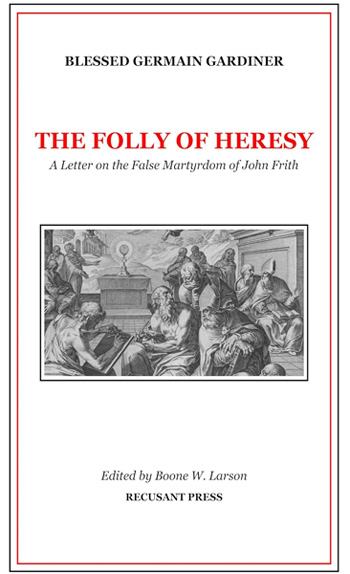
A recommendedn work that can be purchase here
The Church has always prudently and charitably dealt with heretics by giving them first a fair trial before condemning their pride and obstinacy. This just practice is clearly demonstrated in the excellent book The Folly of Heresy: A Letter on the False Martyrdom of John Frith.
John Frith was a young Englishman well-educated and learned in the humanities and languages. After his university years, he became acquainted with the new heresies of Luther through the writings of William Tyndale (an English heretic) and began to spread these heresies publicly in England. For this he was punished – the English at that time being staunch in their defense of the Faith – and fled to Belgium, where he met William Tyndale and other heretics who had sought refuge there.
Frith expanded on the works of other heretics to make his own doctrines, and returned to England to confirm his followers in their false beliefs. He and his adherents distributed his heretical writings, including a new translation of the Old Testament. Sir Thomas More, Chancellor of England, issued a warrant of arrest for Frith with the charge of heresy, and he was brought before the Inquisition.
Blessed Germain Gardiner, a layman who would become a martyr for the Catholic Faith after Henry VIII revolted against the Church, was chosen to assist in John Frith’s examination. His letter to a fellow Catholic on his experience with Frith is the content of this small book, edited by Mr. Boone Larson of Recusant Press.
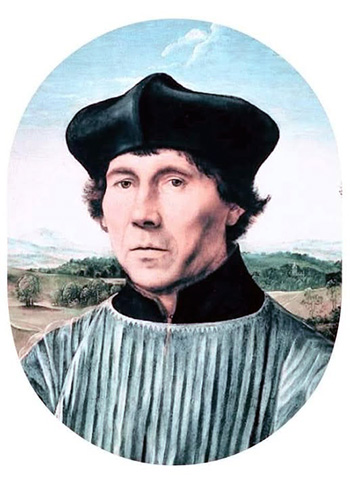
Bishop Stephen Gardiner made the first examination of Firth & tried to return him to the Catholic Faith
Bl. Germain’s letter begins with a strong criticism of John Frith, who, being only in his twenties, thought himself wise enough to correct the Church and deny her authority: “God has raised in his [Frith’s] young breast to rebuke the world of their long, horrible error and detestable blindness, wherein so many hundreds of years all men have abided.” (p. 3)
Frith displayed many signs of arrogance and pride. With haughty laughter and ironic smirks he defended his position, thinking his personal interpretations sufficient guard of truth.
He loudly denied the existence of Purgatory and the doctrine of Real Presence of Our Lord in the Blessed Sacrament among other falsehoods, but when asked to give his reasons for not believing them, he could not defend his position with any sound reasoning.
Bl. Germain’s uncle, Bishop Stephen Gardiner of Winchester, was one of the first to interview Frith, charitably endeavoring to explain to him the folly of his new beliefs. Although the Bishop made great efforts to demonstrate the truths of the Faith, Frith refused to argue and retorted only that he was moved by a “different spirit” so there could be no understanding between them.
Indeed, Frith was of the opinion, like all heretics of the age, that every man should be left to his own conscience and not be forced to accept anything as an article of faith. He claimed that all the Doctors of the Church were of the same opinion as he regarding the Blessed Sacrament, and pretended to be willing to accept correction if he could be shown plainly a writing of one of the ancient Doctors – any later theologians he would not accept as being reliable – demonstrating the True Presence.
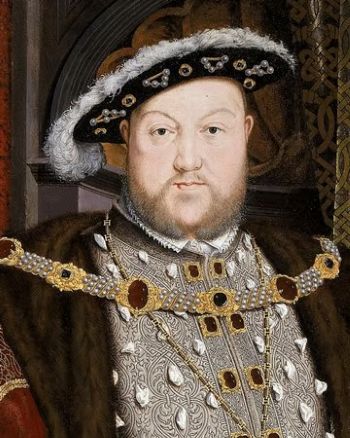
Henry VIII, who first encouraged Blessed Germain's work against heretics, & later sentenced him to death for defending the Faith
Quoting extensively from the early Church Fathers, including the sermon of St. John Chrysostom on the Blessed Sacrament that most plainly demonstrates the Catholic position, Bl. Germain was astonished at the bad will of Frith, who maintained that all should be interpreted in a spiritual and not a physical sense. Frith would have the Doctors be read as he understood them rather than as the texts plainly read, and no quotes sufficed for him.
“Hereby,” wrote Bl. Germain, “a man may plainly see by what means they allure men to their sect, whether by the words of God as they pretend, or by their own inventions, false dissimulations and lies.” (p. 30) Further he observed: “This has ever been a craft of heretics, by false alleging or false understanding some one Catholic Doctor, whose authority were much reputed among good men, to pretend that their opinion were also Catholic.” (p. 34)
The only theologian Frith could find to prove his new doctrine was an obscure 1500s monk who did not adhere to the Catholic belief. Alleging good will in “offering himself to be reformed,” he in fact would admit no truth unless his conscience were clear of the arguments against it. Bl. Germain points out that Our Lord manifests his Truth through virtue, knowledge or miracles, none of which were exhibited by Frith, who expected others to follow him on his word only.
“There is but one truth,” affirmed Bl. Germain, “and one Church which professes the truth: so that one of these two churches is not of God. If our Church be not the right Church, then within these few years before these new gospellers began to institute their churches, and found these new-fangled opinions, there was no Church at all.” Frith arrogantly answered: “Yes, the faith was ever preserved among the elect.” (p. 53)
Bl. Germain lamented that Frith should “cast away his soul, being so dearly bought, and destroy by the Devil’s instigation such good qualities as God had given unto him to employ in His service.” (p. 57)
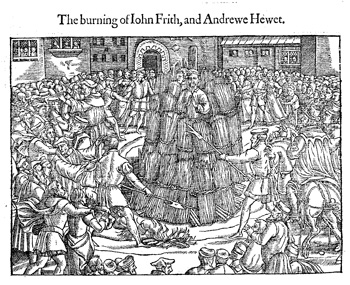
He continued: “For this fool [Frith] persisted still in his unwillfulness even unto the fire, whither he went, as I have known and heard many go to the gibbet, counterfeiting an excessive outward gladness, either to lighten their inward pensiveness or to make their judges be hated, or else for a glory, because they would have it said they died like men, dying indeed most of all like desperate wretches.” (p. 56)
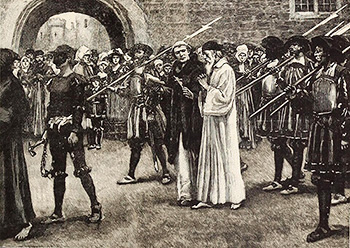
Firth, the young man carrying Scriptures, arrogantly walks to the fire
The same King who first encouraged Bl. Germain’s noble work against heretics sentenced him to death for defense of that same Faith on March 7, 1544. Accused as a traitor who deprived “the King of his dignity, title and name of Supreme Head of the English and Irish Church." Bl. Germain was to be the last martyr under Henry VIII.
His noble example and Catholic spirit should be an encouragement to all Catholics who live in our evil times.
With Bl. Germain, we can pray:
“From the contagious infection of which sort and kind [heresy] I beseech Our Lord for His tender mercy evermore preserve us, and send them who be such, who with the corrupt, stinking waters of their own digging alter and turn the sweet taste of God’s holy and most wholesome doctrine into very deadly poison – send them, I say, the grace to amend; and leaving off their own mad inventions with all meekness, to hearken unto the old, accustomed teaching of His Catholic Church.” (p. 59)
Posted May 11, 2026



______________________
______________________
 |
 |
 |
 |
 |
 |