Catholic Customs
 |
 |
 |
 |
 |
 |
 |
Customs of Easter Day - I
The Wonders of Easter Morning
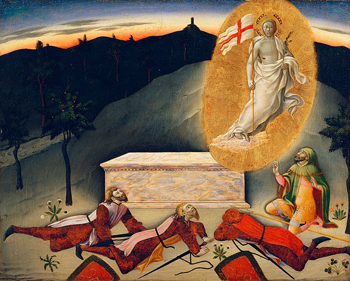
“This day, which the Lord hath made,
is the Solemnity of Solemnities and our Pasch;
the Resurrection of Our Savior Jesus Christ according to the flesh.”
(Excerpt from The Roman Martyrology)
Thus does the Church proclaim the arrival of the Dominica gaudii (“Sunday of joy”). Since the hour of Our Lord’s Resurrection more than 2,000 years ago, Catholics in every land have considered Easter Sunday to be the most joyous day of the year.
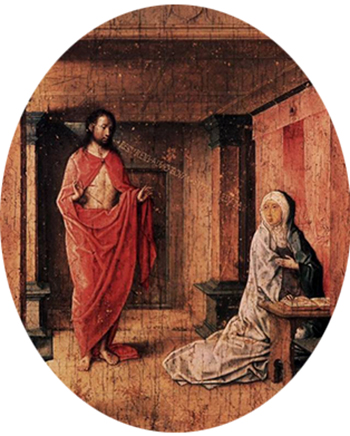
Christ appears to His Mother after the Resurrection,
Juan de Flandes (1460–1519)
In Germanic countries and England, the name Ostern or Easter – from the Old English eastre meaning ‘Passover’– was given to this day. In addition to their connection to the Pasch, these names were derived from the Germanic words Ostar, Ostara and Eastur alluding to dawn and the rising sun, which is a perfect symbol of Our Lord rising from the Tomb at the break of day. 1
Indeed, the sacred hours preceding dawn on Easter Sunday were held in great estimation by our Catholic forefathers, for it was in these hours that Our Savior rose from the dead and appeared to Our Lady. The joy that these hours brought to all mankind touched the earth and the elements which rejoiced in the triumph of their King.
Cleansing Easter water
The water of Baptism is the means by which the mysteries of Our Lord’s Resurrection are imparted to mankind. For this reason Catholics of old believed that all water flowing in streams and springs during the early hours of Easter morning received special qualities.
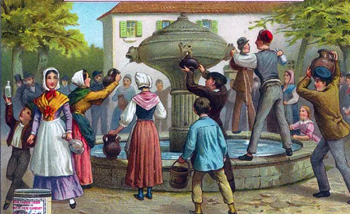
French villagers draw Easter Water from the spring; below, women from Brandenburg silently fill vessels with Easter water
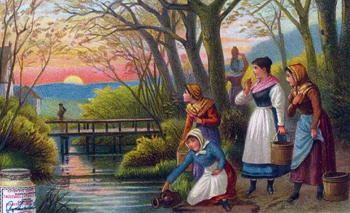
To partake of the blessings of this water, many people of Central Europe flocked to streams or rivers before sunrise and silently prayed as they bathed or washed their face and hands in the water. It was believed that this cleansing with the Easter water would bring health, strength to the eyes, and relief from skin disorders. Those who could not go to the running water washed their faces in the drops of dew that glittered on the grass.
In Poland, persons suffering from slow-healing wounds bathed their sores in this Easter water. For those who were infirm or unable to go to the river, family members brought back water for their use; afterwards the extra water was returned to the source from which it came. 3 In France and Quebec, however, the water was preserved until the following Easter in a special vessel to be used for healing sicknesses and as a protection against storms. 4
An east wind coming from the direction of the rising sun and the direction from which Our Lord will return on Judgment Day was considered as vital in some areas to imbue Easter water with its blessed qualities. 5
New life & new clothing
On Easter morning, reflection on the waters of Baptism also directed the thoughts of Catholics to the neophytes who, since their Baptism at the Easter Vigil, were clad in new white garments. To unite with the joy of the neophytes, medieval Catholics adopted the custom of wearing new clothes on Easter Sunday as a symbol of the “new life” that all of the baptized received through the Resurrection. 6
In England, Ireland, Wales, France and the Island of Cyprus, the people continued into the 20th century to wear at least one new article of clothing (even if only a set of gloves, a pair of shoes or a ribbon). 7
Throughout the year when these new Easter clothes were worn it was believed they would bring good fortune. Many people believed that not only Easter clothes but any new clothes should be worn first in a church. 8
Rising Sun
and offer to Our Lord the myrrh of our hymns:
we shall see Him who is the Sun of justice,
and gives life to all creatures.” 9
Almost every Catholic man of the past arose before dawn on Easter morning to watch the sun rise. They looked to the sunrise expecting to obtain many blessings from seeing it on the day that the true Sun of Justice rose from the dead.
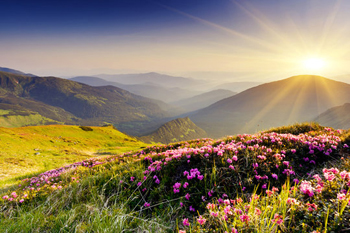
The rising sun on Easter day
If the sun did not dance, then many believed that the Devil had blocked their view of this marvel. The Irish often looked at the sun’s reflection in a basin of water or in a well, because they believed that in the water the Devil would not be able to use his power to prevent them from seeing the dancing sun.
Between the pre-dawn hours of 3 and 5 a.m., villagers awakened each other to embark on their journey to a nearby hill or open plain. In medieval times in many areas the village priest accompanied the people to lead them in the recitation of special prayers. 12
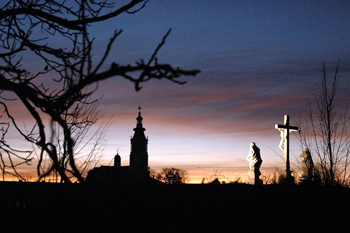
The first signs of Easter Sunrise over a churchyard; below, the Sun shines as a symbol of Our Risen Savior
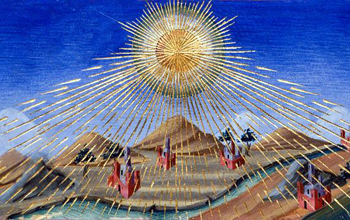
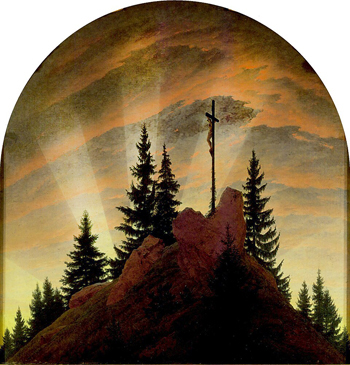
At the glorious moment of the sun’s arrival, the hills, meadows and plains of Christendom were filled with people dressed in their gayest apparel. As the rays began to burst through the clouds and peak over the hills, the people were filled with joy believing that the Angels danced on these rays that brought purification and joy to those they touched.
Everyone prayed fervently to Our Risen Lord as the rays shone upon their faces and presented to Him all of their heartfelt petitions.
The Russians beseeched Our Lord to grant them good health and a fruitful harvest. 14 In certain areas of Hungary, selected men from the village sang and prayed while walking the boundaries of the parish imploring that God would “keep away hail, locusts and floods from our fields and fir, and strangers from our village; grant us a year of abundant harvest and peace!” 15
Bells pealed, cannons fired, instruments were played, and voices rose in jubilant song to greet the Easter sun. In French Alpine villages, the rising sun was saluted by bagpipes and fifes. 16 Austrians greeted the sun by dancing their traditional Easter dances and singing their ancient hymns. One hymn that summarizes well the sentiments of this morning begins:
This is now indeed a most heavenly night,
The Savior is risen in glory and light;
He rose when dawn was approaching soon.
All things do rejoice on this morning so fair;
The fire, the water, the soil and the air,
The stars above, and the paling moon.
So stand we and sing in the dawn’s early glow,
Till Easter day brightens the valley below:
Hail, Christ, thou Light of eternal noon! (17)
Following this Easter salute, the parish priest led all the people in procession to the church where the solemn Mass was to be said. Having cleansed themselves in the Easter water and greeted Our Lord in His glorious symbol of the rising sun, Catholics were eager to assist at the Sacred Mysteries.
To be continued
- Francis X Weiser, The Easter Book (San Diego, California: The Firefly Press, 1996), pp. 85-87.
- Richard Thonger, A Calendar of German Customs (London: Oswald Wolff, 1966), p. 40.
- Sophie Hodorowicz Knab, Polish Customs, Traditions, and Folklore (New York: Hippocrene Books, 1996), p. 103.
- https://archive.wikiwix.com/cache/index2.php?url=https%3A%2F%2Fshps.qc.ca%2Fleau-de-paques-et-sa-benediction-printaniere%2F#federation=archive.wikiwix.com&tab=url
- William S. Walsh, Curiosities of Popular Customs and of Rites, Ceremonies, Observances, and Miscellaneous Antiquities (Philadelphia: J. B. Lippincott Company, 1898), p. 359.
- Weiser, The Easter Book, pp. 92-93.
- Dorothy Gladys Spicer, Festivals of Western Europe (New York: The H. W. Wilson Company, 1958), p. 46. Ismene Haji-Costa and D. A. Percival, “Some Traditional Customs of the People of Cyprus,” Folklore 55, no. 3 (1944): 107–17, http://www.jstor.org/stable/1256781.
- Charles Kightly, The Perpetual Almanack of Folklore (New York: Thames and Hudson, 1987)
- Dom Prosper Guéranger, The Liturgical Year, vol. VII (Fitzwilliam, New Hampshire: Loreto Publications, 2013) p. 176.
- https://irishfolklore.wordpress.com/2018/04/01/easter-folklore-and-customs/
- Walsh, Curiosities of Popular Customs , p. 359.
- Weiser, The Easter Book , p. 92.
- Hodorowicz Knab, Polish Customs, Traditions, and Folklore, p. 103.
- Polina Rozhnova, A Russian Folk Calendar (Moscow: Novosti, 1992), p. 79.
- https://www.arcanum.com/hu/online-kiadvanyok/MagyarNeprajz-magyar-neprajz-2/vii-nepszokas-nephit-nepi-vallasossag-A33C/szokasok-A355/jeles-napok-unnepi-szokasok-A596/aprilis-A6D6/husveti-unnepkor-A6F1/husvetvasarnap-A736/
- E. I. Robson, A Guide to French Fêtes (London: Methuen and Company, 1930), p. 10.
- Weiser, The Easter Book, p. 90.



Posted April 1, 2026
______________________
______________________
 |
 |
 |
 |
 |
 |