Theology of History
 |
 |
 |
 |
 |
 |
 |
The Kingdom of Christ – III
The Christian Ideal of Social Perfection
If we assume that, within a given population, most of the individuals practice the Law of God, what effect can be expected to result for society? This is equivalent to asking: If every single part in a clock functions according to its nature and purpose, what effect can be expected to result for the clock as a whole? Or, if every part of a whole is perfect, what must be said of the whole itself?
 There is always a certain risk involved in drawing analogies from mechanical objects when dealing with human matters. Let us dwell instead upon the image of a society in which all its members are good Catholics – an image sketched by St. Augustine.
Let us imagine that "an army composed of soldiers formed by the doctrine of Jesus Christ forms: Governors, husbands, spouses, parents, children, masters, servants, kings, judges, taxpayers and tax collectors are the way that Christian doctrine desires them to be! And yet, the pagans still dare to say that this doctrine is opposed to the interests of the State! On the contrary, they must acknowledge without hesitation that it serves as a great safeguard for the State, provided it is faithfully observed" (Epist. CXXXVIII, §. 5, Ad Marcellinum, c. II, n. 15).
And in another work, the Holy Doctor, addressing the Catholic Church, exclaims:
"You guide and instruct children with tenderness, the young with vigor, and the elderly with calm, in a manner befitting the age not only of the body but also of the soul. You subject wives to their husbands by a chaste and faithful obedience – not to gratify passion, but to propagate the species and establish the domestic society. You confer authority upon husbands over their wives – not so that they might abuse the frailty of the female sex, but rather so that they might follow the laws of sincere love. You subordinate children to their parents through a tender authority.
“You unite them not only in society, but also in a kind of fraternity between one citizen and another, one nation and another, and among men themselves through the memory of their first parents. You teach kings to watch over their peoples, and you prescribe to peoples that they obey their kings. You teach with solicitude those to whom honor is due, to whom affection is due, to whom respect is due, to whom fear is due, to whom consolation is due, to whom admonition is due, to whom encouragement is due, to whom correction is due, to whom reprimand is due, to whom punishment is due; and, even if not all things are due to all people, you make known in what manner charity is due to all, and injustice to no one" (De Moribus Ecclesiae, c. XXX, n. 63).
It would be impossible to describe the ideal of an entirely Christian society any better. Could order, peace, harmony and perfection ever be carried to a higher extent in a society? A brief observation suffices to conclude the matter. If, in this day and age, all men were to practice the Law of God, would not all the political, economic and social problems that torment us be swiftly resolved? But what solution can be expected for them so long as men continue to live in habitual disregard of the Law of God?
 Has human society ever realized this ideal of perfection?
Undoubtedly. The immortal Leo XIII affirms it:
Once the Redemption was accomplished and the Church had been founded, "then man, as if awakening from a long, ancient and mortal lethargy, beheld the light of truth, which he had desired for so many centuries, yet sought in vain.
"First of all, he realized that he was born for goods far loftier and more magnificent than the fragile and perishable goods perceived by the senses, which had hitherto formed the end of his thoughts and concerns. He understood that the meaning of human life, the supreme law, the end to which all things must be subject was this: that we come from God and must one day return to Him.
"From this first principle, the consciousness of human dignity was reborn; Men’s hearts realized that social fraternity is necessary. As a consequence, human rights and duties attained their perfection, or became fully established, while on all sides virtues expanded in ways pagan philosophy could never even have imagined. For this reason, the men’s aims, habits and customs took a new course.
"And as the knowledge of the Redeemer spread far and wide and His virtue, which destroys the ignorance and vices of the Antiquity, penetrated into the very life-blood of society, then was wrought that transformation which, by the creation of a Christian Civilization, entirely changed the face of the earth" (Leo XIII, Encyclical Tametsi futura prospicientibus, November 1, 1900).
Christian Civilization – Christian Culture
It was this luminous reality – composed of an order and perfection that was more supernatural and celestial than natural and terrestrial – that came to be called Christian Civilization: It was the product of Christian Culture, which, in turn, is the daughter of the Catholic Church.
By "culture of the spirit," we may understand the fact that the soul of given man is not left abandoned to the disordered and spontaneous interplay of the operations of his faculties – the intelligence, will and sensibility. On the contrary, by an ordered effort in conformity with right reason, he acquires a certain enrichment of these three faculties; just as the cultivated field is not one that brings to fruition every seed that the wind chaotically deposits in it, but rather the one that, through the effect of man's labor, produces something useful and good.
 In this sense, Catholic Culture is the cultivation of the intellect, the will and the sensibility in accordance with the norms of morality taught by the Church. We have already seen that it is identified with the very perfection of the soul. If this exists among the generality of the members of a society (albeit in degrees and modes adapted to the social condition and age of each individual), it becomes a social and collective fact. And it will constitute an element – the most important one – of social perfection itself.
Civilization is the state of a human society that possesses a culture, and that has created – in accordance with the basic principles of this culture – an entire body of customs, laws, institutions and distinctive literary and artistic systems.
A civilization is Catholic if it is the faithful outcome of a Catholic Culture and if, therefore, the spirit of the Church serves as the actual normative and vital principle of its customs, laws, institutions, and literary and artistic systems.
If Jesus Christ is the true ideal of perfection for all men, then a society that applies all His laws must be a perfect society. The culture and civilization born of the Church of Christ must necessarily be not merely the best civilization, but the only true one. As the Holy Pontiff Pius X states: "There is no true civilization without moral civilization, and there is no true moral civilization except with true Religion" (Letter to the French Episcopate, August 28, 1910, regarding Le Sillon).
From this, it follows with crystalline evidence that there is no true civilization except as a consequence and fruit of the True Religion.
The Church & Christian Civilization
Anyone who supposes that the Church’s action upon men is merely individual – and that she forms persons, but not peoples, cultures or civilizations – is singularly mistaken. Indeed, God created man as naturally sociable and He willed that men, living in society, should labor for the sanctification of one another. For this very reason, He also created us as susceptible to influence.
Driven by the very pressure of the instinct of sociability, we all possess a tendency to communicate our ideas to others to a certain extent, and likewise to receive their influence in return. This holds true in relationships between individuals, as well as between the individual and society. The environments, laws and institutions in which we live exert an effect upon us; they exercise a pedagogical influence over us.
To wholly resist this environment – whose ideological influence permeates us even by osmosis, as if through our very skin – is a feat of high and arduous virtue. For this reason, the early Christians were no more admirable when facing the wild beasts of the Colosseum than they were in maintaining the integrity of their Catholic spirit while living within the bosom of a pagan society. Thus, culture and civilization serve as immensely powerful means for influencing souls. They influence them for their ruin when the culture and civilization are pagan, and for their edification and salvation when they are Catholic.
 How, then, could the Church be indifferent to the task of producing a culture and a civilization and limit herself to acting upon each individual soul on a merely personal basis?
Moreover, every soul upon whom the Church acts – and who responds generously to that action – becomes, as it were, a focal point or a seed of this civilization, actively and energetically radiating itself outward into its surroundings. Virtue shines forth and is contagious. Through this contagion, it spreads. By acting and propagating itself, it tends to evolve into a Catholic Culture and Civilization.
As we can see, it is the very nature of the Church to produce a Christian Culture and Civilization. It is to bear all its fruits in a fully Catholic social atmosphere. The Catholic must aspire to a Catholic Civilization just as a man imprisoned in a dungeon longs for the open air, and a captive bird yearns to regain the infinite expanses of the skies.
This, then, is our purpose, our great ideal. We march toward the Catholic Civilization that may yet rise from the rubble of today’s world – just as Medieval Civilization was born from the ruins of the Roman world. We advance toward the conquest of this ideal with the same courage, perseverance and resolve to face and overcome every obstacle with which the Crusaders marched upon Jerusalem.
For if our forebears knew how to die to re-conquer the Sepulcher of Christ, how could we – the children of the Church just as they were – not be willing to fight and to die to restore something of infinitely greater worth than the most precious Sepulcher of the Savior: namely, His Reign over souls and societies, which He created and redeemed to love Him eternally?
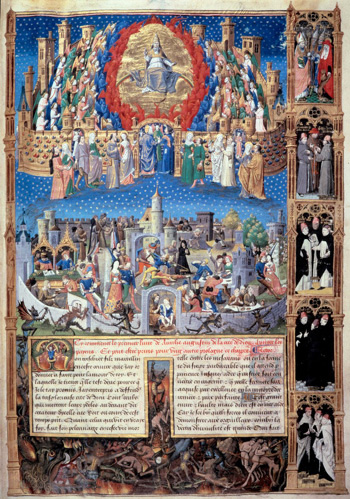
A medieval manuscript showing how the city of man reflects the City of God
Let us imagine that "an army composed of soldiers formed by the doctrine of Jesus Christ forms: Governors, husbands, spouses, parents, children, masters, servants, kings, judges, taxpayers and tax collectors are the way that Christian doctrine desires them to be! And yet, the pagans still dare to say that this doctrine is opposed to the interests of the State! On the contrary, they must acknowledge without hesitation that it serves as a great safeguard for the State, provided it is faithfully observed" (Epist. CXXXVIII, §. 5, Ad Marcellinum, c. II, n. 15).
And in another work, the Holy Doctor, addressing the Catholic Church, exclaims:
"You guide and instruct children with tenderness, the young with vigor, and the elderly with calm, in a manner befitting the age not only of the body but also of the soul. You subject wives to their husbands by a chaste and faithful obedience – not to gratify passion, but to propagate the species and establish the domestic society. You confer authority upon husbands over their wives – not so that they might abuse the frailty of the female sex, but rather so that they might follow the laws of sincere love. You subordinate children to their parents through a tender authority.
“You unite them not only in society, but also in a kind of fraternity between one citizen and another, one nation and another, and among men themselves through the memory of their first parents. You teach kings to watch over their peoples, and you prescribe to peoples that they obey their kings. You teach with solicitude those to whom honor is due, to whom affection is due, to whom respect is due, to whom fear is due, to whom consolation is due, to whom admonition is due, to whom encouragement is due, to whom correction is due, to whom reprimand is due, to whom punishment is due; and, even if not all things are due to all people, you make known in what manner charity is due to all, and injustice to no one" (De Moribus Ecclesiae, c. XXX, n. 63).
It would be impossible to describe the ideal of an entirely Christian society any better. Could order, peace, harmony and perfection ever be carried to a higher extent in a society? A brief observation suffices to conclude the matter. If, in this day and age, all men were to practice the Law of God, would not all the political, economic and social problems that torment us be swiftly resolved? But what solution can be expected for them so long as men continue to live in habitual disregard of the Law of God?
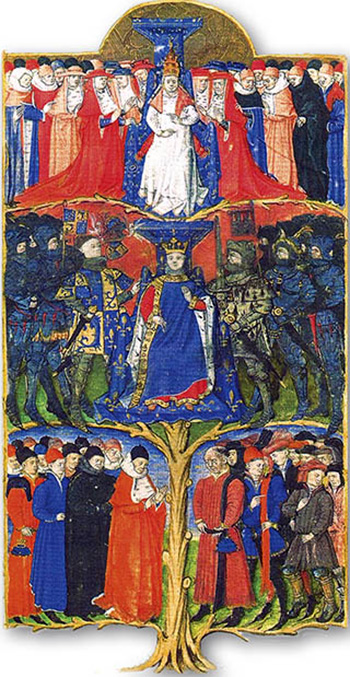
The medieval order of society achieved a certain perfection
Undoubtedly. The immortal Leo XIII affirms it:
Once the Redemption was accomplished and the Church had been founded, "then man, as if awakening from a long, ancient and mortal lethargy, beheld the light of truth, which he had desired for so many centuries, yet sought in vain.
"First of all, he realized that he was born for goods far loftier and more magnificent than the fragile and perishable goods perceived by the senses, which had hitherto formed the end of his thoughts and concerns. He understood that the meaning of human life, the supreme law, the end to which all things must be subject was this: that we come from God and must one day return to Him.
"From this first principle, the consciousness of human dignity was reborn; Men’s hearts realized that social fraternity is necessary. As a consequence, human rights and duties attained their perfection, or became fully established, while on all sides virtues expanded in ways pagan philosophy could never even have imagined. For this reason, the men’s aims, habits and customs took a new course.
"And as the knowledge of the Redeemer spread far and wide and His virtue, which destroys the ignorance and vices of the Antiquity, penetrated into the very life-blood of society, then was wrought that transformation which, by the creation of a Christian Civilization, entirely changed the face of the earth" (Leo XIII, Encyclical Tametsi futura prospicientibus, November 1, 1900).
Christian Civilization – Christian Culture
It was this luminous reality – composed of an order and perfection that was more supernatural and celestial than natural and terrestrial – that came to be called Christian Civilization: It was the product of Christian Culture, which, in turn, is the daughter of the Catholic Church.
By "culture of the spirit," we may understand the fact that the soul of given man is not left abandoned to the disordered and spontaneous interplay of the operations of his faculties – the intelligence, will and sensibility. On the contrary, by an ordered effort in conformity with right reason, he acquires a certain enrichment of these three faculties; just as the cultivated field is not one that brings to fruition every seed that the wind chaotically deposits in it, but rather the one that, through the effect of man's labor, produces something useful and good.
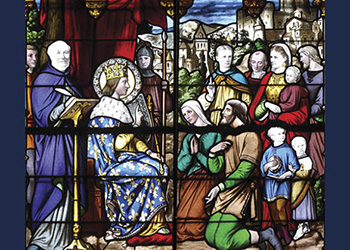
St. Louis receives his subjects with majesty & goodness, reflecting a Catholic Culture
Civilization is the state of a human society that possesses a culture, and that has created – in accordance with the basic principles of this culture – an entire body of customs, laws, institutions and distinctive literary and artistic systems.
A civilization is Catholic if it is the faithful outcome of a Catholic Culture and if, therefore, the spirit of the Church serves as the actual normative and vital principle of its customs, laws, institutions, and literary and artistic systems.
If Jesus Christ is the true ideal of perfection for all men, then a society that applies all His laws must be a perfect society. The culture and civilization born of the Church of Christ must necessarily be not merely the best civilization, but the only true one. As the Holy Pontiff Pius X states: "There is no true civilization without moral civilization, and there is no true moral civilization except with true Religion" (Letter to the French Episcopate, August 28, 1910, regarding Le Sillon).
From this, it follows with crystalline evidence that there is no true civilization except as a consequence and fruit of the True Religion.
The Church & Christian Civilization
Anyone who supposes that the Church’s action upon men is merely individual – and that she forms persons, but not peoples, cultures or civilizations – is singularly mistaken. Indeed, God created man as naturally sociable and He willed that men, living in society, should labor for the sanctification of one another. For this very reason, He also created us as susceptible to influence.
Driven by the very pressure of the instinct of sociability, we all possess a tendency to communicate our ideas to others to a certain extent, and likewise to receive their influence in return. This holds true in relationships between individuals, as well as between the individual and society. The environments, laws and institutions in which we live exert an effect upon us; they exercise a pedagogical influence over us.
To wholly resist this environment – whose ideological influence permeates us even by osmosis, as if through our very skin – is a feat of high and arduous virtue. For this reason, the early Christians were no more admirable when facing the wild beasts of the Colosseum than they were in maintaining the integrity of their Catholic spirit while living within the bosom of a pagan society. Thus, culture and civilization serve as immensely powerful means for influencing souls. They influence them for their ruin when the culture and civilization are pagan, and for their edification and salvation when they are Catholic.
The castle of Foix, born of a Catholic Culture, stands ready to defend the city & its people
As we can see, it is the very nature of the Church to produce a Christian Culture and Civilization. It is to bear all its fruits in a fully Catholic social atmosphere. The Catholic must aspire to a Catholic Civilization just as a man imprisoned in a dungeon longs for the open air, and a captive bird yearns to regain the infinite expanses of the skies.
This, then, is our purpose, our great ideal. We march toward the Catholic Civilization that may yet rise from the rubble of today’s world – just as Medieval Civilization was born from the ruins of the Roman world. We advance toward the conquest of this ideal with the same courage, perseverance and resolve to face and overcome every obstacle with which the Crusaders marched upon Jerusalem.
For if our forebears knew how to die to re-conquer the Sepulcher of Christ, how could we – the children of the Church just as they were – not be willing to fight and to die to restore something of infinitely greater worth than the most precious Sepulcher of the Savior: namely, His Reign over souls and societies, which He created and redeemed to love Him eternally?
Posted October 30, 2026



______________________
______________________
 |
 |
 |