Personalities
 |
 |
 |
 |
 |
 |
 |
Gregory VII & the Countess Matilda - I
St. Gregory VII Reluctantly Pardons Henry IV
We depict the famous scene of Henry IV begging pardon before the great Pope Gregory VII at her Castle of Canossa where he had taken refuge. Let the reader note how seriously Emperors, Bishops and the people took the sentence of excommunication in the 11th century.
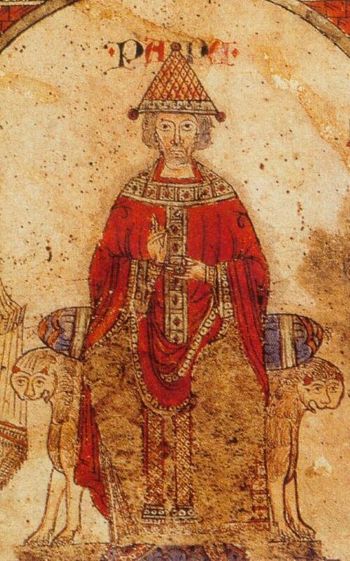
St. Gregory VII, detail from an exultet roll 1087
The Pope was soon after delivered by the people, but he was wounded and had narrowly escaped with his life. At this news, The Countess Matilda of Tuscany – who was a cousin of King Henry IV but heartily supported the Pope’s reform – mounted her horse and at the head of her troops, set out for Rome.
Moved by her grief, her piety and her courage, the people prostrated themselves before her on her route calling her la Gran Contessa [the Great Countess].
The wounded Pontiff was the object of Matilda's tender care. She had formerly supported him as Cardinal. She was on her way to Rome for the purpose of conducting him into Lombardy where he might reside with greater security than in the city of the Caesars.
Thus did Gregory VII set out with Hugh, the Abbot of Cluny, and some Cardinals under the escort of Matilda, who was followed by a train of cavaliers and men-at-arms. She pushed forward, almost without stopping, towards Verceil to reach Mantua. There she learned of the arrival of King Henry coming from Germany and of the excitement his presence was causing in Piedmont and Lombardy.
To avoid the possibility of any surprise assault, Gregory withdrew into the fortress of Canossa, the patrimony of the Countess situated in the mountain fortresses of Reggio. Built upon a rock and fortified with a triple enclosure of walls, Canossa was deemed impregnable. Gregory could not have chosen a more secure place of refuge even though it was at the very gates of an enemy’s territory.
Henry convokes a council
Henry back in Germany convoked a synod of Bishops at Worms (1076). He caused them to pronounce a sentence of deposition on Gregory.
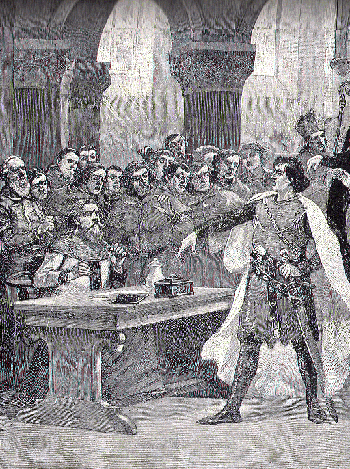
At the Synod of Worms Henry vows to drag the Pope from the Papal Throne
Knowing that their Monarch had been excommunicated, the German Princes and Lords resolved to depose him in one year if he were not absolved. Thus, Henry abandoned his designs and set out to seek pardon from the Pope.
An outlaw and a fugitive, with his wife and son, the deposed King crossed the Alps amid the ice and snow of a severe winter. He had hardly set foot on Italian soil, when he wrote to his cousin Matilda to interest herself on his behalf and to dispose the Pope to indulgence and pardon. Matilda readily promised to gratify his request.
On his way to Canossa, Henry was preceded by several German Bishops, excommunicated like himself, who came, barefooted and clad in the garb of penance, to throw themselves at the feet of the Sovereign Pontiff. The Bishops were relieved from the anathema fulminated against them and, by their submission, gave to their King an example of repentance.
Finally the pardon
Having arrived at some distance from the castle, Henry desired an interview with Matilda, which she did not refuse. On that occasion there were assembled together, Adelaide, the stepmother of Henry, the Margrave Albert Azzo, the uncle of Matilda, and besides other Italian Lords, Hugh, the celebrated Abbot of Cluny.
Henry asked to be speedily reunited to the Church, saying that the anniversary of his excommunication was dawning nigh – a moment anxiously looked for by his enemies to declare him deposed from the German Throne.
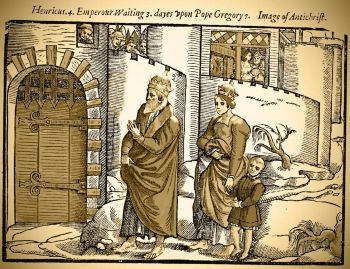
Henry with his wife & child asking to meet
with the Pope & receive pardon
Attired in mourning garments, Henry, impatient of delay and fearing to be absolved too late, advanced with the other excommunicated of his train to the walls of Canossa without awaiting the last reply of the Pontiff. Then, knocking at the castle gate, he humbly craved permission to enter.
Admitted alone to the second enclosure without entering the castle, he remained there, barefooted in the snow and fasting until evening during the intense cold of the month of January. On the two following days he returned to the same place to perform the same penance, and with tears in his eyes, humbly awaited the moment when the Pope would think it opportune to absolve him.
After he had passed through this severe trial, he desired to withdraw unabsolved, but before doing so he entered the chapel of St. Nicholas, which was hard by. With streaming eyes, he besought for the last time the Abbot of Cluny to be his intercessor.
"That will avail nothing," was the short reply or the Abbot.
Matilda who was present at this interview, being deeply touched by the humiliation of a King who was at the same time a relative of hers, joined with him in entreating the Abbot to intercede.
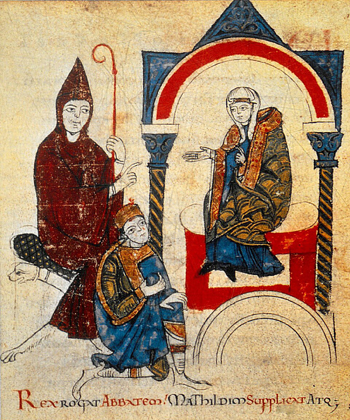
Countess Matilda intercedes for Henry her cousin, who appears before Gregory
Bending his knee before her, the King then spoke: “If you do not come to my aid, I shall never more break a lance, for the Pope has stricken me and my arm is withered. Go, my good cousin, and beg him to bless me.“
Matilda hastened away and, re-entering the castle, besought the Pontiff to put an end to the rigorous penance of the King. The Italian Lords who surrounded Gregory VII were so moved to compassion that, despite their pious admiration for the Pope, they blamed his severity.
Gregory remained unmoved; he bound Henry by an oath and called upon the Lords and Bishops present to be the guarantees of its fulfillment, exempting the King from swearing in person, so little confidence did be place in his royal word.
At last, on the fourth day of his penance, the 26th of January, 1077, the Pope allowed Henry to appear in his presence. The King entered, barefooted, with the rest of the excommunicated, mingling his tears with theirs. He cast himself upon the ground in the form of a cross, repeating several times, "Pardon, Holy Father; pardon me, merciful Father."
Gregory, upon seeing him weeping, said: “Enough! Enough!" The Pope consented to repeal the sentence of excommunication and receive back the King into the bosom of the Church.
The challenge of Pope Gregory
While the Pope was celebrating Mass with great solemnity, being about to communicate and already holding the Sacred Host in his hands, he turned to Henry and uttered these words:
"You have accused me of reaching the Holy See by simony, of having committed crimes that incapacitated me for receiving Holy Orders. Since I am not able to justify myself by the testimony of those who have known me from infancy up to the present day, I desire on this occasion to appeal, not to the judgment of men, but to that of God. May the Body of Our Lord Jesus Christ which I am about to receive, be this day a proof of my innocence; may God dispel every suspicion or cause me to die this instant if I am guilty."
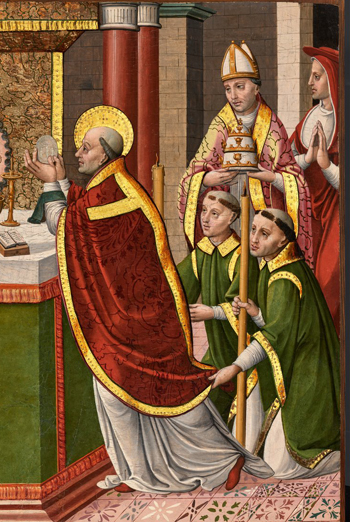
Pope Gregory asks Henry to receive the other half of the host as guarantee of his innocence; Henry refuses
The Pope presented the other half of the Host to the King with these words:
"My son, if it be pleasing to you, do as you have seen me do. There never passes one day that the German Princes do not lay before me charges against you which unfit you for the royal dignity, for communion with the Church and even make you unworthy of the right of a citizen. They demand that you be judged ...
“Follow then, my son, the counsel I give you, and if you feel that you are not guilty, receive this other half the Host, that by so convincing a proof of your innocence, you may close the mouths of your enemies."
At so unheard-of and awful a proposal, Henry was agitated and stammered something or another, while the perspiration started from every pore of his body. He withdrew to take the advice of his attendants on the course he should pursue, and came to the conclusion that it would be better to beg the Pope to put off this trial until a general diet should be convened.
Gregory did not press the matter any farther but finished his Mass. Thus was unraveled a plot worthy of so great a drama. The flight of the King before the Host which the Pope offered him struck the people with no less astonishment than if he had fallen dead while receiving it.
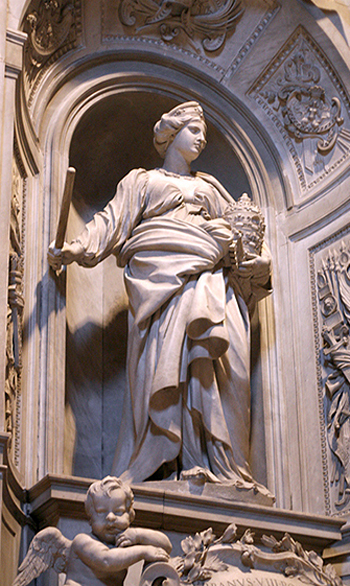
Matilda's statue over her tombstone at St. Peter's Basilica
But when she learned that the Pope had exempted the King from swearing in person, so little confidence did he place in his word, her trust began to waver. Then, when she saw Henry at first dreading and finally declining the "judgment of God," her hopes and illusions quickly vanished.
What a subject of sadness and confusion for her noble soul who understood so well that loyalty should find its home in the heart of Kings, to behold her unworthy cousin wanting in this virtue; to know that by his disloyalty he was delivering himself to the execrations of his people and forever bound to the pillory of History!
Thenceforth she witnessed an incessant and merciless warfare between the Pope and Henry, which her title of protectress of the Apostolic See made it her duty to wage.
To be continued



Posted August 17, 2026
______________________
______________________
 Volume I |
 Volume II |
 Volume III |
 Volume IV |
 Volume V |
 Volume VI |
 Volume VII |
 Volume VIII |
 Volume IX |
 Volume X |
 Volume XI |
 Special Edition |