Theology of History
 |
 |
 |
 |
 |
 |
 |
Egalitarianism - VIII
False Arguments Favoring Equality
Note: Prof. Plinio gave this series of classes in 1957; today in 2026 we see how the egalitarianism in each of the fields he points out has increased and come to dominate almost completely. TIAHow does St. Thomas prove that inequality is the best reflection of God in creation? And how do we know that the doctrine of St. Thomas is the doctrine of the Church? To respond, let us proceed following the method of St. Thomas.

St. Thomas follows a specific discussion method
But then he adds it can be said that inequality does not come from sin. This is his thesis, which he support by several arguments. Then he goes to the body of the proof and demonstrates the true thesis. In a kind of epilogue, he refutes the false arguments, briefly analyzes some arguments he presented, and concludes the exposition of the subject.
In this article I will follow the same method and present the false arguments showing how the modern man is deeply contaminated by them. In the next article, I will refute them with St. Thomas. By the way, in the previous article we have already seen some of his magnificent arguments in favor of inequality.
So, let us see the false arguments in favor of equality and how entrenched they are in the revolutionary mentality.
First error: A good God cannot make unequal beings
In the Summa contra Gentiles, St. Thomas begins by giving the reasons why it seems that things must be equal. These reasons, in final analysis, end up by exposing the root of the egalitarianism of our days.
He begins by saying, "It seems that all equality is good." The reasons he gives for this is “because God, being extremely good, acts badly by doing inferior things, which would not be worthy of Him and would not be extremely good."

According to this false argument a string of unequal pearls is not a reflection of God
So, the wrong thesis in favor of equality would be the following: "Everything God does is extremely good; and whoever is extremely good can only do extremely good things. Now then, when things are unequal, some are not extremely good or else they would not be unequal. Therefore, God cannot have made things unequal".
Second error: A single cause produces a single effect
According to this argument, the same cause always produces the same effects; thus all creation that came from God must be the same

This false argument pretends God’s Creation
is like a science laboratory
Now then, the argument: God is one. Therefore, His effect must always be the same. And it cannot be understood that God does unequal things.
Explaining further, Aristotle says that the thing being one, it naturally produces equal effects. God, being one, should have produced equal effects.
Third error: God does not give unequal attributes
Another erroneous argument: One only gives unequal things to unequal beings. For example, if I have to distribute food to three persons who have unequal physical needs, I will give them unequal amounts of food. If I have three soldiers with different merits, I give them three unequal decorations. If I have three students with different tests, I give them unequal grades. Because unequal beings are given unequal things.

The Catholic awards given for excellence would all be unfair, according to this false argument
Imagine God before he created beings. He imagines a Louis, an Alphonsus and a Plinio; and He imagines unequally endowing these beings, generously conceding gifts to Louis and Alphonsus, depriving Plinio of many things. This would be an injustice made by God. Why?
To give Alphonsus and Louis more than Plinio after they existed is understandable. The former merited more and the latter less. But before they existed, the former could not have deserved more than the latter. So God did an unjust thing. For if inequality occurs as a consequence of merits or punishments, men, before being created, had no merits. God could not have planned to give more or less before he created them and before they sinned.
These are the three false arguments that St. Thomas Aquinas presents to justify the equality between beings.
Equality at the starting point
Let us see how this third argument is present today. God gives unequal things to unequal beings. But when beings are equal, God cannot give them unequal things since this would be an injustice.
This opinion exists today in the idea that every man, by nature, is completely equality to others. This is the law of nature. Nature creates all men entirely equal. An inequality at the starting point is an injustice in the order of things. Everyone must be equal. Only then, due to merits or demerits, should men differentiate themselves. This is precisely the popular thinking today. The starting point in life must be the same for all men.

The principles of 1789 lead to complete equality
Even more, we know that the American Constitution was made with the help of ecclesiastical hands, which laid out this same principle.
But, there is something more profound: There is a kind of Catholic egalitarianism that consists in thinking it unjust to consider one man to be inferior to another, because God, the Father of all, loves everyone equally. Thus, to affirm inequality is to go against God's intention, it is to imagine a non-egalitarian God.
Since all men are equal before God and God loves each one infinitely, to assert some inequality is to insult the order established by God; it is to act against the Spirit of God. For example, Jesus Christ came to preach equality between men in the Gospel. And whoever rebels against the principle of equality adopts an anti-evangelical stance. St. Thomas spoke exactly against this idea in the last article, which is a very modern idea.
Goodness of God
The first argument is also easy to exemplify: "God is extremely good and He, therefore, cannot do things that are not equally good, because his work can only be extremely good." What is one of the current formulations of this fallacious argument? It justifies the attitudes of feeling sorry for the man inferior to us. That it, to consider a man inferior to another is to consider the former to be in a state of shame and humiliation. That is why he is to be pitied.
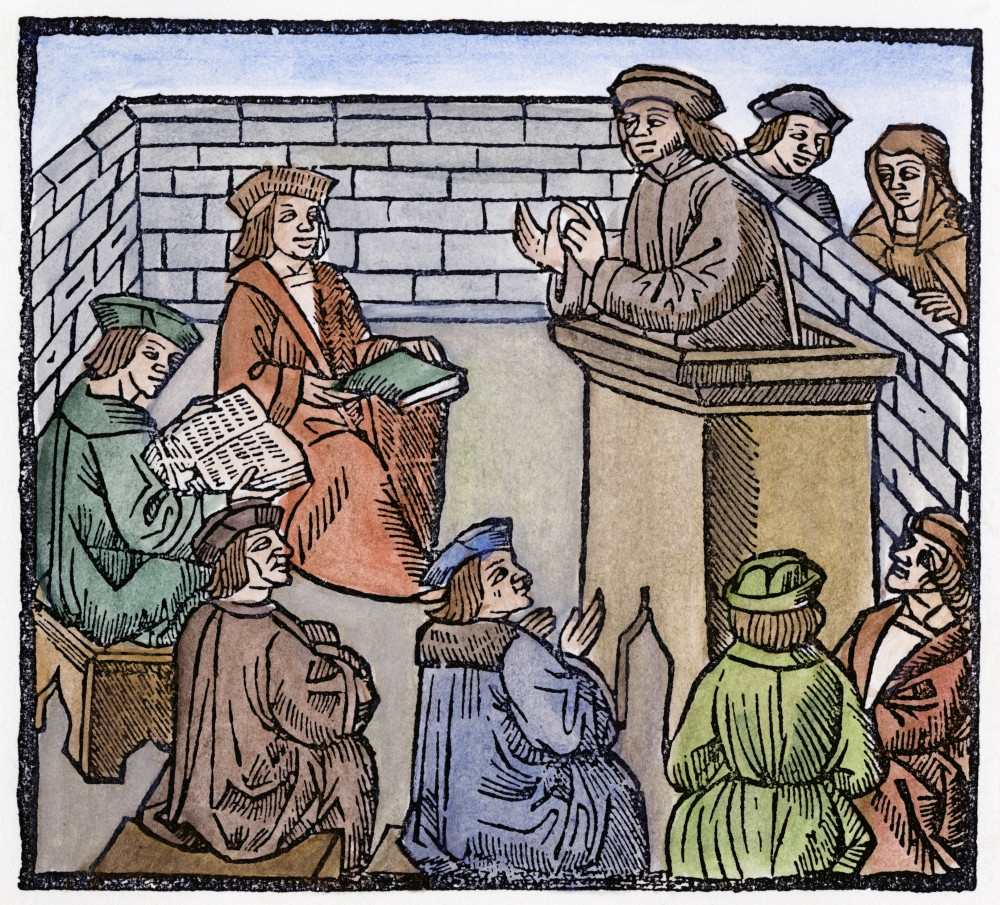
It hurts the revolutionary students for the professor to appear superior, as in the past
An example: Let us say that I am at a college giving classes to students. If I am charitable, I should not make my students feel that I am superior to them. Because making them feel this is reminding them of something that hurts them. The fact that a man is inferior is like a flaw, a defect.
If this is true, God does not create defective things. Therefore, He could not have created such a situation. Therefore, inequality does not come from God, but from the Devil, from sin, from man etc. And this feeling sorry for the inferior is the substratum of liberalism, of egalitarianism.
Simplicity & equality
The exemplification of the second argument lies in a kind of worship of simplicity and uniformity in all human things, as if these were the only perfection they should have. So, for instance, in a very hierarchical and complex order of things, there is an implication of something wrong because it is very complex. The thing, insofar as it is simple and easy, is good.
Thus the spirit of simplicity taught in the Gospel by Our Lord – the pinnacle of morality – is opposed to complexity and difficult things. In the final analysis, God is infinitely simple, He is too great to be concerned with such trifles.
Heading to the refutation
We have thus presented the false arguments and shown their uses in our days. In the next article, we will prove, according to St. Thomas, that inequality is in fact a great good.
Continued
Posted February 16, 2026



______________________
______________________
 |
 |
 |