New Canonizations
 |
 |
 |
 |
 |
 |
 |
The progressivist Fulton Sheen - II
‘Rochester Hates Sheen’
How did Fulton Sheen earn Rochester’s hatred by him using it as a guinea pig for radical progressivist reforms?
In the wake of Fulton Sheen’s recent “beatification,” it is more timely than ever to examine who exactly Fulton Sheen was. In continuation of my previous article, I decided to look for what the people of Rochester, his Diocese, said about him at the time, since they were “up close and personal” with the Prelate after the Council.
I found much evidence of Sheen’s progressivist actions by investigating Rochester’s diocesan paper, The Catholic Courier Journal, as well as its secular newspaper, The Democrat and Chronicle. These and other sources will be linked in this article.
Sheen, Progressivism & Vatican II
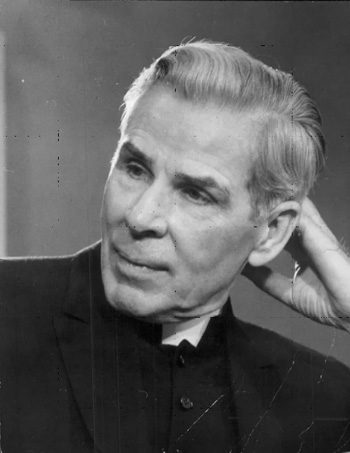 Sheen was fully aware of the most pressing topics of his time and reportedly spent long hours studying them, if credence can be given to his one-sided, glowing obituaries. According to the New York Times, each half-hour talk he gave represented 30 hours of study and rehearsal on the topic. (New York Times, Dec. 10, 1979, p. D13) For much of his life, he was said to have spent six to seven hours a day studying, and could recite a speech verbatim after spending only 15 minutes looking it.
(The Voice, Dec. 14 1979, p. 4, 14).
His admirers also acknowledged that he was quite aware of the changing progressivist situation in the Church and was acting with full knowledge, not ignorance.
So, let us put to rest the superficial talk that Sheen was just a naïve follower of the new fashions in the Church.
In truth, Sheen was a staunch promoter of Vatican II’s false ideals. He called himself a “progressive” who “moves too fast” when asked about his time in Rochester (NY Times, Oct. 16, 1969, p.1). When Fulton Sheen arrived at the Diocese, he was “all set to remold Rochester into a demonstration diocese of his [new concept of] Church in America,” according to his Diocesan paper. (Catholic Courier Journal or CCJ, Nov. 18, 1966; Courier Journal or CJ, Dec. 12, 1979 p. 2) Sheen also voiced this desire to make Rochester the flagship Vatican II guinea pig diocese several other times. (CCJ, Dec. 16, 1966 p. 1; Dec. 23 1966, p. 2)
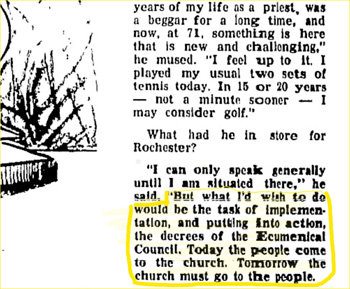 Shortly after his arrival at Rochester, “each step he took was clear evidence he intends to keep his word ‘to implement the Vatican Council’ – first of all, its spirit of openness to all ‘men of good will’ regardless of their denominational labels and, secondly, in the Council’s specific directives such as in new ways of worship.” (CCJ
Dec. 23, 1966, p. 2) His plan was to experiment with Rochester, which was a conservative diocese, to see how far he could push progressivist reforms.
Sheen actually spoke at the Council, praising its principles of collegiality, poverty and aggiornamento (adaptation to the world) in his Nov. 9 ,1964 address. (CCJ, Jan. 6 1967, p. 4) Later, Sheen disdainfully affirmed that before Vatican II “phrases and formulas [took] the place of thinking” in the Church, and that “theology had [become] frozen,” needing to “take on new life.” (CCJ, Jan. 20, 1967 p. 4, preface to Jean Guitton’s 1965 book The Feminine Fulfillment, here)
Sheen’s miserablism & hatred of pomp
Pope Paul VI assigned Bishop Fulton Sheen to the Diocese of Rochester in October, 1966, only one year after the Council’s end.
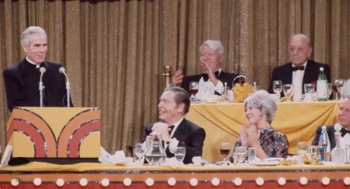 Sheen wasted no time in implementing progressivist poverty (miserablism) in Rochester. He, who was so pompous in his television shows and loved to hobnob with glittering stars and prestigious personalities, enforced a new Conciliar hatred of pomp.
His love of poverty led him to his Judas-style attempt to despoil an inner city church, St. Brigid’s, by trying to give the building and its property away to the federal government to house the poor in early 1968.
He explained in his Autobiography: “I decided: why not give up a church with all of its property to the federal government, on condition that they use that block – if it be a block – as a beachhead for housing? Let it build, say, a hundred or two hundred units in that area given by the Church, and then begin to fan out through the inner city (1) in order that the poor might have better quarters.” (pp. 60-61 here)
Sheen then explained that he set about (secretly) working with the government, the Apostolic Delegate and the Vatican to despoil St. Brigid. When everything was finalized, he made the announcement that he would give away the inner city church, which was home to mostly Puerto Rican parishioners.
 But he made the announcement without ever having spoken to the pastor of the church or its parishioners. As could be expected, general outrage ensued. Parishioners made over 100 calls to the Bishop’s office, students protested with picketing (some carrying signs saying “God’s house is more important than housing”), and some youth even threw pebbles at Sheen’s car during one of his visits.
Eventually 125 priests signed a letter asking Sheen to rescind the offer, to which Sheen was forced to agree. It is not surprising that both Sheen and the public consider this one of his most spectacular failures in Rochester.
This was not Sheen’s only action to promote miserablism. On July 22, 1968 the New York Times (p. 43) reported his vigorous campaign against building multimillion dollar churches, which he pejoratively called an “edifice complex” of “oversized churches, rectories and convents” that causes the Church to be “introverted” and deprives the poor their right to a decent home.
He suggested that some churches be “converted to motion picture houses” and “cafeterias for feeding the poor and the aged when not in use for religious services,” reported the Times. He even created a 1.25-3% tax on new church constructions, with the tax used to help invest in inner city services and foreign missions.
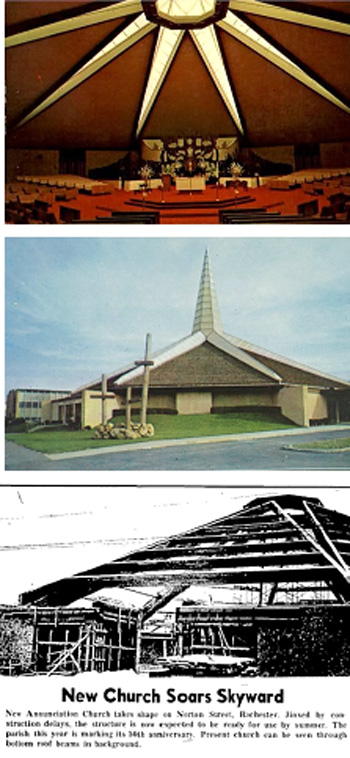
While he was against this expensive church, he had no problem having the modern, egalitarian and ugly Annunciation Church constructed on Norton Street. (CCJ, Mar. 10, 1967 p. 1; Mar. 22 1968 p. 7) Under his watch his diocesan paper also frequently promoted miserablist modern religious art, such as this crucifixion scene. (Mar. 17, 1967 p. 1)
Against the Vietnam War
Sheen was against the Vietnam War. How does this position reconcile with his past condemnations of Communism? The only logical answer is that he was not against Communism’s principles, only some of its methods.
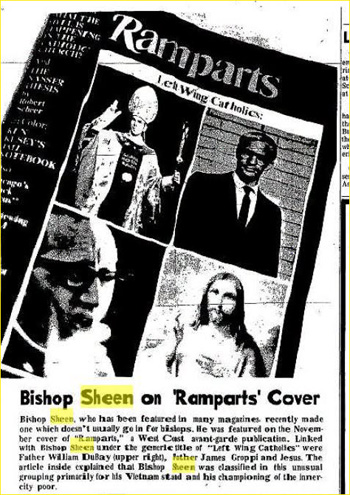 Sheen asked Lyndon B. Johnson to take the troops out of Vietnam immediately in a
July 30, 1967 sermon from Sacred Heart Cathedral, insisting that Christians “must be reconciled with all men,” including the communists in Asia.
Let it be noted that he pushed for pacifism, “reconciliation” and inaction in face of the growing communist expansion, a threat that Our Lady of Fatima warned about and condemned when she mentioned the errors of Russia. Pacifism and inaction before evil can constitute a crime, as it most certainly did in this case of Sheen’s opposition to the Vietnam War, a lost war that ended up spreading Communism.
His biographer Thomas Reeves affirmed that Sheen’s anti-Vietnam war also put his followers against him: “Many on the right, normally sympathetic toward Sheen for his religious and moral positions, were greatly displeased.” (America’s Bishop, p. 310)
This stance, along with his progressivist “preferential option for the poor” led him to be named a “left-wing Catholic” by Ramparts Magazine.
Institutional & liturgical innovations
Sheen was a proponent of radical new institutional changes. In his Autobiography, he explained that he attempted to rent a store in the supermarket area of Rochester to house the Blessed Sacrament and allow people to go to Mass and confession (p. 159). This would have been a type of “supermarket chapel,” a chapel in the middle of grocery stores, a terrible profanation to say the least. This, like his St. Brigid’s initiative, also failed.
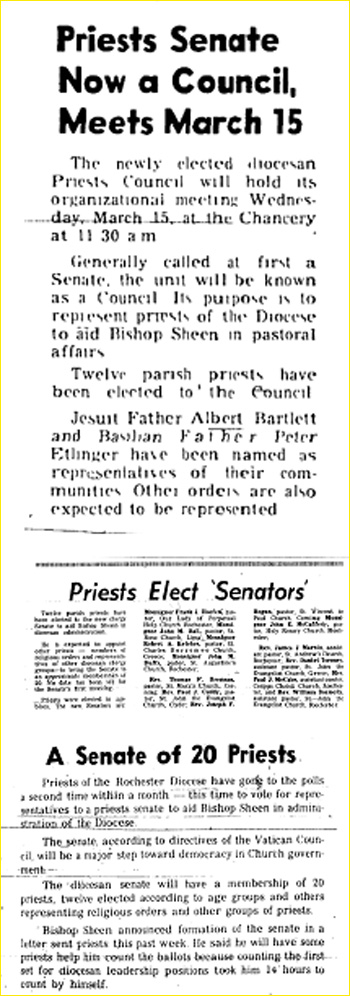 Democratization was one of Sheen’s favorite institutional changes. He pushed for laity to not only have a greater say in Church administration and decisions (CCJ,
Jan. 27, 1967, p. 1) but also a
greater participation at Mass.
Perhaps one of his most egregious acts was attempting to created “interdenominational parishes” in the inner city – that is, parishes that would be simultaneously Catholic, Protestant and Jewish, with separate hours for the respective services. This utopian dream never became a reality, but the evidence of his efforts to achieve it remained.
In the CCJ’s Jan. 13 1967 issue (p. 4), Sheen addressed his priests:
“The mission of the Church is not to be a spiritual zoo keeper, but to realize that every person is as precious in the sight of God as the soul of a Shakespeare or an Einstein. Does this not render imperative a greater union between all the denominations in the inner city? Is it necessary to have all of the parishes, Protestant, Catholic and even synagogues which previously existed? Would it be well in certain instances to have fewer churches but interdenominational, in the sense that separate hours, mutually agreed upon, would be used for worship?”
‘Rochester hates Sheen’
By the end of three years in Rochester, the people there were apparently very unhappy. One source told the Journal Star of Peoria (Illinois) that “Rochester hates Sheen.” Even his own diocesan paper stated that, after his resignation, “drama marked Bishop Sheen’s Reign.”
The New York Times noted that “after the first few months [in Rochester], Bishop Sheen did not attract unusually large audiences when he visited parishes in his diocese.” (New York Times, Oct. 16 1969, p. 50) After Sheen resigned from Rochester, he was asked if his duties tired him. He said he considered his three years there his time to “clean the Church,” and that it was “uncomfortable to be around the house when it’s cleaning time.” (CJ, Oct 17 1969, p. 1)
In the next articles I plan to examine other points of Sheen’s agenda.
To be continued
Posted October 21, 2026

In the wake of Fulton Sheen’s recent “beatification,” it is more timely than ever to examine who exactly Fulton Sheen was. In continuation of my previous article, I decided to look for what the people of Rochester, his Diocese, said about him at the time, since they were “up close and personal” with the Prelate after the Council.
I found much evidence of Sheen’s progressivist actions by investigating Rochester’s diocesan paper, The Catholic Courier Journal, as well as its secular newspaper, The Democrat and Chronicle. These and other sources will be linked in this article.
Sheen, Progressivism & Vatican II
Bishop Sheen poses as a movie star, not as a saint
His admirers also acknowledged that he was quite aware of the changing progressivist situation in the Church and was acting with full knowledge, not ignorance.
So, let us put to rest the superficial talk that Sheen was just a naïve follower of the new fashions in the Church.
In truth, Sheen was a staunch promoter of Vatican II’s false ideals. He called himself a “progressive” who “moves too fast” when asked about his time in Rochester (NY Times, Oct. 16, 1969, p.1). When Fulton Sheen arrived at the Diocese, he was “all set to remold Rochester into a demonstration diocese of his [new concept of] Church in America,” according to his Diocesan paper. (Catholic Courier Journal or CCJ, Nov. 18, 1966; Courier Journal or CJ, Dec. 12, 1979 p. 2) Sheen also voiced this desire to make Rochester the flagship Vatican II guinea pig diocese several other times. (CCJ, Dec. 16, 1966 p. 1; Dec. 23 1966, p. 2)
Before arriving in Rochester, he declared to The Catholic Courier that he would implement Vatican II
Sheen actually spoke at the Council, praising its principles of collegiality, poverty and aggiornamento (adaptation to the world) in his Nov. 9 ,1964 address. (CCJ, Jan. 6 1967, p. 4) Later, Sheen disdainfully affirmed that before Vatican II “phrases and formulas [took] the place of thinking” in the Church, and that “theology had [become] frozen,” needing to “take on new life.” (CCJ, Jan. 20, 1967 p. 4, preface to Jean Guitton’s 1965 book The Feminine Fulfillment, here)
Sheen’s miserablism & hatred of pomp
Pope Paul VI assigned Bishop Fulton Sheen to the Diocese of Rochester in October, 1966, only one year after the Council’s end.
The ostentatious Sheen wanted poverty
for the Church, not for himself
His love of poverty led him to his Judas-style attempt to despoil an inner city church, St. Brigid’s, by trying to give the building and its property away to the federal government to house the poor in early 1968.
He explained in his Autobiography: “I decided: why not give up a church with all of its property to the federal government, on condition that they use that block – if it be a block – as a beachhead for housing? Let it build, say, a hundred or two hundred units in that area given by the Church, and then begin to fan out through the inner city (1) in order that the poor might have better quarters.” (pp. 60-61 here)
Sheen then explained that he set about (secretly) working with the government, the Apostolic Delegate and the Vatican to despoil St. Brigid. When everything was finalized, he made the announcement that he would give away the inner city church, which was home to mostly Puerto Rican parishioners.
He was against beautiful old churches,
but build this chicken-foot-like monstrosity
Eventually 125 priests signed a letter asking Sheen to rescind the offer, to which Sheen was forced to agree. It is not surprising that both Sheen and the public consider this one of his most spectacular failures in Rochester.
This was not Sheen’s only action to promote miserablism. On July 22, 1968 the New York Times (p. 43) reported his vigorous campaign against building multimillion dollar churches, which he pejoratively called an “edifice complex” of “oversized churches, rectories and convents” that causes the Church to be “introverted” and deprives the poor their right to a decent home.
He suggested that some churches be “converted to motion picture houses” and “cafeterias for feeding the poor and the aged when not in use for religious services,” reported the Times. He even created a 1.25-3% tax on new church constructions, with the tax used to help invest in inner city services and foreign missions.
While he was against this expensive church, he had no problem having the modern, egalitarian and ugly Annunciation Church constructed on Norton Street. (CCJ, Mar. 10, 1967 p. 1; Mar. 22 1968 p. 7) Under his watch his diocesan paper also frequently promoted miserablist modern religious art, such as this crucifixion scene. (Mar. 17, 1967 p. 1)
Against the Vietnam War
Sheen was against the Vietnam War. How does this position reconcile with his past condemnations of Communism? The only logical answer is that he was not against Communism’s principles, only some of its methods.
Rampart’s Magazine praised him
for being a ‘left-wing Catholic’
Let it be noted that he pushed for pacifism, “reconciliation” and inaction in face of the growing communist expansion, a threat that Our Lady of Fatima warned about and condemned when she mentioned the errors of Russia. Pacifism and inaction before evil can constitute a crime, as it most certainly did in this case of Sheen’s opposition to the Vietnam War, a lost war that ended up spreading Communism.
His biographer Thomas Reeves affirmed that Sheen’s anti-Vietnam war also put his followers against him: “Many on the right, normally sympathetic toward Sheen for his religious and moral positions, were greatly displeased.” (America’s Bishop, p. 310)
This stance, along with his progressivist “preferential option for the poor” led him to be named a “left-wing Catholic” by Ramparts Magazine.
Institutional & liturgical innovations
Sheen was a proponent of radical new institutional changes. In his Autobiography, he explained that he attempted to rent a store in the supermarket area of Rochester to house the Blessed Sacrament and allow people to go to Mass and confession (p. 159). This would have been a type of “supermarket chapel,” a chapel in the middle of grocery stores, a terrible profanation to say the least. This, like his St. Brigid’s initiative, also failed.
Among the first to insist on sharing power with the people
Perhaps one of his most egregious acts was attempting to created “interdenominational parishes” in the inner city – that is, parishes that would be simultaneously Catholic, Protestant and Jewish, with separate hours for the respective services. This utopian dream never became a reality, but the evidence of his efforts to achieve it remained.
In the CCJ’s Jan. 13 1967 issue (p. 4), Sheen addressed his priests:
“The mission of the Church is not to be a spiritual zoo keeper, but to realize that every person is as precious in the sight of God as the soul of a Shakespeare or an Einstein. Does this not render imperative a greater union between all the denominations in the inner city? Is it necessary to have all of the parishes, Protestant, Catholic and even synagogues which previously existed? Would it be well in certain instances to have fewer churches but interdenominational, in the sense that separate hours, mutually agreed upon, would be used for worship?”
‘Rochester hates Sheen’
By the end of three years in Rochester, the people there were apparently very unhappy. One source told the Journal Star of Peoria (Illinois) that “Rochester hates Sheen.” Even his own diocesan paper stated that, after his resignation, “drama marked Bishop Sheen’s Reign.”
The New York Times noted that “after the first few months [in Rochester], Bishop Sheen did not attract unusually large audiences when he visited parishes in his diocese.” (New York Times, Oct. 16 1969, p. 50) After Sheen resigned from Rochester, he was asked if his duties tired him. He said he considered his three years there his time to “clean the Church,” and that it was “uncomfortable to be around the house when it’s cleaning time.” (CJ, Oct 17 1969, p. 1)
In the next articles I plan to examine other points of Sheen’s agenda.
To be continued
Posted October 21, 2026


______________________
______________________
 Volume I |
 Volume II |
 Volume III |
 Volume IV |
 Volume V |
 Volume VI |
 Volume VII |
 Volume VIII |
 Volume IX |
 Volume X |
 Volume XI |
 Special Edition |