New Canonizations
 |
 |
 |
 |
 |
 |
 |
The progressivist Fulton Sheen - III
Sheen’s Wild Ecumenism in Rochester
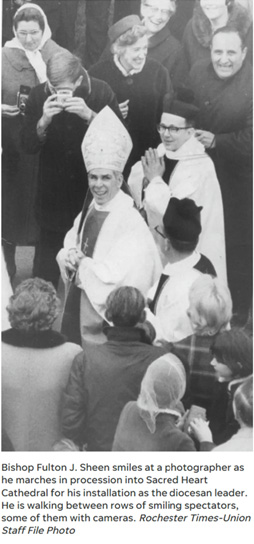
Source: Democrat and Chronicle
Examining Sheen further, I wondered how much worse his ecumenical background could actually be? Were his ecumenical encounters only superficial kiss-kiss moments to look modern, or were these encounters symptomatic of something deeper?
What Catholics are perhaps unaware of is that, shortly after the Council, there was an explosion of wild ecumenical experimentation. After his installation in 1966, the Diocese of Rochester under Bishop Sheen’s direction went full steam ahead, triumphantly pushing and reporting ecumenical prayers and events every week.
Below are just a few of these instances I found.
Sheen’s ecumenical installation ceremony
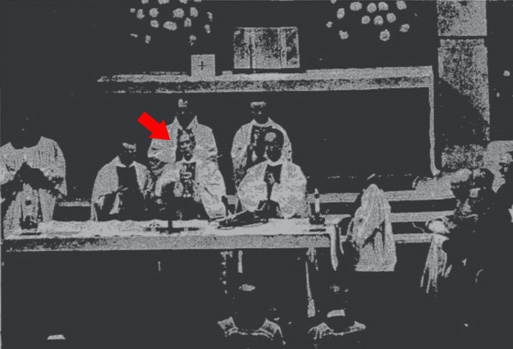
Sheen’s installation ceremony was ecumenical, besides liturgically progressivist
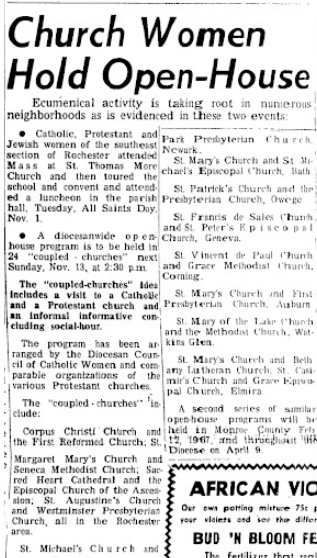
Shortly after he was announced as Bishop in Rochester, the Catholic Courier Journal ran this headline: “Church Women Hold Open House” (Nov. 4 1966, p. 5), reporting that “ecumenical activity is taking root in numerous neighborhoods.” The CCJ affirmed that the Diocesan Council of Catholic Women was organizing open house “church couples,” with Catholic, Protestant and Jewish temples participating. It stated: “A diocesan wide open-house program is to be held in 24 ‘coupled churches’ next Sunday, Nov. 13 at 2:30pm. The ‘coupled-churches’ idea includes a visit to a Catholic and a Protestant church and an informal informative concluding social hour.”
Some months later in January of 1967, the CCJ reported (Jan. 13 1967, p.1) its first massive ecumenical event: Diocese-wide prayers for unity and an ecumenical interchange during the week of Jan. 18-25, 1967. Excerpts from the report and invitation follow, citing Vatican II as the inspiration:
“More than 35 series of church services are scheduled during that time [Jan. 18-25] throughout the twelve-county Rochester Diocese. Members of at least 150 Catholic and Protestant parishes will attend one another’s churches to pray and ponder the steps still to be taken to win God’s gift of ultimate unity.
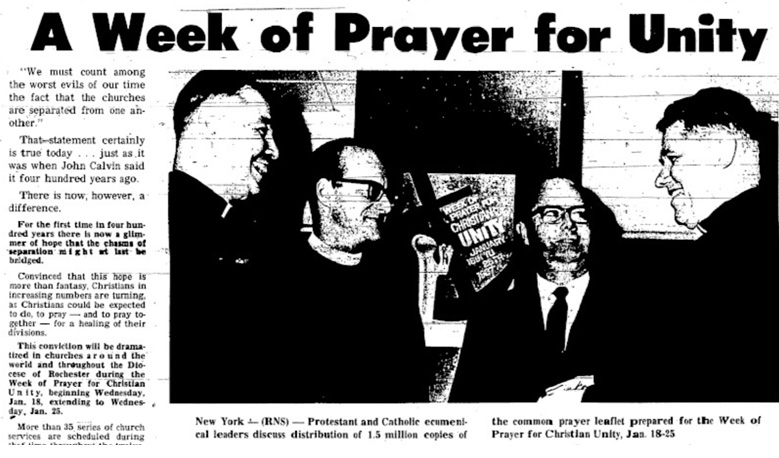
The Diocese’s first major ‘Unity Week’
The following week, Jan. 20 (p.1), the CCJ reported: “Services in scores of churches throughout the area of the Rochester Diocese have been filled with thousands praying this week for religious unity. The unity rites drew Catholics and Protestants to one another’s churches in unprecedented numbers to take part in the Jan. 18 to 25 Week of Prayer for Christian Unity.”
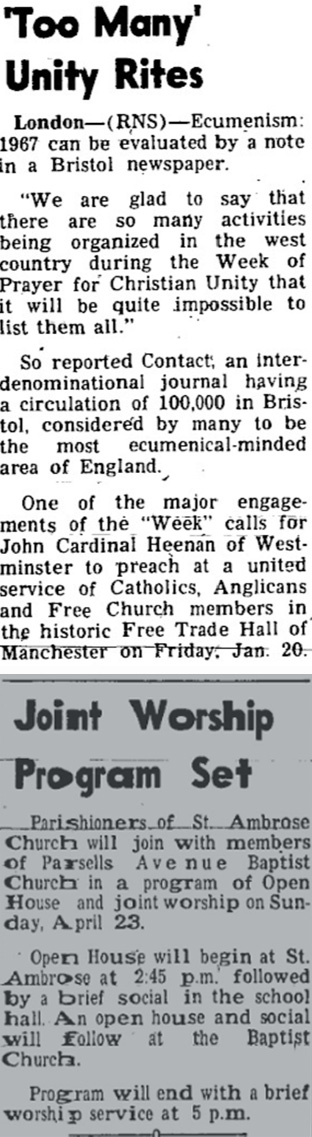
A few weeks later in the same Feb. 10, 1967 issue (p.1), a second round of ecumenical open houses was announced by the CCJ with 18 churches and various Protestant sects participating in Rochester.
This massive ecumenical activity was carried out with the impetus and blessing of Fulton Sheen, whose goal – I remind my readers – was to implement Vatican Council II fully in Rochester.
More ecumenism in Rochester
Under Sheen’s new direction, the Diocesan paper reported ecumenical events in Rochester and elsewhere essentially every week. Some examples include a Protestant seminary pastor giving a speech about the “Death of God” at the Catholic Nazareth College (March 3, 1967, p. 5), a Trumansberg ecumenical service between Protestants and Catholics (p. 6), Catholics celebrating their Mass at the Nichols Methodist temple (Feb 9 1968 p. 5), a Jewish Seder Service held at Annunciation Catholic School with the Seminary faculty leading (Apr 11 1969 p. 15), an ecumenical Scripture conference (Mar 14 1969 p. 7), an ecumenical luncheon with an Episcopal cleric featured as speaker (ibid. p. 15), and an ecumenical Catholic-Protestant "university of life" conference in Webster (Feb. 23 1968 p. 6).
It was also not uncommon for Sheen to invite Protestants to write reflections for the Catholic Diocesan paper, as seen in the March 3 1967 edition, which featured on its front page a Lenten meditation by a Protestant pastor of Lake Avenue Baptist Church.
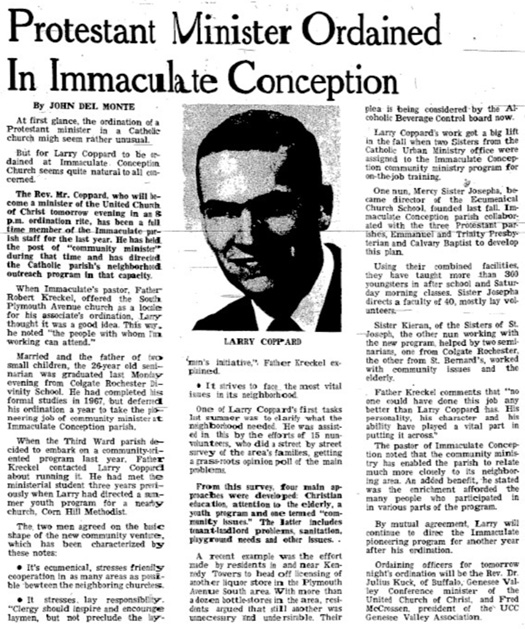
Sheen lent one of his Catholic churches to host a Protestant pastor’s ordination
Indeed, the May 24 1968 edition (p. 7) of the Courier Journal reports: Larry Coppard would be ordained a Protestant minister in the Immaculate Conception Catholic Church the next day (May 25). Coppard, a married father of two and a graduate of Baptist Colgate Divinity School (the local Protestant seminary), was already working officially with Immaculate Conception Church as a “community minister” in charge of the parish’s neighborhood outreach program. The article further reports that, by an agreement with Immaculate Conception’s parish priest, Coppard would continue to direct the community outreach program for a year after being ordained a Protestant minister…
This is only a small smattering of the examples I found. It was shocking to see in every issue of the CCJ example after example of egregious ecumenism approved and led by Sheen. Under him, the Catholic Courier Journal constantly pointed to Schismatics, Protestants and Jews as models for its Catholic audience.
While Bishop of Rochester, Sheen also received a special Brotherhood Award from the Mount Neboh Synagogue in Manhattan for his work in advancing interreligious dialogue with Jews (Feb. 23 1968 p.1). After leaving Rochester in 1969, Sheen went on two years later to speak in New York City’s Marble Church, the oldest Reformed Calvinist temple in NYC. (New York Times, July 26, 1971, p. 29). He also spoke at the Protestant Garden Grove Community Church (Crystal Cathedral) in California in 1972.
Apparently, after leaving Rochester, Sheen’s NYC office was jammed with his 10,000 books, 3,000 of which were Protestant. (The Democrat and Chronicle)
Catholic Courier Journal dropped the name ‘Catholic’
One of the bolder ecumenical initiatives of Sheen in Rochester was to drop the name “Catholic” from the Diocesan paper, a name it had proudly borne for almost 70 years since 1889.
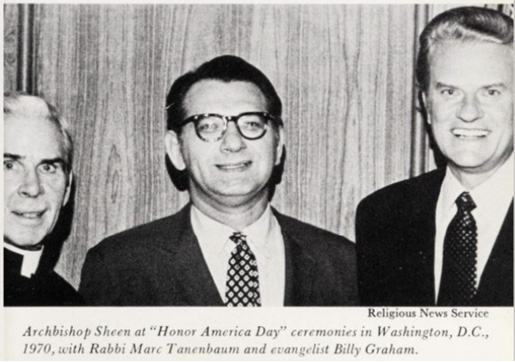
Sheen with Jewish rabbi Marc Tannenbaum
& Protestant televangelist Billy Graham
Needless to say that this initiative was motivated once again by ecumenism, to deny one’s Catholic identity in order to please the false religions and the world – otherwise known as human respect.
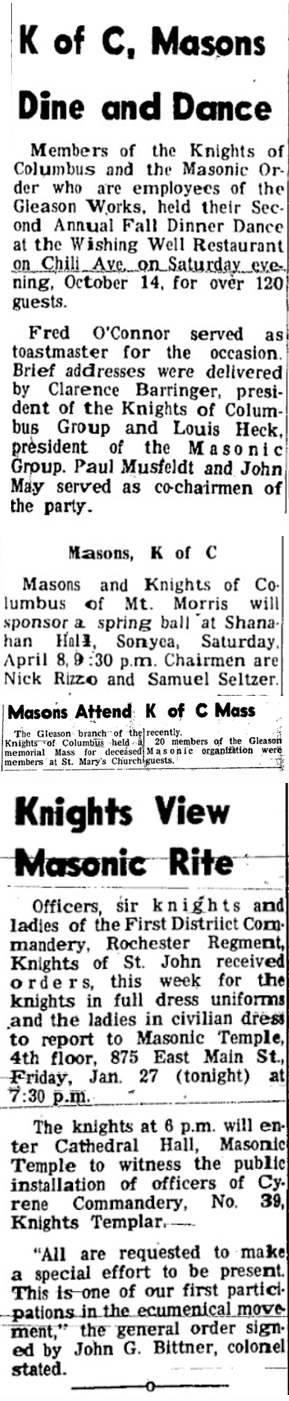
Masonry promoted by
Rochester Diocese
under Sheen
Was Sheen’s dialogue limited to those religions that appear in public? The answer is, no.
Previously, a few months before Sheen’s official installation in December of 1966, the CCJ had already reported on collaborations between the Knights of Columbus and Masonry, such as “Knights and Masons Break Bread Together” (Jun. 3 1966 p. 11), and also a joint dinner on Oct. 28 1966 (p.15).
This reporting of positive collaborations in Rochester with Masonry only continued after Sheen took hold of the Diocese. Some examples can be seen in the issues of Jan. 27 1967 (pp. 3, 5), Mar. 3, 1967 (p. 10), Oct. 27 1967 (p. 14), as well as Masons attending a Knights of Columbus Mass on Feb. 23, 1968 (p. 8).
It seems that at a certain point, the CCJ had to temper its positive reports of the thawed relations with Masonry. The wild post-conciliar experimentation that was taking place on the local level was sure to raise reactions. To quell public opinion, the Vatican had to assure the people: “Do not worry, we have not changed the ban on Masonry.”
This did not last long, as can be seen in a 1974 leaked letter from the Prefect of the CDF, Card. Franjo Seper, who publicly encouraged Catholic membership in Masonry once again.
Echoing this letter, Fulton Sheen – who left Rochester in late 1969 – also answered a question in which he stated that Catholics can be Masons. The Los Angeles Times (Oct. 31 1978, p. 31) reports his words:
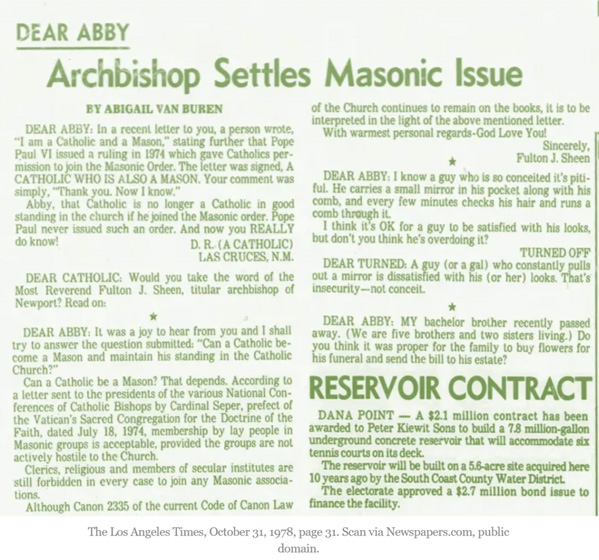
Sheen: ‘Masonry is acceptable’
A progressivist in ecumenism
As can be seen, Sheen’s ecumenism was not limited to short or infrequent encounters. The data in this article are more than sufficient to show that Sheen was an engaged ecumenist, using his new Diocese as an experimental laboratory to push some of the most radical ecumenical initiatives. It is, therefore, not surprising that Sheen should become a perfect candidate for “sainthood” in the Conciliar Church.
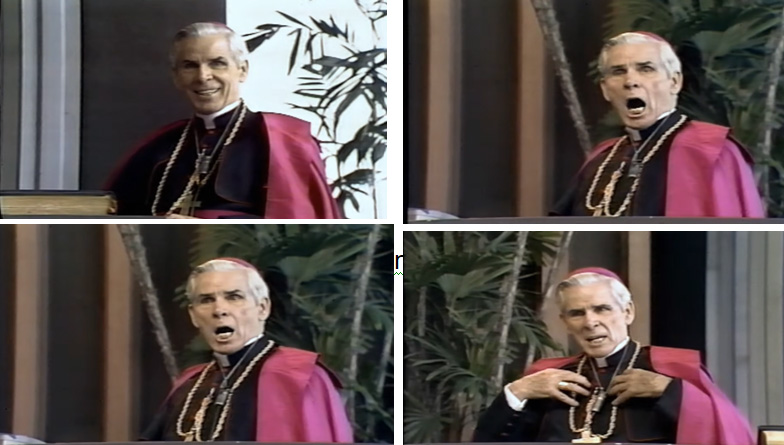
Sheen’s showy & dramatic gestures at the Protestant Garden Grove community church
To be continued
Posted November 18, 2026



______________________
______________________
 Volume I |
 Volume II |
 Volume III |
 Volume IV |
 Volume V |
 Volume VI |
 Volume VII |
 Volume VIII |
 Volume IX |
 Volume X |
 Volume XI |
 Special Edition |