 |
 |
 |
 |
 |
 |
 |
Impressions in Quito 2025 - Part 2
Cultural & Religious Impressions of Quito
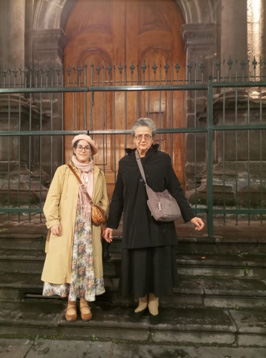
Above, Dr. Horvat & I in front of the lateral doors to the Church of the Immaculate Conception
Catholic spirit of the people
It was both a pleasure and a surprise to see how Catholic the city of Quito and its people are. Despite the Communism that has invaded the political sphere in Ecuador for more than a decade – thanks in large part to the support of the progressivist clergy – and despite the typical egalitarian way of being and dressing that we as Americans help to spread across the world, its people still retain much of the Catholic spirit.
In general, I found the Quiteños to be extremely warm, friendly and always ready to help. It was also charming to see the indigenous women of Quito, always colorfully and modestly dressed, selling on the city streets nice scarves traditionally hand-woven out of their local fabrics.
Quito’s piety: Our Lady’s city
What stood out most to me was finding people in the churches, praying, kneeling, having no human respect to venerate Our Lady publicly. They speak of Our Lady with a tender devotion. The people of Quito love Our Lady so much that they had a huge 135-foot statue of her made and placed on the city’s highest hill, El Panecillo. This Winged Virgin is the Virgin of the Apocalypse, to whom the people of Quito have a special devotion.
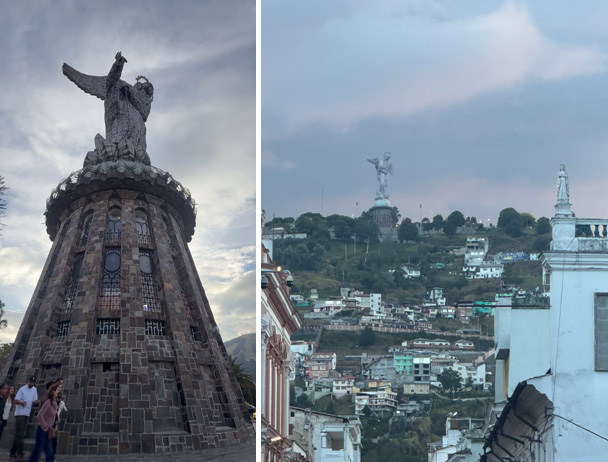
The enormous 135-foot sculpture of Our Lady of the Apocalypse watches over Quito
In the Historic Center, there are Catholic churches on every corner, sometimes two or three in a single block. Practically every major Religious Order is represented, but those with the greatest presence are the Franciscans, Conceptionists, Dominicans, Jesuits, Carmelites, Mercedarians and Augustinians. The only major order I did not see present is the Benedictines.
Quito’s art, food & medieval air
The people of Quito have an affinity and great talent for art, which can be seen everywhere in the Historic Center. The magnificent colonial architecture, cobblestone streets, street merchants calling out their products in sing-song tones, and artists playing their guitars on sidewalks gives the strong impression of walking into a village from times past.
The churches are filled with exquisite paintings and statues ranging from early Renaissance to the 19th century. These works of art were used as catechetical tools to teach the local indigenous truths about our Faith – Heaven, Hell, the virtues, the Sacraments – as well as to illustrate the lives of Our Lord, Our Lady and the Saints. The natives were the owners, so to speak, of this rich and highly elevated art, which raised them in spirit and culture.
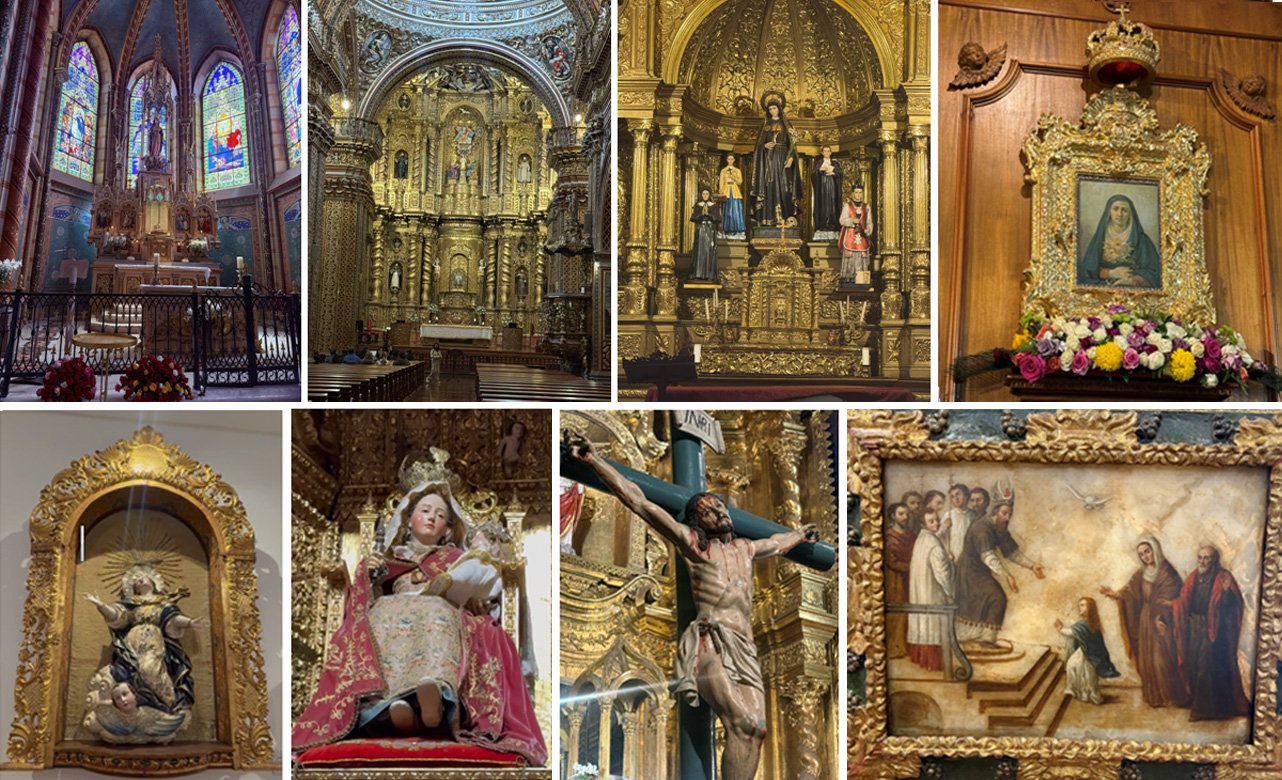
Top left clockwise: the Blessed Sacrament Chapel in the National Basilica of the Vow; the main altar of the Jesuit Church; an altar with St. Mariana de Jesús Paredes y Flores; the miraculous painting of Our Lady of Sorrows that wept; a painting of the presentation of Our Lady in the Temple; a Crucifix in the Church of the Blessed Sacrament; the altar of Our Lady of Bethlehem in the Jesuit Church; a statue of the Assumption in the Franciscan Monastery
Everywhere we went – the hotels, restaurants, tourist sites, churches – the spirit of hierarchy and service are present in Quito.
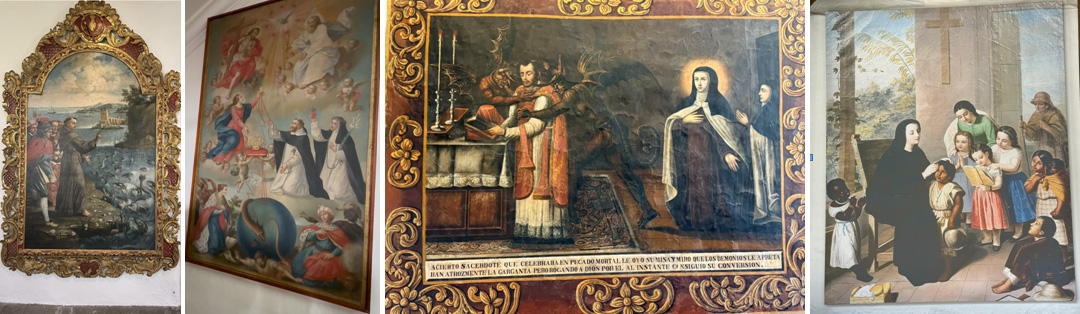
Left to right: St. Anthony preaching to the fish in the Franciscan Convent; an allegory of the Faith in the Dominican Convent Museum; St. Theresa of Avila witnessing a priest celebrate Mass in a state of mortal sin with devils around him; St. Mariana de Jesús Paredes y Flores tenderly caring for & teaching the indigenous children of Quito
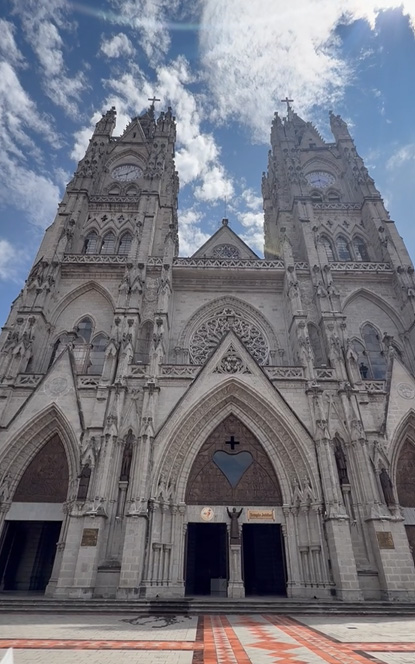
The National Basilica of the Vow
Quito’s center, however, was relatively peaceful, although there was a strong military presence everywhere we went. It was not uncommon to see soldiers in both regular and camouflage uniforms as well as police with rifles and anti-mob gear. We daily walked past many security gates and riot barricades. The President had left the Presidential Palace, which is directly in front of the Conceptionist Convent, for another city to prevent the disturbances from spreading to the country’s capital, as occurred in 2019. This is why armed military and police stood guard particularly at the Palace and other important government buildings.
All of this turmoil is an unfortunate result of the Revolution predicted by Our Lady of Good Success and explained by Prof. Plinio Corrêa de Oliveira in his book Revolution and Counter-Revolution.
The Church of the Immaculate Conception
Seeing the Church of the Immaculate Conception, entering it and praying before the statue of Our Lady of Good Success felt almost unreal to me. The Church alone is of a majestic simplicity, being a part of the complex of buildings of the Conceptionists which once comprised a city block and today is still a considerable property.
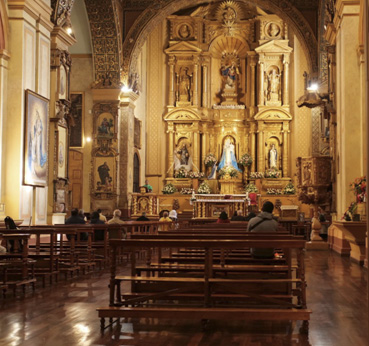
Interior of the Church of the Immaculate Conception
Seeing those magnificent structures made me wonder if that is how our Missions here in California would have developed but for Mexico’s separation from Spain, the unfortunate secularization of 1833, and then the invasion by Protestant adventurers from the East looking for gold and a good life.
The interior of the Church has a simple but elevated colonial atmosphere. Everything – the paintings, the side altars with the Christ Child of Pichincha and the Crucifixion scenes – serve to stimulate piety and raise one’s thoughts to heavenly things, making one forget the trifles of everyday life. It also brought vividly to my mind the present-day crisis in the Church and Our Lady’s prophetic message.
Being with Our Lady & the Christ Child
We were able to see the miraculous statue of Our Lady of Good Success in the Upper Choir of the Church, where she reigns for most of the year over the Abbess Seat, behind a beautiful gold trimmed glass case. There she stood, maternal, inviting, but sad. We were allowed the great privilege to embrace Our Lady as well as to hold the Christ Child, who looked most tender and warm.
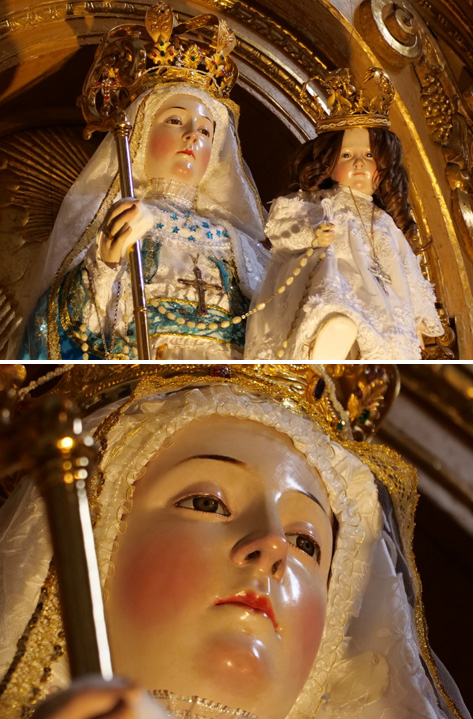
Our Lady of Good Success & the Christ Child
At times, I felt that her face communicated an imposing air of authority of one who was about to punish and chastise disobedient children. “Woe to the religious of the 20th century” were the words that came to my mind seeing her like this. And yet, even then, she lost nothing of her tenderness. Her presence always charms, attracts, and invites one to follow her, obey her and be her faithful slave of love, avoiding anything that could displease her.
The Christ Child, at the same time charming, menacing and sad, seemed ready to let fall His arm over a sinful mankind and avenge the many blasphemies, heresies and impurities of our calamitous times.
The Church’s closure
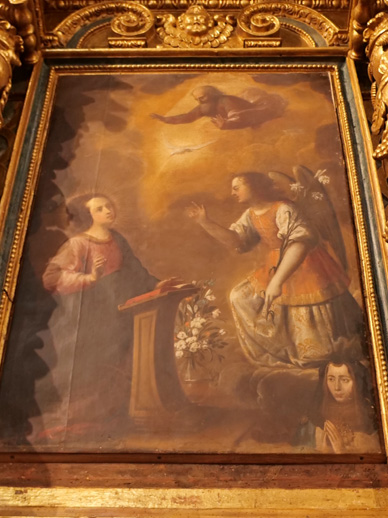
A painting of the Annunciation, in which a figure miraculously appeared at the bottom right, believed to be Mother Mariana
I found their openness to Our Lady’s messages and prophecies to be refreshing; they candidly accept with all Catholic naturality that Our Lady appeared there and delivered her messages. Miracles are common in Quito, and the very air felt supernatural and epic. Perhaps it is the people’s simple faith that draws those miracles from Heaven. Yes, there is faith, even though the traditional Latin Mass is banned in the city by the progressivist Archbishop and only Novus Ordo Masses are allowed.
Nowhere among the locals did I find that Protestant spirit of systematic doubt so deeply instilled in us Americans, until we met an European from a Slavic country who was visiting Quito and spoke with us outside the Church. Curiously and sadly, he had nothing but probing questions for Dr. Horvat as he acridly questioned sources and the authenticity of Our Lady’s messages...
The shortness of our visit
The only sad part of our visit was the short time we had with her. A week is not long enough to be with her or see the many sights of Quito. How I wish I could go there more often to visit Our Lady, to offer her prayers of reparation, to be in that same building where Mother Mariana and the other Founding Mothers sanctified themselves and received so many prophetic revelations from Our Lady.
Some very good aspects of our American culture are our love of adventure, our capacity to admire others, as well as to admire the marvelous. There is much to be admired in Quito, and there is also much of the adventure, the marvelous and the angelic that we Americans crave. Perhaps this is why we saw so many Americans there – those who visit feel the epic and marvelous aspects of Quito, and travel thousands of miles just to see its grandiose landscapes, its magnificent churches, its charming people and to experience its authentic devotions, which touch and fill the deepest yearnings of our souls.
How we are in need of Our Lady of Good Success, especially in these times of crisis and calamity! May her will be done in the Convent as well as in Quito! May she conquer her enemies and punish those who try to sabotage devotion to her! Finally, may she give good success in the fight against the Revolution in the Church and Society, and may we soon see the Chastisement and the happy time of the Restoration foretold by her!
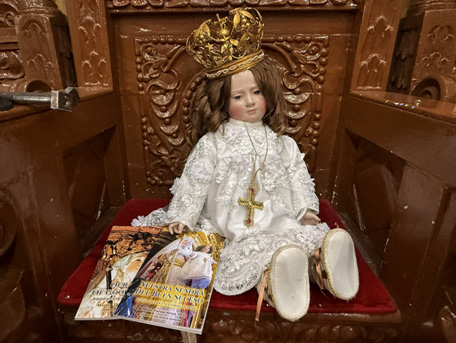
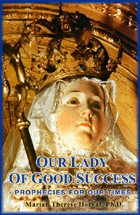
I asked for a blessing from the Christ Child for our two books:
Prophecies for Our Times
in English &
in Spanish



 An Encounter with Our Lady & Her Divine Child: Pilgrimage 2025 2011: Impressions of Our Lady of Good Success The Sadness of Our Lady of Good Success in Quito 2019 The Child Jesus of the Cross
on Pichincha Mountain The Prophetic Mission of Mother Mariana The Prophecies Approved by the Church Testimonials of Miracles Are We at End Times? What Do the Prophecies Say about the 'Prelate to Come'?
An Encounter with Our Lady & Her Divine Child: Pilgrimage 2025 2011: Impressions of Our Lady of Good Success The Sadness of Our Lady of Good Success in Quito 2019 The Child Jesus of the Cross
on Pichincha Mountain The Prophetic Mission of Mother Mariana The Prophecies Approved by the Church Testimonials of Miracles Are We at End Times? What Do the Prophecies Say about the 'Prelate to Come'? |
 |
 |
 |
 |  |
 |
 |
 |
