 |
 |
 |
 |
 |
 |
 |
Our Lady of Bethlehem Pilgrimage - 2026
Our Lady of Bethlehem: Her History
Our first speaker currently resides in Texas with his family. He has lived in California where he met his wife, and has visited Our Lady of Bethlehem several times. He teaches at a Catholic secondary school and gives a solid Catholic formation to his students.
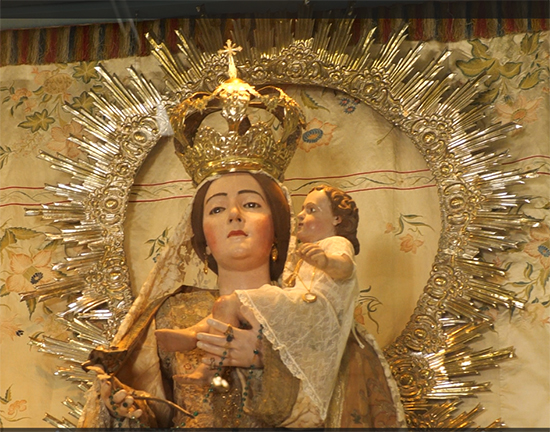
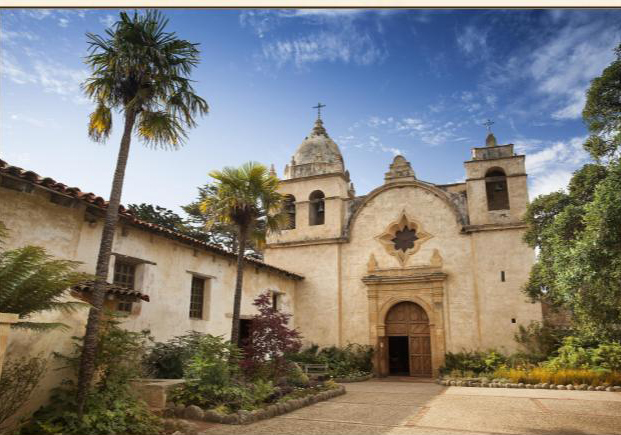
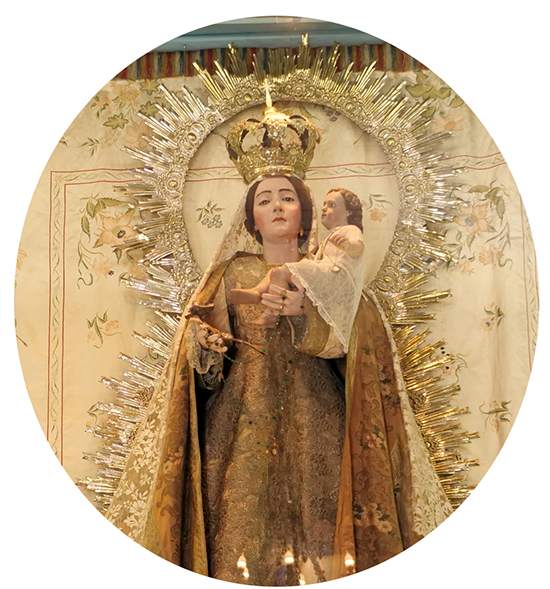
Our Lady of Bethlehem in the side chapel of San Carlos Borromeo Mission in Carmel, below
Carved anonymously in 15th century in Spain, this life-sized statue accompanied St. Junípero Serra on his journey from Mexico to Monterey in 1769. It was the first Expedition to Alta California, called the Holy Expedition and also the “Impossible Mission,” for it seemed impossible that a handful of friars and small troop of soldiers could conquer the long coast of Alta California for Spain. But this Impossible Mission was guided and protected by Our Lady of Bethlehem.
Interestingly, the statue of Our Lady stands 5 foot 2 inches tall, the same height as Fr. Serra. She is adorned with a gold silk dress with shades of salmon and beige, a regal silver crown gifted to her by a naval lieutenant in thanksgiving for saving his ship on a dangerous voyage. Most impressively she holds the tender Infant Jesus on her left arm and the Holy Rosary on her right.
Her long history
The honorific title of Our Lady of Bethlehem, or Nuestra Señora de Belen, is rooted in a devotion to honor Our Lady at the Birth of Christ. It gained popularity in Portugal and Spain in the 15th century during the Age of Exploration, when explorers such as Juan Rodríguez Cabrillo, Sebastián Vizcaíno, Vasco da Gama and Christopher Columbus were setting sail not simply to reconnoiter new lands, but to spread the light of the Gospel to souls in darkness.
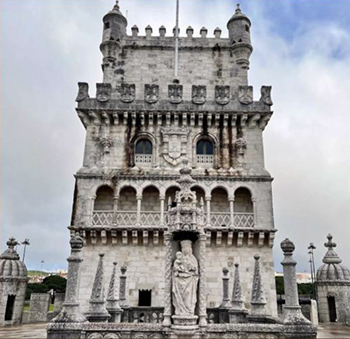
Our Lady of Bethlehem standing at the Belem Tower on the estuary of the Tagus River
Inside that Tower is a beautiful statue of Our Lady of Bethlehem, also honored as the Virgem da Estrella (Star of the Sea), Our Lady of Help and Our Lady of Good Success, because the sailors invoked her for successful voyages. This Tower and image of Our Lady would be the first and last sight of the sailors as they embarked and returned from their explorations.
We can also see the connection of Fr. Serra’s predecessors, like Columbus who set sail with a vessel called The Gracious Mary, to honor Our Lady, Star of the Sea. I would like to briefly mention here it is interesting to think that our nation’s capital, Washington DC – with the DC standing for the District of Columbia – thus commemorates a Third Order Franciscan who, in a sense, opened the door to the Americas more than a half-century before the statue of Our Lady, Fr. Serra and the Franciscan missionaries embarked for the New World.
Establishing the first missions
The plan to establish the California Missions is an interesting story. In the middle and end of the 1700s, the Jesuit priests and brothers were chosen to establish the first missions in New Spain. When they were suppressed (in Portugal and France/New France in 1759, and Spain and New Spain in 1767) the Baja California Missions were turned over to the Franciscans, and latter also to the Dominicans.
So, almost overnight, in the northern most mission towns of New Spain, the black-robed Jesuits disappeared, and the brown-robed Franciscans replaced them. This sets the stage for the meeting of Our Lady of Bethlehem and Fr. Serra on their sacred journey into unchartered lands with peoples who had not yet heard of the Son of Man in the Gospels, nor His Mother.
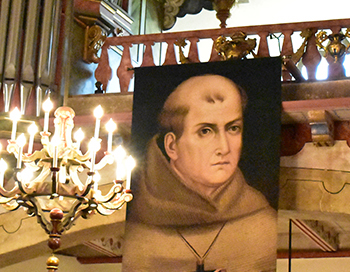
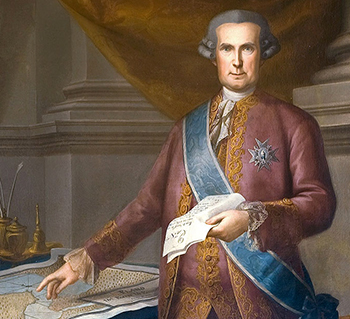
An large image of Fr. Serra hangs from the choir; below, Don José de Galvez, considered ‘mad’ for planning the Holy Expedition
For a long time the Franciscans in Mexico City had wanted to send missionaries to California, which had already been claimed by the Spanish Empire in 1542 by right of discovery when Juan Rodriguez Cabrillo explored the Pacific Coast. Finally, threatened by rumors that Russia and England were seeking to establish themselves along the coast of California, King Charles III went into action.
He commissioned a remarkable man, Don José de Galvez, the Visitor General of New Spain and a fervent Catholic, to send an expedition to Alta California and to secure Spain’s hold on the large 500-mile coastal stretch extending from the port of San Diego to the port of Monterey.
From his headquarters in Santa Ana in Mexico, General Galvez requested the presence of the zealous Fray Serra, who was directing the Franciscan College of San Fernando. He was the right man to undertake this difficult mission.
Fr. Serra was born on the Island of Majorca Spain, in 1713. At age 16 he entered the Order of Friars Minors. During his novitiate, reading the Letter of Madre Maria de Agreda to future missionaries, he already had a desire to convert the pagan natives in New Spain.
After many long years of waiting, he arrived in Veracruz in 1749. He was already 55 years old when he was named President of the Missions of Alta California and set out on the Sacred Expedition of 1769 to conquer the coast of California for Our Lord and for Spain.
Dom Galvez and Fr. Serra made a plan to establish missions about every 50 miles along the way from San Diego de Alcala to Monterey – el Camino Real as we know it today. It has been said that Serra and Galvez were deemed the last conquistadores for the Spanish crown.
Our Lady of Bethlehem, Patroness of Alta California
Here Our Lady of Bethlehem, also known as La Conquistadora, enters the Sacred Expedition. In 1769, the Archbishop of Mexico City, Antonio de Lorenzana y Butrón, gave this regal statue to General Galvez to guide the expedition of conquest and evangelization. In turn, Dom Galvez loaned the statue to Fray Junípero to accompany him and conquer the hearts of the natives.
His condition was that she be returned to him in Mexico City once the Cross of Christ was planted on of the Bay of Monterey. The friar, struck by the beauty and grace of the lifelike statue, agreed.
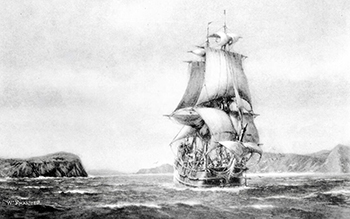
San Carlos leaving for the Holy Expedition
On January 6, 1769, in San Diego, Fr. Serra blessed the ships that would set out on the sea expedition and meet him as well as the rest of the land expedition . The first ship was the San Carlos, and the second the San Antonio – which carried the bells, liturgical vessels and precious statue of Our Lady of Bethlehem. The third, the San Jose, left shortly afterwards on the order of Dom Galvez, who wrote that his heart had sailed with it.
The land expedition with Fr. Serra and the Commander and first Governor of Alta California, Dom Gaspar de Portola, set out from Mission Loreto in Baja California. Already Fr. Serra was hampered by the ulcers and infections on his chronically weak leg. He sent Gen. Portola ahead, assuring him he would catch up.
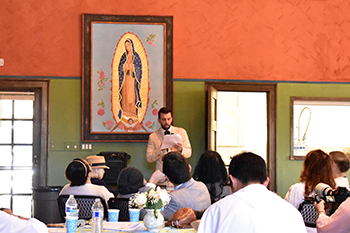
Mr. Mark Dwyer gives the history of the Carmel Mission at Fr. Crespi Hall; below, Fr. Serra founded the first 9 of the chain of 21 California Missions
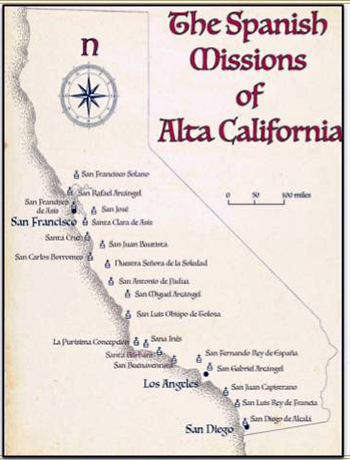
The expedition then continued north to San Diego, leaving the desert landscape and approaching a promising valley with arable land and easy access to water. Fr. Serra describes the Indians throughout these lands but gentle and competent in their primitive crafts.
When the land party finally reached San Diego, they received some hard news. The San Jose was shipwrecked with no survivors and the San Carlos had been struck by pestilence with few survivors. The San Antonio, which carried the statue of Our Lady, was the only ship to arrive safely in good condition. Despite these losses, the fervor of Fray Junípero and Gen. Portola did not diminish. The latter sent the San Antonio back to Mexico for more men and supplies for the expedition to Monterrey.
On July 16, 1769, Fr. Serra officially established the first California mission for Spain by planting the Cross on Presidio Hill and said a Mass in thanksgiving for this arduous feat. There were some initial battles between the Spanish leather jacket soldiers and the local Kumeyaay Indians in San Diego, but as the influence of the shamans decreased the Indians sought refuge in the Mission and started to work together.
At Mission San Diego de Alcalá, which became known as the Mother of the Missions, the Indians first laid eyes on Our Lady and her Son inside the first primitive straw hut chapel. They were entranced with the lifelike figures; the women, who thought the Christ Child was emaciated. with tender affection would even try to feed him.
The first Monterey expedition
Gov. Portola set out on a land expedition on a mission to find the port of Monterey described so precisely by. But the port eluded his weary group, although they did find the beautiful bay in San Francisco and Indians open to receive the Gospel.
The exploratory expedition returned discouraged to San Diego. There supplies were running low, and many were losing hope in the Expedition’s success. Portola sadly decided that unless a supply ship arrived at San Diego by March 15, they would end the Holy Expedition and leave for Baja California.
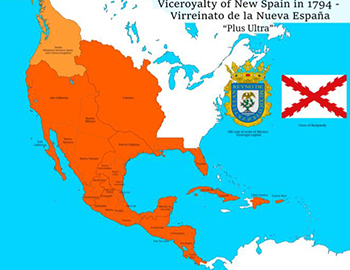
The thriving Viceroyalty of New Spain at the turn of the 18th century
On the last day and at the last hour before sunset on March 19, looking westward from atop Presidio Hill, Fr. Serra spotted a ship on the horizon. It was the long awaited relief ship, the San Antonio.
Providence had provided once again. For the San Antonio was actually planning to travel past the San Diego port thinking that the Fr. Serra and Gen. Portola were awaiting resupply in Monterey. Because the ship lost one its anchors it was forced to turn back to the port of San Diego. It was a triumph of the faith of Fr. Serra and a sign of the protection of Our Lady of Bethlehem who was guiding this mission to success, despite seemingly impossible obstacles.
The Sacred Expedition was still alive; in thanksgiving Fr. Serra would promised to celebrate a High Mass on the 19th of each month until his death in honor of St. Joseph who had answered his prayers.
Mission San Carlos Borromeo established
Shortly afterward, Gov. Portola and Fray Serra set out again to discover the elusive port of Monterey. Fr Serra boarded the San Antonio with Our Lady of Bethlehem and set sail for Monterey on Easter Monday, April 16, 1770. The Portola land party left a day later, accompanied by Fr. Serra’s close companion and diarist, Fr. Juan Crespi.
Finally, after 46 days of rough sailing, the ship reached the harbor of Monterey on May 31. The land party had already arrived, this time recognizing the port they had mysteriously passed one year prior. The Impossible Expedition was a success.
So, on June 3, 1770, the Feast of Pentecost, Fr. Serra celebrated his first High Mass in Alta California’s second mission and officially founded the Royal Presidio Mission of San Carlos Borromeo, named in honor of the Spanish King’s Patron Saint.
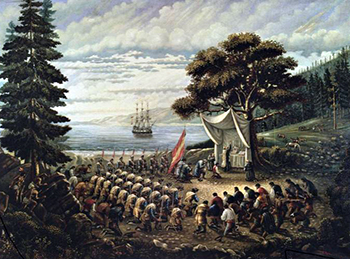
The first Mass at Monterey Bay
under the famous live oak tree
Padre Serra recalls the scene with in a letter to Mexico City reporting the success: "Everyone arrived singing, while the bells hung from the old oak tree were ringing at full peal…With all the men kneeling before the altar, we sang the Veni Creator. A large cross had been laid out on the ground; we lifted it together and planted it upright in the earth. I said the prayers for its blessing, and everyone knelt to venerate it. Then I sprinkled holy water over the ground around the cross. At each new act, the bells would ring, the soldiers would fire their guns, and the San Antonio would discharge a volley from its cannon.
“After raising aloft the standard of the King of Heaven, we unfurled the flag of our Catholic Monarch. As we raised each of them we shouted, 'Long live the Faith! Long live the King!’... After that ceremony, I began the High Mass, with a sermon after the Gospel, and as long as the Mass lasted, it was accompanied with many salvos of cannon. The Mass ended, I took off my chasuble, and all together we sang in Spanish the Salve Regina in front of the wonderful statue of Our Lady of Bethlehem, which was on the altar.”
The mission was originally set at the current location of the presidio, but Fr. Serra was not content with the bad example of the soldier and soon moved the mission five miles south to Carmel Valley, where it is situated to this day. The Mission thrived and became the headquarters of Fr. Serra, the one he loved most because it reminded him of his home in Mallorca.
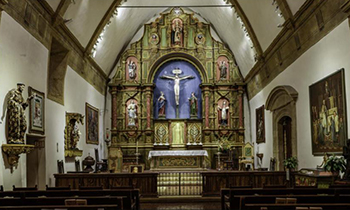
In the original retablo, Our Lady of Bethlehem occupied the central place where the Crucifixion scene now is seen
On August 10, the news of the founding of the Monterey mission reached Dom Galvez in Mexico City. The whole city was jubilant and all the bells rang. Now the whole world knew that the Spanish Crown had officially claimed the long coast of California with a meager crew of friars, soldiers and sailors.
In his jubilation, Don Galvez made the decision to return the beautiful statue of Our Lady to Fr. Serra in Carmel so that she might remain there to protect the California Missions. Providence had destined her for Carmel and here she remains. In the following years, many voyagers would ask for Our Lady’s intercession to gain safe passage on journeys by sea.
Labors & fruits
Fr. Serra accomplished much with Our Lady’s help, but his victories did not come without challenges. He faced many adversaries in the Spanish government, among the local Indians and even within his own Order, but none of this stopped this steadfast friar as he always moved forward. In 15 years, he founded the first nine Missions in the California chain.
Thus, it is recorded in his writing to the Father Guardian at the end of his life that the seeds of the Gospel had been sown in California: “6,000 Baptisms and 5,307 Confirmations in this population of unbelievers where the name of the Savior had never been pronounced.”
For 15 years Fr. Serra labored here – from July 16, 1769, the day Fr. Serra founded his first mission in San Diego, to July 16, 1784, when he would celebrate his last Confirmations in San Francisco. There it was revealed to him that his time on Earth was drawing to a close; feeling weak and feeble he returned to Carmel to be with his Patroness, Our Lady of Bethlehem.
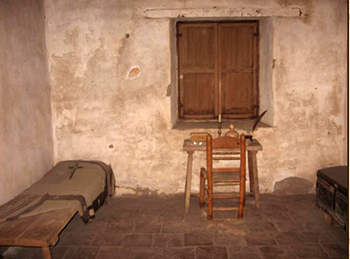
The simple room where Fr. Serra died on August 28, 1784 at the Carmel Mission Museum
Fr. Serra passed away the next day on August 28, 1784, alone in his small, simple cell. Atop his chest was the Cross of Caravaca which he wore devoutly since his entrance into the Franciscan Order as a constant reminder of Our Lord’s Passion.
The Caravaca Cross, by the way, has a special blessing that makes it a powerful protection against the malignant influence of devils. Fr. Serra kept it with him always and it was buried with him when he died. During the exhumation of Fr. Serra’s body in 1943, it was found on his chest and can be seen today in the Carmel Mission Museum.
During the restoration, the remains of Frs. Serra, Crespi and Lasuén were placed in the sanctuary below the main altar. So to this day Fray Junípero remains close to His Mother and Protectress, Our Lady of Bethlehem.
As a side note, let me mention another great Franciscan apostle, not of California, but of Texas – the Ven. Antonio Margil de Jesus. This miracle worker preached and labored almost a century before Fr. Serra began his work in Alta California. It was he who wrote the hymn called the Alabado with which Fr. Serra used to teach the truths of the Catholic Faith to the Indians. You can read about his life in the Marvelous Stories & Miracles book published as a pdf on the TIA website on its Library page.
Secularization & restoration
After the death of Fr. Serra in 1784, 12 more Missions were established to complete the chain of 21. But this magnificent work would come to an end in only 40 years. After the 1833 Decree of Secularization all the California Mission properties were confiscated by the Masonic Mexican government that had just won its independence from the Viceroyalty of Spain. It was beginning of the end of the first great plan of God for California and its natives.
The Indians were ultimately displaced, abandoned and taken advantage of by prospective landholders. With the loss of their livestock and harvests that had become so abundant they were left destitute. Between 1845 and 1880, the California Indian population dropped from 150,000 to around 20,000.
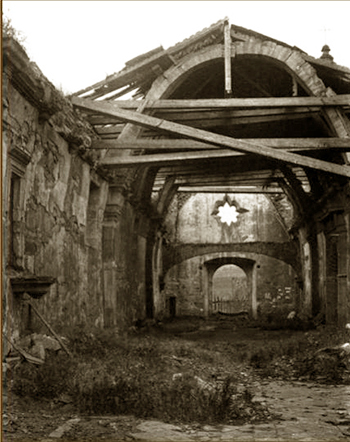
Mission San Carlos Borromeo, abandoned & almost destroyed in 1846
Amidst all this chaos the statue of Our Lady of Bethlehem remained in the Carmel and Monterey area. The loyal Indian Cantuas family kept Our Lady of Bethlehem in their home during the secularization. Dona Maria Dutra, one its members, requested before her death in 1925 that she be placed under the care of Gertrude Ambrosia, a descendant of one of the soldiers from the Sacred Expedition.
In 1931 the great restoration project of the Carmel Mission started, led by a San Francisco cabinetmaker and Third Order Franciscan, Mr. Harry Downie. He would reunite Our Lady of Bethlehem with the Christ Child, who had been kept in the Presidio chapel, and place them back in Carmel Mission where she has remained ever since.
Conclusion
When you turn the corner from the nave of the Mission church to enter the side chapel, you see Our Lady of Bethlehem in splendor for the first time, as if drawing back the curtains on an early summer day to see the bright illumination of the sun, but she is far more beautiful than the sunrise. Her countenance is maternal, patient, loving and kind. Yet in the many times that I have seen her, I would say that she also has a look of concern. This look, I believe, is due to the many offenses made against Her Son in these turbulent days of the Church and society.
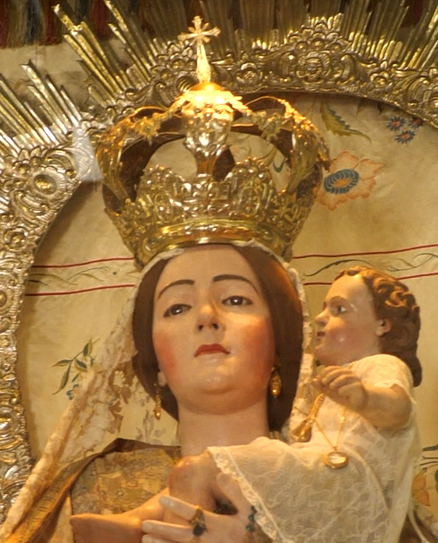
Our Lady of Bethlehem
As Catholics, it is customary to have a devotion to the local Saints of a particular region. The Franciscans of New Spain, both in California and Texas, have sadly been forgotten or set aside over the years, but we are here to acknowledge their courageous efforts and to ask for their intercession.
Also it is customary for a Catholic region or city to have a special statue or image of Our Lady. Despite the neglect and abandonment that Our Lady of Bethlehem at Carmel has endured through many years, we are here now to acknowledge her as our Mother and the first Patroness and Conqueror of California. She has conquered our hearts, and she gives us hope for a time where Mary will reign in the hearts of all men once again.
By visiting Our Lady here today, we begin to return to that first plan of God for California, and we can encourage others to come here and have recourse to her, our Patroness. She conquered this land once for her Son, and she will do so again.
May Our Lady of Bethlehem continue to inspire those here in California and those who seek the truth of Christ Jesus in such a cold, dark world. May Our Lady, the Star of the Sea, guide us to the Light of her Son.
Posted July 24, 2026



Purchase here