What People are Commenting
 |
 |
 |
 |
 |
 |
 |
Prof. Plinio, Caiphas & CR in the Church
Holy Ghost Confirms Caiphas as High Priest

Re: Your Recent Response to Fr. Cekada's Sedevacantist Argumentation
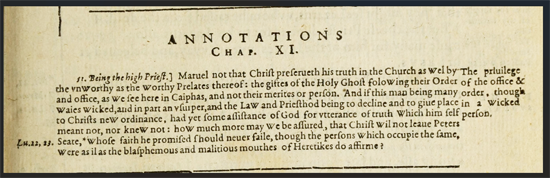
While reading your late response* to the sedevacantist arguments of Fr. Cekada et al., I was reminded of this rather prescient annotation on John 11.51 to be found in the Rheims New Testament (ed. 1582), p. 253, which I have transcribed and attached for you below.
Note that this Bible received its approbation from four doctors of theology, and that its notes were largely written by a seasoned veteran of Counter-Reformation apologetics and controversy, Fr. Gregory Martin, with the aid of Fr. (and later Cardinal) William Allen and others.
Ver. 51. Being the High Priest.— Marvel not that Christ preserveth His truth in the Church as well by the unworthy as the worthy prelates thereof: The gifts of the Holy Ghost following their Order and office, as we see here in Caiphas, and not their merits or person.
And if this man, being many ways wicked and in part an usurper, and the Law and Priesthood being to decline and to give place to Christ's new ordinance, had yet some assistance of God for utterance of truth which [he] himself meant not, [and] knew not, how much more may we be assured that Christ will not leave Peter's Seat, whose faith He promised should never fail (Lk. 22.32), [even if] the persons which occupy the same were as ill as the blasphemous and malicious mouths of heretics affirm!
N.B., I have made a few alterations to the original for readability's sake. Importantly, the bracketed "even if" replaces the original's "though," which is an antiquated sort of subordinating conjunction, and is not equivalent to our present-day usage of "though," which would imply a statement of fact, hence my emendation. See the original below.
Yours cordially,
In the Sacred Heart,
R.B.
For a larger copy click here
______________________
Counter-Revolution in the Church
Why the Counter-Revolution:
Evaluating the post-Vatican II crisis presents a profound dilemma that requires careful theological navigation, as the situation resists easy categorizations. Blind submission requires the faithful to embrace documented error. On the other hand, it seems straightforward to assume that the chair is vacant, and frankly there are countless reasons to arrive at this conclusion, especially since the principles of Saint Thomas Aquinas would support this perspective.
However, a deeper analysis may prove that it is not that simple and that in fact it is more likely that it is not vacant, because the visible, perpetual hierarchy commanded by Christ must somehow endure.
Furthermore, the so-called traditional Catholics who hail so-called hero cardinals of the Novus Ordo to be their allies, let alone hold on to Summorum Pontificum as their go-to, are deeply misleading. The man behind that document, Pope Ratzinger, one of the main figures of Vatican II, a modernist to the core, who never changed by his own admission, dared to call the true Latin Mass the extraordinary form, a labeling that would have been anathema in the pre-Vatican II era. That highly praised document did not even restore the authentic liturgy, but instead codified a heavily diluted version of the rite, stripped of numerous essential elements.
The unassailable truth established by pre-1914 ecclesiology is that a man can be a validly elected ruler while simultaneously acting as a destructive tyrant whose commands must be met with open, uncompromising resistance.
The Absolute Execution of the Pauline Anathema:
Saint Paul establishes the absolute immutability of the faith in his Epistle to the Galatians with the uncompromising command that if anyone preach a gospel to you besides that which we have preached to you, let him be anathema. The Apostle repeats this word immediately to prove that the condemnation is automatic, severe, and cuts off the specific doctrine from the body of truth.
The Council of Trent and the pre-1914 popes applied this exact Pauline anathema to the specific errors of modernism, religious freedom, and ecumenism. When the post-Vatican II hierarchy promulgated Dignitatis Humanae and Unitatis Redintegratio, they explicitly advanced the exact propositions previously struck down by these anathemas.
This introduces a raw, undeniable fact. The doctrines of Vatican II are under the curse of the Pauline anathema. However, according to the standard pre-1914 manualists, a pope who promulgates a harmful, non-infallible pastoral directory does not automatically lose his administrative office. Instead, he becomes a bad father who commands a sin. Because the Pauline anathema attaches directly to the false doctrine itself, the faithful are bound by divine law to treat those specific teachings and rites as accursed, while the man who uttered them remains the legal, visible occupant of the see.
The Right to Resist a Tyrannical Ruler:
Traditional Catholic theology explicitly accounts for the reality of a wicked or destructive pope. Saint Robert Bellarmine laid down the exact canonical rule, stating that just as it is lawful to resist the Pope if he assaulted the body, so it is lawful to resist him if he assaulted the soul or troubled the state, and much more if he wished to destroy the Church. Bellarmine commands that it is lawful to resist him by not doing what he commands and by hindering the execution of his will.
This is not a matter of soft, modern dialogue or pastoral accompaniment. It is an act of spiritual self-defense. Saint Thomas Aquinas confirms this in the Summa Theologiae, noting that when the faith is in imminent danger, prelates must be rebuked by their subjects, even publicly. The authority of the pope is strictly limited by the deposit of faith. He is the guardian of the law, not its author. When a pope uses his legal office to subvert the Catholic faith, his authority ceases to bind the conscience of the faithful in those specific commands.
The Reality of the Occupied Church:
The post-Vatican II institution retains the legal infrastructure, the physical buildings, and the valid canonical titles of the Catholic Church. To deny this is to argue that the visible Church disappeared, which is a heresy condemned by the Vatican Council of 1870.
The factual reality is far more severe. The visible structure of the Church has been captured by men who operate with a system of absolute doctrinal subversion, mimicking the Arian crisis where the heretics held the basilicas while the orthodox faithful were driven into the fields.
The argument is logically invulnerable because it recognizes the valid legal titles of the post-Vatican II popes while completely nullifying their modern novelties. By applying the strict pre-1914 principles of regular canon law, the faithful possess the absolute right to reject the new mass, ignore the pastoral directives of Vatican II, and brand their novelties with the Pauline anathema, all while remaining inside the visible structure of the true Catholic Church.
If we love Holy Mother Church we must fight for her, and most importantly for her Head, Christ Jesus.
Unus Dominus, Una Fides, Unum Baptisma.
Prof. V.S.N., Cambridge
Posted November 3, 2026



______________________
The opinions expressed in this section - What People Are Commenting - do not necessarily express those of TIA
______________________
______________________
 |
 |
 |
Salve María.
God bless you. Recently I re-published the marvelous analysis by Prof. Plinio of St. Hildegard and her prophecy of the advent of the Revolution. Here is the link.
There is another article I wrote, which is special in the sense that it's been long in the making. The text consists in a tribute to Prof. Plinio. It is my privilege to have written this since I admire his work for the love of the Church. As a small token of appreciation, the work of Don Atila is mentioned.
People must know exactly what Prof. Plinio has done and dedicated his whole life to.
+In Maria Regina,
Mgster. Yousef Altaji Narbón, Panama
The Editor responds:
Esteemed Magister Yousef Altaji Narbón,
Salve Maria!
May Our Lady bless you and your important apostolate in Panama.
I am glad you republished the Comments of Prof. Plinio on St. Hildegarde of Bingen in Spanish. I hope many people will benefit from those wise words.
I compliment you for your noble article paying Prof Plinio a tribute of honor and gratitude as he deserves. To defend him at a moment when the enemies of the Church – both external and internal – are doing their best to denigrate his name, represents a courageous and particularly timely tribute.
As one of his closer disciples who profited from his Catholic teachings and his holy presence, I am particularly pleased that you have publicly affirmed your admiration for him.
I also thank you for your generous mention of my name and work, whose main merit is to have been accomplished in obedience to his command and following his close orientation.
May Christ the King – whose Feast we celebrated nine days ago – and the Queen of Heaven bless you and your valorous companions in this remarkable fight, and give you the courage and perseverance to wage the same war that Prof. Plinio always pursued.
Cordially,
Atila S. Guimarães