Book reviews
 |
 |
 |
 |
 |
 |
 |
Guadalupe & the Flower World Prophecy
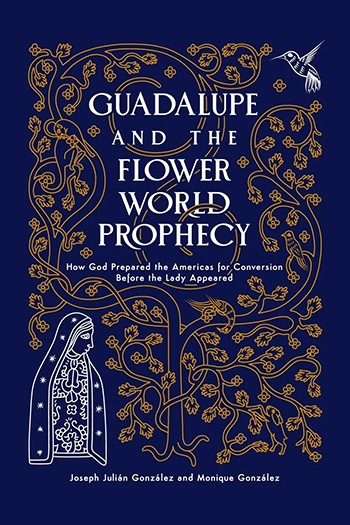
Review of Guadalupe and the Flower World Prophecy, How God Prepared the Americas for Conversion Before the Lady Appeared by Joseph Julián & Monique González, Sophia Institute Press, 2025, 288 pp.
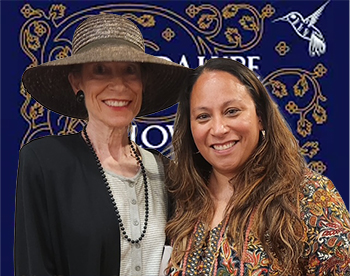
Tesa Besica with co-author Monique Gonzalez
While their talk was fascinating and engaging, the book was a chore to read. Parts were riveting and revealing, but the major part was academic and took quite an effort to plow through.
The authors go into great detail about the Náhuatl, or Nahua, language, philosophy, culture, traditions, Cantares Mexicanos (a collection of songs dealing with the prophecy), etc.
What caused the roughly 10-million native people of Mexico who had been stubbornly resistant to the evangelistic overtures of the Catholic friars to suddenly approach them in droves, traveling days without food or shelter to beg for Baptism, often refusing to budge out of churches until they were given the Sacrament?
This book proposes a new answer to this question, and sets out convincing evidence that the prophecies and flower songs in the indigenous culture prepared the people for the miracle of Our Lady of Guadalupe that took place in 1531.
The four pillars
From the early civilization of Mesoamerica, the authors explain, there were elements that served to prepare the people for Christian evangelization. The four foundational pillars, or ‘bridges of understanding,’ in the Nahua or Aztec prophecies were Beauty, Truth & Goodness, Life after Death, One Supreme God and Worthiness to enter Heaven. (Kindle version p. 45) These pillars created a natural link to the Catholic Faith.
The many prophecies in the Nahua flower songs about a promised land with a holy mountain and Flower World also seemed fulfilled in the apparition of Our Lady and the magnificent flowers she ordered Juan Diego to gather.
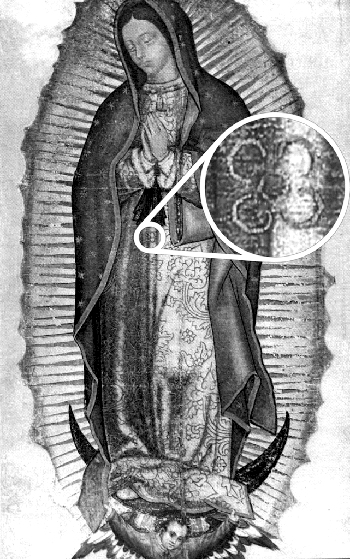
The quatrefoil on Our Lady's tilma is over her womb, signifying the portal to Christ
Direction was important in the myth. Their axis mundi was the quatrefoil, a four-petaled flower that stood for the four directions. The flower linked the earth and the sky, the symbolic intersection between the sacred and the mundane worlds.
Quatrefoils were often marked on cave entrances, signifying portals into the divine realm. Of note, there is a quatrefoil on Our Lady's mantle on the Tilma, a symbol that the Indians would have recognized and understood.
The location of the quatrefoil on the Tilma is also important. Mary's pregnant womb bears the symbol of the axis mundi, of world axis, indicating that here is the portal between earth and heaven. In her womb is the vital intersection of the universe, where heaven and earth meet. (pp. 339-340) The authors raise the hypothesis that such a detail so deeply rooted in the native culture allowed the natives to make the connections necessary to understand Christ as the way to Paradise.
Aztec flower songs
Singing and dancing played a great part in indigenous artistic culture. Songs often were the medium of transmitting news, beliefs and philosophy. Music school was compulsory and obligatory regardless of social standing. Once one became a "performer," if a mistake was made during a performance – such as a dancer making a misstep – he was taken away for execution!
Fray Bernardino de Sahagún found these schools superior to those of Europe. (p. 121) They were also trained to retain prodigious amounts of oral transmissions, often after only one hearing; this is one reason Juan Diego was able to retain the words of Our Lady to relay them to the Bishop accurately.
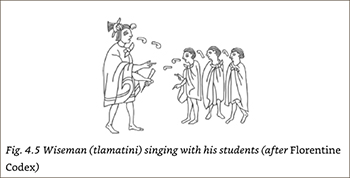
The illustrations on this page are from Nican Mopohua, the story of Guadalupe recorded in Náhuatl in 1649
In the ancient songs, the singer always fails to find the flowers, and he admits it is because of his wretchedness. Thus he is a failed hero, but one has hope that "the god of far and near" – whom the Nahua people called In Tloque Nahuaque – can someday make him worthy of that paradise. (p. 26-27)
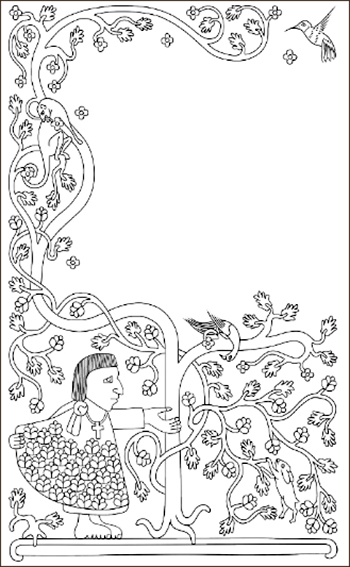
Juan Diego gathers the flowers
& places them in his tilma
Further, when the Virgin Mary speaks to Juan Diego she speaks in Nahua and identifies herself as the Mother of the one true God. She also says, “I am the Mother of In Tloque Nahuaque,” thus tying herself to that ancient Song Poem. (pp. 316, 320) The authors propose all this would have naturally connected in the Nahua mentality, opening them to Baptism with the hope to enter a real Paradise.
The timing of the apparition is also important. Only several decades before the miracle, the Nahua wise men leaders had gathered together and speculated on the Flower Songs. One finally concluded that the flower in the songs meant the only truth on earth. Thus, when Juan Diego found the flowers, the Nahua people understood that he founds the one real Truth.
These are only a few of the Flower World connections that the authors illustrate in their well-documented book with more than 450 footnotes.
The story briefly told by the natives
After 12 years of evangelization, only a dearth of the population had embraced Catholicism, and many who did only pretended to convert.
Enter Juan Diego, a humble Catholic widower who lived with his uncle. On his way to Mass one Saturday, he drew near to a little hill called Tepeyac at dawn; he heard birdsong and the hill answering; it was so beautiful that he asked himself if he was worthy to listen.
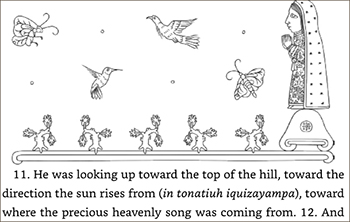
Our Lady appears to Juan Diego
Juan Diego left sadly, but Our Lady was waiting for him again at the same place. Juan begged her to appoint someone noble or more deserving be her messenger; Mary insisted that it was he whom she had selected.
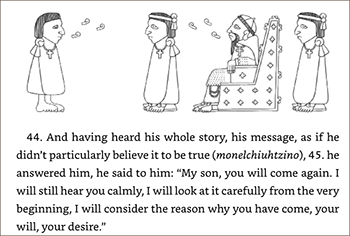
The Bishop hears his message but does not believe him
He tried to avoid Tepeyac and Our Lady, but she came to him and told him his uncle was cured. She ordered him to "go to the top of the hill where he will find different kinds of flowers, cut them, gather them, put them all together; then come down here; bring them here, into my presence." (p. 263) This was in the month of December when the frost would have destroyed any flowers.
Mary then placed the flowers in Juan's Tilma, told him what to say to the Bishop, and sent him on his way. The servants mistreated him and tried to forbid his seeing the Bishop, but Juan waited hours for an audience, not allowing them to open his Tilma to see what he was carrying. Finally he gave them a little peek; but when they grabbed for a flower, all they saw was her image on the Tilma.
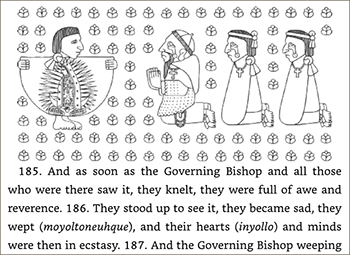
he Bishop falls to his knees on seeing the image of Our Lady on the tilma
TThe Tilma was placed in Bishop Zumárraga's private chapel, a small house (érmita) was built, and Juan and his uncle moved into a small hut they built next to the shrine, and there he lived out his life tending to the house and becoming the voice of the miracle.
This story converted 10-million indigenous, the largest conversion event ever in all of History. But the point the authors make is that it was not just the Tilma that converted them, because practically no one saw it. The people understood the miracle as the fulfillment of the Flower World Prophecies.
Juan Diego was the unworthy hero, stepping into the ordinary world in real time and "crossed the threshold" (the First Pillar). He immediately confronted the "bridge of understanding" (the Second Pillar) by fulfilling the words of the Flower World prophecies. The description of the hill is consistent with that of Flower World Paradise. All the imagery of Nican Mopohua (the earliest Nahuatl account of the Virgin's apparition) condenses into the luminous woman (Mary) whose “clothing shines like the sun” at the center of Mesoamerican Flower World. Mary fulfills the ancient traditions by identifying herself, creating another “bridge of understanding.” (pp. 283-84)
The act of gathering flowers holds profound significance since these flowers embody the axis mundi, the symbol through which celestial truths descend to earth (Third Pillar). (p. 317)
The Christian Baptism of Juan Diego made him a worthy hero (Fourth Pillar). (p. 346) The natives’ mystical vision of an impossible-to-reach Flower Heaven found realization in his “hero’s journey” that opened to them a real Heaven and created a conversion path for millions. Thus, the indigenous knew that Baptism was necessary for their entry into the Flower World or Heaven.
The conversions came because the whole Our Lady of Guadalupe story was supported by the Nahua traditions and culture. The people knew to the depths of their beings that this was the fulfillment of the prophecies for which they had long been waiting. They realized "the Christian God had been involved in their affairs and prepared them for thousands of years for this point in history,” (p. 274)
Not syncretist
Finally, the authors demonstrate that the many claims today that the conversion of the Indians was syncretism – the blending of two religions into a new third one – falls flat in face of facts. Rather, they affirm the “Guadalupe Event was a bridge leading the Nahua away from their pagan practices and toward the full embrace of Christianity.” (p. 352)
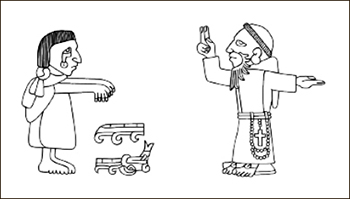
The Indians broke their idols before the priests
Financially it was foolhardy to convert because their many slaves, wives, and concubines provided wealth and comfort by raising crops, weaving, making blankets and other crafts, managing multi-households, and providing other services. Yet, they did so because they were convinced that they had found the truth and that Baptism was the portal to a Paradise they had longed for but could not find.
In conclusion, the book is not a novel and one must not approach it as such, or one will be sorely disappointed. It is much more technical, but the parts dealing with the Guadalupe event and some of the cultural aspects are fascinating. One can either plow through the rest – or skip over it, as one of my friends did.
What is interesting is to learn how Our Lady was instrumental in the salvation of millions of her children. It is also a hopeful reminder of how God prepares the way and provides for people everywhere “to be saved and come to the knowledge of truth."
Posted April 27, 2026



______________________
______________________
 |
 |
 |
 |
 |
 |