Stories & Legends
 |
 |
 |
 |
 |
 |
 |
California’s Missions
The Midnight Mass at Carmel
Richard D. White was born in Ireland in 1843 and came to San Francisco as a young man. A gentleman of extensive reading and culture, he became enthused about the stories and legends of the days of cavaliers and padres, and rendered many into poems, which were published in a small tome entitled The Cross of Monterey in 1882.
"The Midnight Mass at Carmel” records a legend popular among the natives of the area, and was first published in The Monitor in 1906 (vol. 61, n. 18, February 10, 1906). Every year on November 4, the feast of St. Charles Borromeo, patron of the the Mission, Fr. Serra would return at midnight to say a midnight Mass.
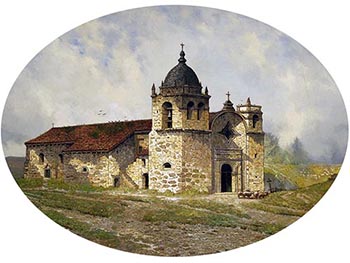
At that time the old Mission San Carlos Borromeo lay in ruins. The full scale renovation only began in 1936. Mr. White captured the rich spirit that still hovered over the remains of the Mission church built by Fr. Serra, the second Mission in the series of nine that he would install. It was Fr. Serra's favorite for its beauty reminded him of his home on the Island of Mallorca, Spain.
"The Midnight Mass at Carmel” records a legend popular among the natives of the area, and was first published in The Monitor in 1906 (vol. 61, n. 18, February 10, 1906). Every year on November 4, the feast of St. Charles Borromeo, patron of the the Mission, Fr. Serra would return at midnight to say a midnight Mass.
At that time the old Mission San Carlos Borromeo lay in ruins. The full scale renovation only began in 1936. Mr. White captured the rich spirit that still hovered over the remains of the Mission church built by Fr. Serra, the second Mission in the series of nine that he would install. It was Fr. Serra's favorite for its beauty reminded him of his home on the Island of Mallorca, Spain.
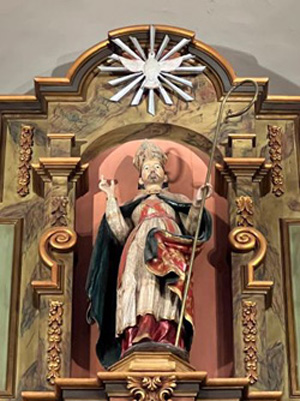
The statue of St. Charles Borromeo on the retablo in the present day Basilica
Builded by Carmelo’s Bay,
There remains an ivied ruin
That is crumbling fast away.
In its tower the owl finds shelter,
In its sanctuary grow
Rankest weeds above the earth mounds,
And the dead find rest below.
Still, by peasants at Carmelo,
Tales are told and songs are sung
Of Junípero the Padre
In the sweet Castilian tongue:
Telling how each year he rises
From his grave the Mass to say,
In the midnight, 'mid the ruins,
On the eve of Carlos’ day.
And they tell, when aged and feeble,
Feeling that his end was nigh,
To the Mission of San Carlos
Padre Serra came to die;
And he lay upon a litter
That the Franciscan friars bore,
And he bade them rest a moment
At the cloister’s open door.
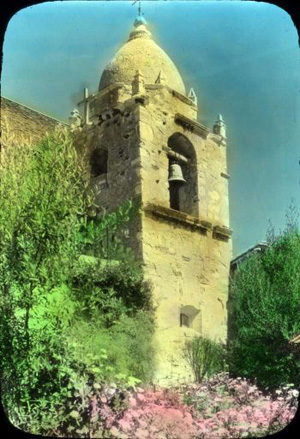
The bell tower of the the Carmel Basilica
That in beauty lay unrolled,
And he blessed the land as Francis
Blessed Assisi’s town of old;
And he spoke: "A hundred Masses
I will say that still may rest
God’s kindliest smile forever
On the land that I have blessed."
Ere a Mass was celebrated
Good Junípero had died,
And they laid him in the chancel,
On the altar's Gospel side.
But each year the Padre rises
From his grave the Mass to say,
In the midnight, 'mid the ruins,
On the eve of Carlos’ day.
Then the sad souls, long years buried,
From their lowly graves arise,
And, as if doom’s trump had sounded,
Each assumes his mortal guise;
And they come from San Juan's Mission,
From St. Francis by the bay,
From the Mission San Diego,
And the Mission San José.
And they came from Santa Clara,
And from Santa Cruz as well,
From the Mission of Sonoma,
And the Mission San Rafael.
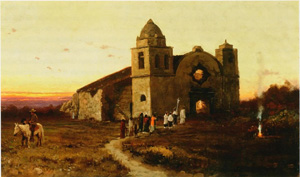
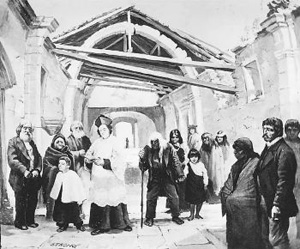
A Mass at the Mission in 1875; below, it was
a tradition to say a Mass on the Saint’s feastday at the ruins
They arise and swell the line
That along Camino Real
Journey to Carmelo’s shrine.
With their gaudy painted banners,
And their flambeaux burning bright,
In a long procession come they
Through the darkness and the night;
Singing hymns and swinging censers,
Shadowy forms - they onward pass
To the ivy-covered ruins,
To be present at the Mass.
And the grandsire, and the granddame
And their children march along,
And they know not one another
In that weird, unearthly throng.
And the youth and gentle maiden,
They who loved in days of yore,
Walk together now as strangers,
For the dead love nevermore.
In the church now all are gathered,
And not long have they to wait;
From his grave the Padre rises,
Midnight Mass to celebrate.
First he blesses all assembled.
Soldiers, Indians, acolytes;
Then he bows before the altar,
And begins the mystic rites.
When the Padre sings the Sanctus,
And the Host is raised on high,
Then the bells up in the belfry,
Swung by spirits, make reply;
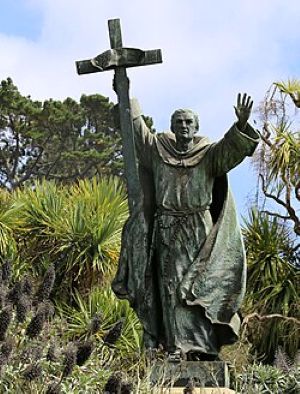
A statue of Fr. Junipero Serra at Carmel Mission
In the air a volley fire,
While the Salutaris rises
Grandly from the phantom choir.
“Ite, Missa est,” is spoken,
At the dawning of the day,
And the pageant strangely passes
From the ruins sere and gray;
And Junípero the Padre
Lying down, resumes his sleep,
And the tar-weeds, rank and noisome,
O’er his grave luxuriant creep.
And the lights upon the altar
And the torches cease to burn,
And the vestments and the banners
Into dust and ashes turn;
And the ghostly congregation
Cross themselves, and one by one,
Into thin air swiftly vanish,
And the Midnight Mass is done.
Envoy:
Ye who doubt what here is spoken,
And who would its truth gainsay,
Go and watch beside the ruins
On the eve of Carlos’ day.
And the sad souls when you see them,
In a long procession pass,
Be my warrant of this legend
Of Carmelo‘s Midnight Mass.



Posted May 30, 2026
______________________
______________________
 |
 |
 |
 |
 |
 |