Stories & Legends
 |
 |
 |
 |
 |
 |
 |
St. Anthony Drives the Moors Out of Oran
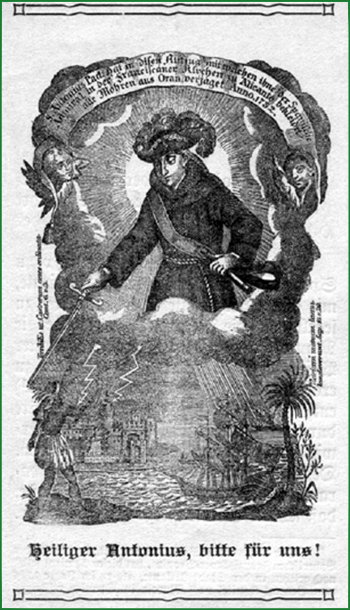
St. Anthony, favor us!
This Spanish conquest of Oran was made possible through the intercession of St. Anthony, who worked a great miracle, which I will now relate to the readers.
The King of Spain Philip V had ordered one of his Admirals to sail across the sea and recapture the fortress of Oran in Algeria, which the Moors had unjustly held for so many years. The Admiral, the Duke of Montemar, explained to the King that it was impossible to capture the well-guarded fortress, which was considered impregnable.
Nevertheless, the King insisted. The Admiral acquiesced, bowed to the Sovereign, and rejoined his fleet, which was ready to set sail. He ordered the crew to hoist the sails and set off for the port of Alicante, where the great fleet would assemble.
As he reviewed his well-ordered plan, he foresaw the utter impossibility of wresting such a heavily fortified city from the enemy. Therefore, he went into the city to visit its Franciscan Church in order to commend this momentous undertaking to the infinite God and to St. Anthony of Padua, the patron of that house of worship. After his prayer, he visited the friary and asked the Father Guardian to celebrate a Mass for his intention in honor of St. Anthony.
When the Mass had ended, the Father Guardian and several other friars came to pay their respects to the Admiral. In the presence of many onlookers, the Admiral asked the Father Guardian to bring a ladder and place it against the high altar, upon which stood a beautifully carved, life-sized statue of St. Anthony. At first, the Father General smiled, as if the Admiral were jesting, but the Duke of Montemar insisted with the utmost seriousness and zeal. The ladder was fetched and placed beneath the statue.
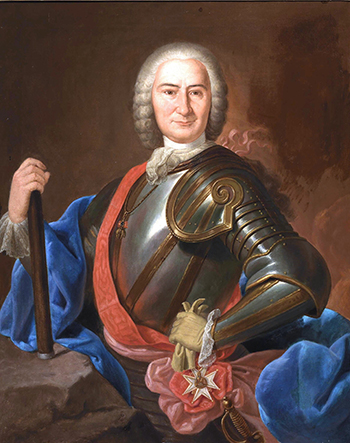
José Carrillo de Albornoz, Duke of Montemar, leader of the expedition
Then, in a loud voice and before the entire populace, he declared: "It is you – only you, Oh St. Anthony! - who can capture Oran; I am not capable of it."
Placing his hand upon the head of St. Anthony, he continued: "O St. Anthony! From this moment on, you are the Admiral and I am your servant and soldier. As such, I stand under your command and await your orders. After God, my trust rests entirely in you, Oh great worker of miracles!"
Having said this, he descended the ladder, proceeded with full confidence to his fleet, and embarked. As a favorable wind drove his ships closer to the hostile city, the men – torn between fear and hope – braced themselves for the greeting of enemy fire.
When nothing was heard, the Admiral ordered his soldiers to fire their cannons. Still, there was silence. He then ordered the troops to disembark and go ashore. To their great astonishment, they saw no enemy anywhere. Indeed, to their even even greater wonder – the city gates stood wide open.
Uncertain whether this was just a ruse of the enemy, the Admiral ordered his troops to enter the city with the utmost caution. Yet, here too all was silent and deserted; not a single enemy was to be seen.
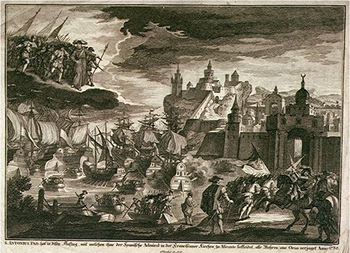
St. Anthony with an army from Heaven expels the Moors from Oran, c. 1732
"As soon as the Christian fleet came into view, everyone became terrified to see an innumerable army in the air that accompanied it. Its commander-in-chief was a Franciscan Friar clad in the Admiral’s insignia, wearing a Spanish hat adorned with feathers, wielding a sword at his side and carrying a baton of command in his hand. This Friar threatened the city with total destruction.
“At this sight, everyone – great and small, young and old – fled in great haste, leaving everything behind them.”
Thus, the renowned and mighty fortified city of Oran fell into the hands of the Admiral, the Duke of Montemar, without any resistance or loss of lives on the Christian side. The Admiral was filled with an unspeakable joy at such an unexpected and extraordinary victory. He made utmost haste to report this miraculous event to his King.
The statue of St. Anthony, adorned with the aforementioned military insignia could be seen for many years afterwards in Alicante. This miracle occurred on the Feast of St. Anthony in 1732, and the facts were officially confirmed in Rome in 1770.
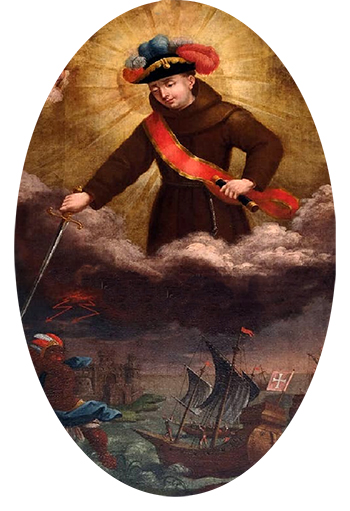
St. Anthony accepted the Admiralship
& won the victory
Adapted from the booklet published by Fel. Rauch in Innsbruck,
Scheyring, Saint Anthony of Padua, the Wonder-Worker, and His Veneration
(Scheyring, Der heilige Wundersmann Antonius von Padua und seine Verehrung )
Posted July 25, 2026
Scheyring, Saint Anthony of Padua, the Wonder-Worker, and His Veneration
(Scheyring, Der heilige Wundersmann Antonius von Padua und seine Verehrung )
Posted July 25, 2026




______________________
______________________
 |
 |
 |