Fr. Joseph Gelineau (1920-2008) was a Jesuit priest, a preferred member of Bugnini’s Consilium, the Pontifical Commission established to implement Vatican II’s liturgical directives. His words about the New Mass can thus be said to carry the weight of Consilium's authority.
In this excerpt from his essay, Tomorrow the Liturgy, he states that the New Mass destroyed the Roman Rite, transforming it into a completely different liturgy.
“In truth, it is a different liturgy of the Mass. This must be stated without ambiguities: The Roman Rite as we knew it no longer exists. It is destroyed.”
He also explains how those changes were prepared and declares that the original Roman Rite will never return.
Below, our translation from the French original.
On the eve of the Council, the vast edifice of Roman rites seemed capable of withstanding the centuries to come. At least, that was what most Catholics – bishops and laity alike – believed.
Slowly built up through the life of local churches and the sharing of their distinctive customs; gradually unified throughout the Roman Church following the Council of Trent; increasingly encumbered with meticulous prescriptions and prohibitions by rubricists; ideologically exalted by the revival of liturgical piety initiated by Dom Guéranger and Saint Pius X; firmly upheld through the publication of liturgical books ... this edifice appeared unassailable. Yet, it was riddled with serious cracks.
The absolute nature of a rubric ... can persist for a time and up to a point by appealing to "obedience to the Church" and by virtue of the aura of the "sacred" naturally inherent in the rite. But when such practices end up stifling prayer or reaching a certain level of absurdity, people eventually recall that just as the Sabbath was made for man and not man for the Sabbath, so also are rites made for people, not people for rites. Once such a critique takes hold ... the process becomes unstoppable. ...
The most dramatic instance is that of the Latin language, to which the chant repertoire was inextricably linked; upon this repertoire, in turn, depended the temporal unfolding – verbal, sonic, ceremonial and visual – of the liturgy, all of which combined to create the overall image of the rite. Let there be no mistake: Translating is not simply saying the same thing using equivalent words; it is a matter of changing the form. Yet, liturgy is not merely a vehicle for information or instruction where only the content matters; it is a symbolic action enacted through meaningful "forms." If the forms change, the rite changes. If a single element is altered, the entire structure of meaning is transformed. Let those who, like me, experienced and celebrated the High Mass sung in Latin and Gregorian chant recall it – if they can. Let them compare it with the current post-Vatican II Mass. It is not only the words, the melodies and certain gestures that differ.
In truth, it is a different liturgy of the Mass. This must be stated without ambiguities: The Roman rite as we knew it no longer exists. It is destroyed. The walls of the original edifice have fallen, while others have changed in appearance to the point that the structure today resembles either the ruins or the partial foundation of another building.
The point is neither to weep over the ruins nor to dream of a historical reconstruction. Liturgical renewal is a manifestation of the Church’s will to live – much like missionary or biblical renewals. When the poor are starving because no one breaks the bread of the Word for them, something must be done. ...
However, it would be a mistake to equate this liturgical renewal solely to the reform of rites mandated by Vatican II. This reform has much deeper roots and extends far beyond that specific event. Liturgy is a work in progress. The fact that the rites ... had eventually reached a state of near-total stagnation does not mean their evolution ended. Indeed, the current renewal was gradually prepared even within the context of that post-Tridentine fixation. ...
In another area, a significant shift was taking shape. Since the Middle Ages, the liturgy had been primarily a clerical act that the laity merely attended. Even cantors or altar servers had to be classified as clerics to serve as ministers of worship. Gradually, the baptized relearned that they, too, were "empowered for worship" – that they were not merely passive, silent spectators, but active participants in the celebration. The symbol of this growing awareness was the widespread adoption after the 1930s of the "dialogue Mass" – a development achieved only after a struggle against the “rubricists”.
The thirty years preceding the Council saw all these seeds begin to germinate. This was the "liturgical renewal" – what Pius XII called a "passing of the Holy Spirit through His Church." ... Many of the French hymns that still form the core of the repertoire for congregations today date back to that era. Without this ferment and long period of preparation, the Second Vatican Council’s reform would neither have been possible nor made sense.
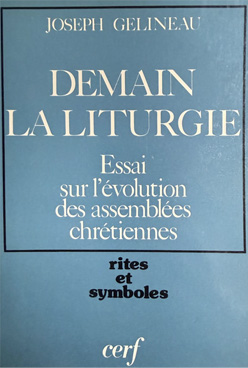
(Joseph Gelineau, Demain La Liturgie: Essai sur l'évolution
des assemblées chrétiennes, Paris: Les Éditions du CERF, 1976, pp. 8-12)
|

|
|