Documents for your files
 |
PROGRESSIVIST DOCUMENTS
Bishop Fellay:
'Accepting Vatican II is not a problem for us'
'Accepting Vatican II is not a problem for us'
On May 11, 2001, Bishop Fellay gave an interview to the Swiss daily La Liberté, in which he affirmed that it is not a problem for SSPX to accept Vatican II, and that they already accept 95% of it. The only disagreement they have with Rome, according to him, is not with the Council's documents, but only with their interpretation.
These statements of Msgr. Fellay are more proof of the constant contradictions of SSPX since its beginnings: in 1965 Msgr. Marcel Lefebvre signed all the documents of Vatican II; immediately after the Council, he exhorted his followers to study Vatican II with devotion because they will derive many graces from it, right reasoning and guidance for their apostolates: later, Lefebvre pretended to be against the Council in his book I Accuse the Council; later on, he contradicted himself yet again when he stated he accepted the Council interpreted "in light of tradition." In 2021 ambiguous statements have been made by Fr. Davide Pagliarani in which he insinuated that SSPX rejects Vatican II, when in reality it does not. Even SSPX itself has stated this on its own website.
The interview published on La LIberté confirms that SSPX is not against Vatican II.
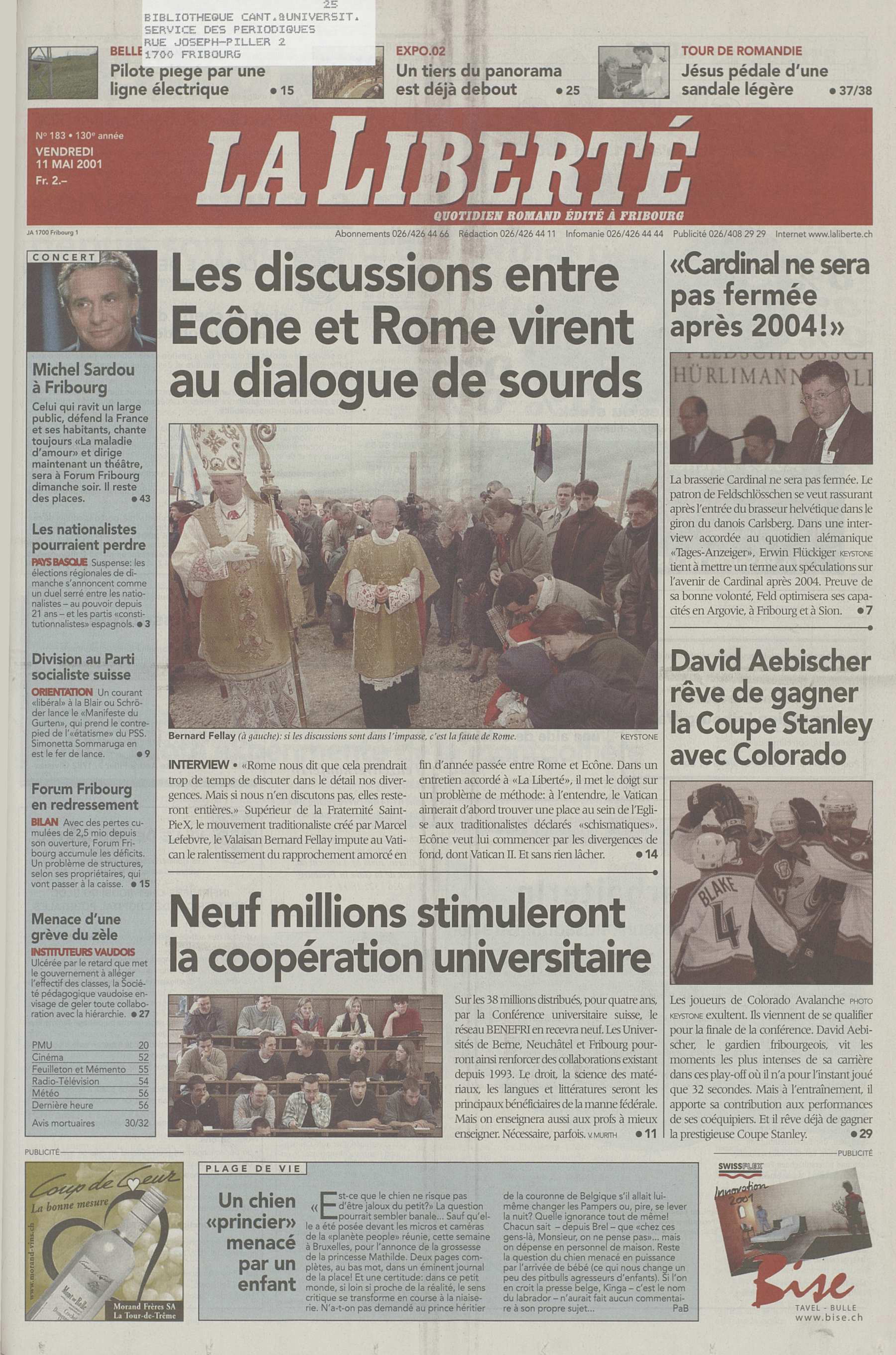
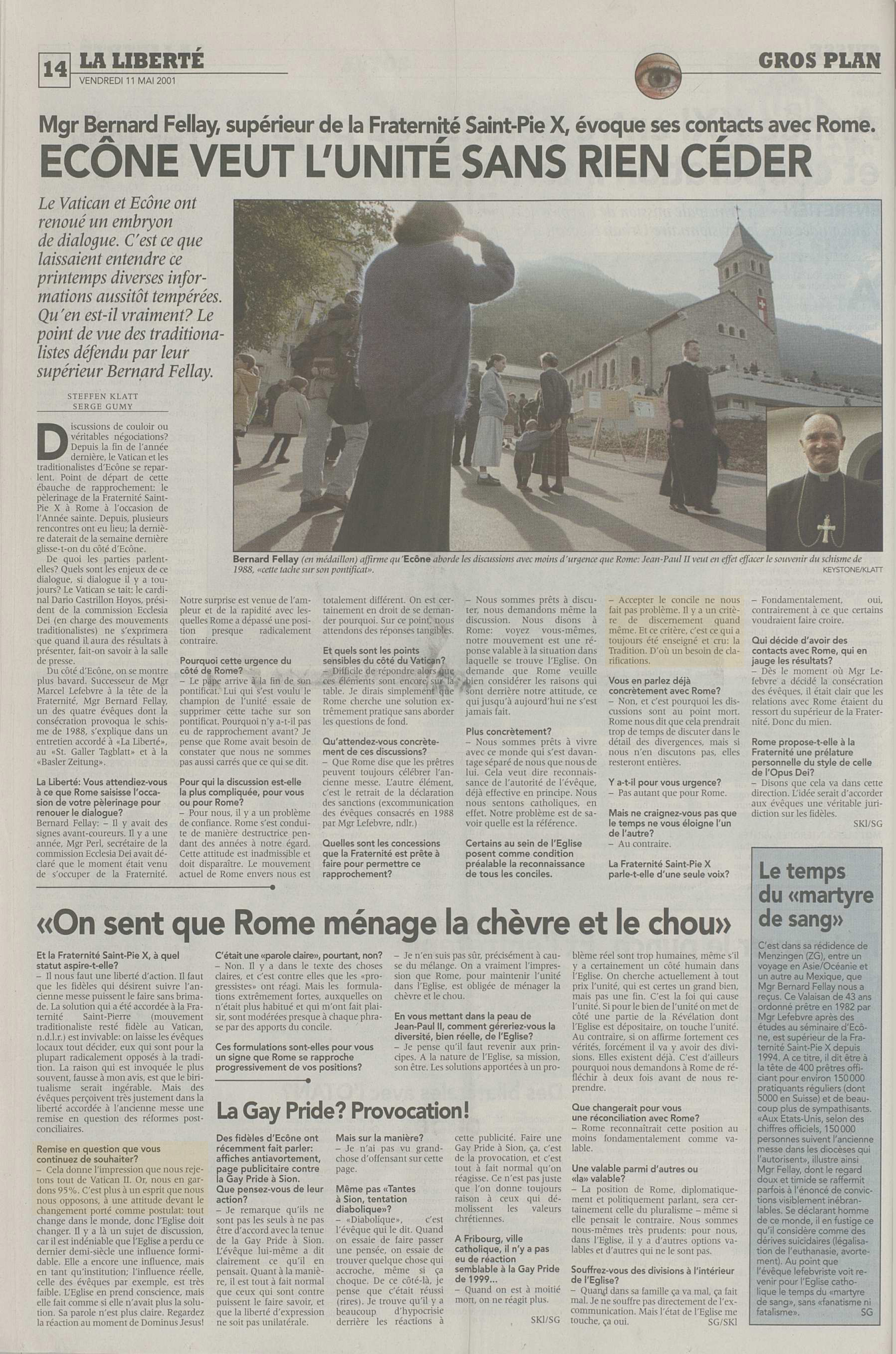
Below, we provide a complete English translation of the article's original French, for the benefit of our readers. The questions by the journalist will be in italics; the bold is ours corresponding to the yellow parts in the newspaper. The important parts are highlighted in yellow in the scanned picture of the newspaper, below right.
Notes on the source and numbering: The original newspaper scan can be found in the Swiss National Library's online newspaper archive here. A downloadable PDF file of the full newspaper from that day can be accessed here. The pages in question are page 1 and 28 according to the PDF's numbering, and page 1 and 14 according to the newspaper's numbering.
La Liberté
May 11, 2001 - First page – Headline
The discussions between Econe and Rome becomes a dialogue of the deaf
Interview - "Rome tells us that discussing our differences in detail would take too much time. But if we do not discuss them, they will remain entirely unresolved." As Superior of the Society of Saint Pius X – the traditionalist movement founded by Marcel Lefebvre – Bernard Fellay, a native of the Swiss canton of Valais, addresses the slowdown in the rapprochement initiated late last year between Rome and Ecône to the Vatican. In an interview granted to La Liberté, he pinpoints a problem regarding methodology: As he sees it, the Vatican would prefer first to find a place inside the Church for the traditionalists declared "schismatic." Ecône, for its part, wishes to begin by addressing the background differences – including those concerning Vatican II. And without any concessions.
- Page 14 -
Headline
Msgr. Bernard Fellay, superior general of the Society St. Pius X, talks about its contacts with Rome
ECONE WANTS UNITY WITHOUT MAKING ANY CONCESSION
The Vatican and Econe restarted a dialogue. It is what many reports, soon denied, told us. What is really happening? Here is the traditionalists' perspective defended by their superior Bernard Fellay.
Stephan Klatt | Serge Gumy
Corridor conversations or genuine negotiations? Since the end of last year, the Vatican and the traditionalists of Ecône have been speaking to one another again. The starting point for this tentative rapprochement was the visit of the Society of Saint Pius X delegation to Rome during the Holy Year. Since then, several meetings have taken place; the most recent, sources in Ecône suggest, reportedly occurred just last week.
What are the parties discussing? What is at stake in this dialogue – assuming, that is, that a dialogue is still actually taking place? The Vatican remains silent: Cardinal Dario Castrillón Hoyos, President of the Ecclesia Dei Commission (responsible for traditionalist movements), will not speak until he has concrete results to present, the Press Office has indicated.
On the side of Ecône, however, people are more talkative. As the successor to Archbishop Marcel Lefebvre at the head of the Fraternity, Bishop Bernard Fellay – one of the four bishops whose consecration triggered the schism of 1988 – offers his perspective in an interview granted to La Liberté, the St. Galler Tagblatt, and the Basler Zeitung.
La Liberté: Did you expect Rome to seize the opportunity presented by your pilgrimage to reopen dialogue?
Bernard Fellay: There were warning signs. A year ago, Msgr. Perl, Secretary of the Ecclesia Dei Commission, stated that the time had come to address the issue of the Fraternity. Our surprise stemmed from the magnitude and speed with which Rome moved past a position that had previously been almost radically opposed.
L – Why this sense of urgency on Rome's part?
BF – The Pope is nearing the end of his pontificate. As someone who has sought to be a champion of unity, he is attempting to remove this blemish from his pontificate. Why was there no rapprochement sooner? I believe Rome needed to see for itself that we are not quite as rigid as we are often portrayed.
L – For whom are the discussions more complicated – for you, or for Rome?
BF – For us, there is a trust issue. For years, Rome has acted toward us in a destructive manner. This attitude is unacceptable and must cease. Rome’s current approach toward us is completely different. One is certainly entitled to ask why. On this point, we are awaiting tangible answers.
L – And what are the sensitive points on the Vatican's side?
BF – It is difficult to answer while these matters are still on the table. I would simply say that Rome is seeking an extremely practical solution without addressing the substantive issues.
L – What, specifically, do you expect from these discussions?
BF – That Rome state that priests may continue to celebrate the Old Mass. The other element is the lifting of the declaration of sanctions (the excommunication of the bishops consecrated in 1988 by Archbishop Lefebvre – Ed.).
L – What concessions is the Society prepared to make to facilitate this reconciliation?
BF – We are prepared to engage in dialogue; indeed, we are asking for it. We say to Rome: look for yourselves at the situation in which our movement finds the Church. We ask that Rome be willing to consider the reasons underlying our stance – something that, until now, has never been done.
L – More specifically?
BF – We are prepared to live within this world – a world that has drifted further away from us than we have from it. This implies recognizing the authority of the local bishop – something that, in principle, is already in effect. We do, after all, consider ourselves Catholic. Our problem lies in determining the proper point of reference.
L – Some within the Church have set the recognition of all Church councils as a precondition.
BF – Accepting the Council poses no problem for us. However, there is a criterion for discernment. And that criterion is what has always been taught and believed: Tradition. Hence the need for clarification.
L –Are you already discussing this specifically with Rome?
BF – No, and that is why the discussions have stalled. Rome tells us that it would take too long to discuss our differences in detail; yet, if we do not discuss them, they will remain unresolved.
L – Do you consider this a matter of urgency?
BF – Not as much as Rome does.
L – But do you not fear that the passage of time might drive you further apart?
BF – On the contrary.
L – Does the Society of Saint Pius X speak with one voice?
BF – Fundamentally, yes – contrary to what some would have people believe.
L –Who decides to initiate contact with Rome, and who evaluates the results?
BF – From the moment Archbishop Lefebvre decided to consecrate the bishops, it was clear that relations with Rome fell within the purview of the Society’s Superior. That is to say, my own.
L – Is Rome proposing a personal prelature to the Society – one modeled after that of Opus Dei?
BF – Let’s just say things are moving in that direction. The idea would be to grant the bishops genuine jurisdiction over the faithful.
L – And what status does the Society of Saint Pius X aspire to?
BF – We require freedom of action. The faithful who wish to attend the old Mass must be able to do so without harassment. The solution granted to the Priestly Fraternity of Saint Peter (a traditionalist movement that remained faithful to the Vatican – Ed.) is unworkable: it leaves everything to the discretion of local bishops – most of whom are radically opposed to Tradition. The most frequently cited reason – which, in my opinion, is a false on – is that "bi-ritualism" is unmanageable. However, some bishops rightly perceive the freedom granted to the old Mass as a challenge to the post-conciliar reforms.
L – A challenge that you continue to hope for?
BF – That gives the impression that we reject "everything" from Vatican II. In fact, we retain 95 percent of it. It is less an idea than a mindset we are opposing – an attitude toward change that is treated as a postulate: Everything in the world changes, therefore the Church must change. This is certainly a matter for debate, for it is undeniable that, over the last half-century, the Church has lost a tremendous amount of influence. It still retains some influence, but primarily as an institution; its "actual" influence – that of the bishops, for instance – s now very weak. The Church is becoming aware of this, yet it acts as if it no longer possesses the solution. Its voice is no longer clear. Just look at the reactions to Dominus Iesus.
L – Yet that was a "clear statement," wasn't it?
BF – No. There are indeed clear elements within the text – and it was precisely against those elements that the "progressives" reacted. However, the extremely forceful formulations – phrasing to which we had grown unaccustomed, and which I personally welcomed – are tempered, almost in every sentence, by references to the Council.
L – Do you view these formulations as a sign that Rome is gradually moving closer to your own positions?
BF – I am not sure – precisely because of that mixture. One gets the distinct impression that Rome, in its effort to maintain unity within the Church, feels compelled to try to have it both ways – to appease all sides.
L – If you were to put yourself in the shoes of John Paul II, how would you manage the very real diversity that exists within the Church?
BF – I believe we must return to fundamental principles: to the nature of the Church – its mission, its very essence. The solutions currently being applied to this genuine problem are far too human in nature – even though, of course, there is certainly a human dimension to the Church. At present, there is an all-consuming quest for unity – which is, admittedly, a great good, but not an end in itself. It is *faith* that creates unity. If, for the sake of unity, one sets aside a portion of the Revelation of which the Church is the custodian, one ultimately undermines that very unity. On the contrary, if we strongly affirm these truths, divisions are bound to arise. They already exist, in fact. That is precisely why we ask Rome to think twice before reprimanding us.
L – What would a reconciliation with Rome change for you?
BF – Rome would recognize this position – at least fundamentally – as valid.
L – Valid as one option among others, or the valid one?
BF – Rome’s position – diplomatically and politically speaking – will almost certainly be one of pluralism, even if they privately believe otherwise. We ourselves are very cautious: in our view, within the Church, there are certain options that are valid, and others that are not.
L – Do you suffer from the divisions within the Church?
BF – When things go wrong in one’s own family, it hurts. I do not suffer directly from the excommunication itself. But the current state of the Church – that, yes, affects me deeply.
These statements of Msgr. Fellay are more proof of the constant contradictions of SSPX since its beginnings: in 1965 Msgr. Marcel Lefebvre signed all the documents of Vatican II; immediately after the Council, he exhorted his followers to study Vatican II with devotion because they will derive many graces from it, right reasoning and guidance for their apostolates: later, Lefebvre pretended to be against the Council in his book I Accuse the Council; later on, he contradicted himself yet again when he stated he accepted the Council interpreted "in light of tradition." In 2021 ambiguous statements have been made by Fr. Davide Pagliarani in which he insinuated that SSPX rejects Vatican II, when in reality it does not. Even SSPX itself has stated this on its own website.
The interview published on La LIberté confirms that SSPX is not against Vatican II.
Below, we provide a complete English translation of the article's original French, for the benefit of our readers. The questions by the journalist will be in italics; the bold is ours corresponding to the yellow parts in the newspaper. The important parts are highlighted in yellow in the scanned picture of the newspaper, below right.
Notes on the source and numbering: The original newspaper scan can be found in the Swiss National Library's online newspaper archive here. A downloadable PDF file of the full newspaper from that day can be accessed here. The pages in question are page 1 and 28 according to the PDF's numbering, and page 1 and 14 according to the newspaper's numbering.
May 11, 2001 - First page – Headline
The discussions between Econe and Rome becomes a dialogue of the deaf
Interview - "Rome tells us that discussing our differences in detail would take too much time. But if we do not discuss them, they will remain entirely unresolved." As Superior of the Society of Saint Pius X – the traditionalist movement founded by Marcel Lefebvre – Bernard Fellay, a native of the Swiss canton of Valais, addresses the slowdown in the rapprochement initiated late last year between Rome and Ecône to the Vatican. In an interview granted to La Liberté, he pinpoints a problem regarding methodology: As he sees it, the Vatican would prefer first to find a place inside the Church for the traditionalists declared "schismatic." Ecône, for its part, wishes to begin by addressing the background differences – including those concerning Vatican II. And without any concessions.
Headline
ECONE WANTS UNITY WITHOUT MAKING ANY CONCESSION
The Vatican and Econe restarted a dialogue. It is what many reports, soon denied, told us. What is really happening? Here is the traditionalists' perspective defended by their superior Bernard Fellay.
Stephan Klatt | Serge Gumy
Corridor conversations or genuine negotiations? Since the end of last year, the Vatican and the traditionalists of Ecône have been speaking to one another again. The starting point for this tentative rapprochement was the visit of the Society of Saint Pius X delegation to Rome during the Holy Year. Since then, several meetings have taken place; the most recent, sources in Ecône suggest, reportedly occurred just last week.
What are the parties discussing? What is at stake in this dialogue – assuming, that is, that a dialogue is still actually taking place? The Vatican remains silent: Cardinal Dario Castrillón Hoyos, President of the Ecclesia Dei Commission (responsible for traditionalist movements), will not speak until he has concrete results to present, the Press Office has indicated.
On the side of Ecône, however, people are more talkative. As the successor to Archbishop Marcel Lefebvre at the head of the Fraternity, Bishop Bernard Fellay – one of the four bishops whose consecration triggered the schism of 1988 – offers his perspective in an interview granted to La Liberté, the St. Galler Tagblatt, and the Basler Zeitung.
La Liberté: Did you expect Rome to seize the opportunity presented by your pilgrimage to reopen dialogue?
Bernard Fellay: There were warning signs. A year ago, Msgr. Perl, Secretary of the Ecclesia Dei Commission, stated that the time had come to address the issue of the Fraternity. Our surprise stemmed from the magnitude and speed with which Rome moved past a position that had previously been almost radically opposed.
L – Why this sense of urgency on Rome's part?
BF – The Pope is nearing the end of his pontificate. As someone who has sought to be a champion of unity, he is attempting to remove this blemish from his pontificate. Why was there no rapprochement sooner? I believe Rome needed to see for itself that we are not quite as rigid as we are often portrayed.
L – For whom are the discussions more complicated – for you, or for Rome?
BF – For us, there is a trust issue. For years, Rome has acted toward us in a destructive manner. This attitude is unacceptable and must cease. Rome’s current approach toward us is completely different. One is certainly entitled to ask why. On this point, we are awaiting tangible answers.
L – And what are the sensitive points on the Vatican's side?
BF – It is difficult to answer while these matters are still on the table. I would simply say that Rome is seeking an extremely practical solution without addressing the substantive issues.
L – What, specifically, do you expect from these discussions?
BF – That Rome state that priests may continue to celebrate the Old Mass. The other element is the lifting of the declaration of sanctions (the excommunication of the bishops consecrated in 1988 by Archbishop Lefebvre – Ed.).
L – What concessions is the Society prepared to make to facilitate this reconciliation?
BF – We are prepared to engage in dialogue; indeed, we are asking for it. We say to Rome: look for yourselves at the situation in which our movement finds the Church. We ask that Rome be willing to consider the reasons underlying our stance – something that, until now, has never been done.
L – More specifically?
BF – We are prepared to live within this world – a world that has drifted further away from us than we have from it. This implies recognizing the authority of the local bishop – something that, in principle, is already in effect. We do, after all, consider ourselves Catholic. Our problem lies in determining the proper point of reference.
L – Some within the Church have set the recognition of all Church councils as a precondition.
BF – Accepting the Council poses no problem for us. However, there is a criterion for discernment. And that criterion is what has always been taught and believed: Tradition. Hence the need for clarification.
L –Are you already discussing this specifically with Rome?
BF – No, and that is why the discussions have stalled. Rome tells us that it would take too long to discuss our differences in detail; yet, if we do not discuss them, they will remain unresolved.
L – Do you consider this a matter of urgency?
BF – Not as much as Rome does.
L – But do you not fear that the passage of time might drive you further apart?
BF – On the contrary.
L – Does the Society of Saint Pius X speak with one voice?
BF – Fundamentally, yes – contrary to what some would have people believe.
L –Who decides to initiate contact with Rome, and who evaluates the results?
BF – From the moment Archbishop Lefebvre decided to consecrate the bishops, it was clear that relations with Rome fell within the purview of the Society’s Superior. That is to say, my own.
L – Is Rome proposing a personal prelature to the Society – one modeled after that of Opus Dei?
BF – Let’s just say things are moving in that direction. The idea would be to grant the bishops genuine jurisdiction over the faithful.
L – And what status does the Society of Saint Pius X aspire to?
BF – We require freedom of action. The faithful who wish to attend the old Mass must be able to do so without harassment. The solution granted to the Priestly Fraternity of Saint Peter (a traditionalist movement that remained faithful to the Vatican – Ed.) is unworkable: it leaves everything to the discretion of local bishops – most of whom are radically opposed to Tradition. The most frequently cited reason – which, in my opinion, is a false on – is that "bi-ritualism" is unmanageable. However, some bishops rightly perceive the freedom granted to the old Mass as a challenge to the post-conciliar reforms.
L – A challenge that you continue to hope for?
BF – That gives the impression that we reject "everything" from Vatican II. In fact, we retain 95 percent of it. It is less an idea than a mindset we are opposing – an attitude toward change that is treated as a postulate: Everything in the world changes, therefore the Church must change. This is certainly a matter for debate, for it is undeniable that, over the last half-century, the Church has lost a tremendous amount of influence. It still retains some influence, but primarily as an institution; its "actual" influence – that of the bishops, for instance – s now very weak. The Church is becoming aware of this, yet it acts as if it no longer possesses the solution. Its voice is no longer clear. Just look at the reactions to Dominus Iesus.
L – Yet that was a "clear statement," wasn't it?
BF – No. There are indeed clear elements within the text – and it was precisely against those elements that the "progressives" reacted. However, the extremely forceful formulations – phrasing to which we had grown unaccustomed, and which I personally welcomed – are tempered, almost in every sentence, by references to the Council.
L – Do you view these formulations as a sign that Rome is gradually moving closer to your own positions?
BF – I am not sure – precisely because of that mixture. One gets the distinct impression that Rome, in its effort to maintain unity within the Church, feels compelled to try to have it both ways – to appease all sides.
L – If you were to put yourself in the shoes of John Paul II, how would you manage the very real diversity that exists within the Church?
BF – I believe we must return to fundamental principles: to the nature of the Church – its mission, its very essence. The solutions currently being applied to this genuine problem are far too human in nature – even though, of course, there is certainly a human dimension to the Church. At present, there is an all-consuming quest for unity – which is, admittedly, a great good, but not an end in itself. It is *faith* that creates unity. If, for the sake of unity, one sets aside a portion of the Revelation of which the Church is the custodian, one ultimately undermines that very unity. On the contrary, if we strongly affirm these truths, divisions are bound to arise. They already exist, in fact. That is precisely why we ask Rome to think twice before reprimanding us.
L – What would a reconciliation with Rome change for you?
BF – Rome would recognize this position – at least fundamentally – as valid.
L – Valid as one option among others, or the valid one?
BF – Rome’s position – diplomatically and politically speaking – will almost certainly be one of pluralism, even if they privately believe otherwise. We ourselves are very cautious: in our view, within the Church, there are certain options that are valid, and others that are not.
L – Do you suffer from the divisions within the Church?
BF – When things go wrong in one’s own family, it hurts. I do not suffer directly from the excommunication itself. But the current state of the Church – that, yes, affects me deeply.



______________________
______________________
 Volume I |
 Volume II |
 Volume III |
 Volume IV |
 Volume V |
 Volume VI |
 Volume VII |
 Volume VIII |
 Volume IX |
 Volume X |
 Volume XI |
 Special Edition |