Theology of History
 |
 |
 |
 |
 |
 |
 |
Egalitarianism - XIV
Some Souls Are Called to Command
by Their Nature
Note: Prof. Plinio gave this series of classes in 1957; today in 2026 we see how the egalitarianism in each of the fields he points out has increased and come to dominate almost completely. TIAIn this article we will consider a complementary point to the topic of how God governs the Universe through intermediary beings, which is how the preeminence of the cognitive faculty generates power.
In this respect I want to clarify that I would not in any way glorify intelligence for intelligence’s sake; this is not a matter of glorifying man. What is understood here by the cognitive faculty is certainly intelligence. But it is necessary to show that, due to a harmony that exists in the human soul and, above all, in Angels, a higher quality of intelligence brings as a natural consequence a higher quality of all the faculties of the soul.
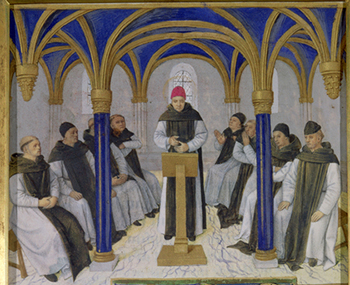
The Cistercians turned to St. Bernard
to resolve their delicate issues
In everything concerning the Church, the cognitive ability is not so much intelligence as in the Catholic sense. And it is precisely the Catholic sense that confers the right to command, much more than intelligence.
Let us take, for example, a religious association facing delicate problems. Who has the supreme right to lead this association? It is the one who, with the most refined Catholic sense, manages to keep the association on the path of solving problems. The true faculty of command is linked to this supernatural cognitive faculty, which is the Catholic sense.
Man's ‘capacity for provision’
There is a point that St. Thomas Aquinas emphasizes strongly and is so important to many of our positions that it is worth discussing.
St. Thomas demonstrates that man, being a reflection of God, has a kind of "providence" in his own terrain. God is extremely intelligent and endowed with an extremely powerful will. Because of this great intelligence and this great will, He is able to understand things as they should be and to accomplish them. Man, endowed with intelligence and will, is also able to understand and act. Thus, man has the power to organize and execute, which is an image of God’s Providence.
Man has his own providence, which is an extension of God’s Providence. And the greater the ‘providential capacity’ of man, the more he resembles God. Since the government of the universe is made by Divine Providence, those who participate most in this Providence and have the greatest intelligence, will and capacity to provide, will govern. Thus, it is justified that a greater capacity generates a true right to power.
The ‘intermediate being’ in the scale of beings
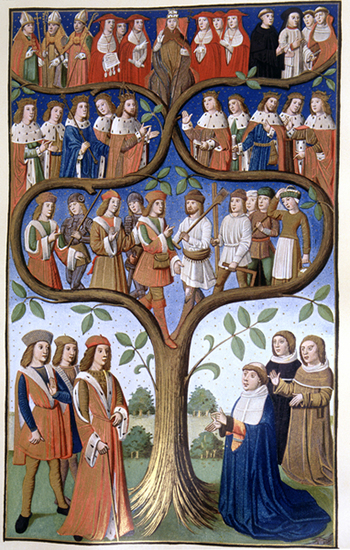
A presentation of medieval society as
the descending branches of a tree
What do we mean by intermediate being? Here, we are no longer dealing with the previous points, but analyzing what is harmonic in the Angelic Hierarchy. That hierarchy is composed of degrees, each of which is intermediate in relation to its superior choir and its inferior choir.
So, what is an intermediate being? It is a being that, compared to one of its sides, resembles the other.
For example, warm water when compared to cold water seems hot, but when compared to hot water seems cold, because it is between hot and cold. Gray, when compared to white, seems similar to black but different; when compared to the black it looks white. (...)
Thus, it is the case to show:
- How the Angelic Hierarchy corresponds to the greatness of God;
- How harmony would be in the Angelic Hierarchy;
- The first point where God reserves for Himself a direct action, which is to create, to preserve and to give supernatural life.
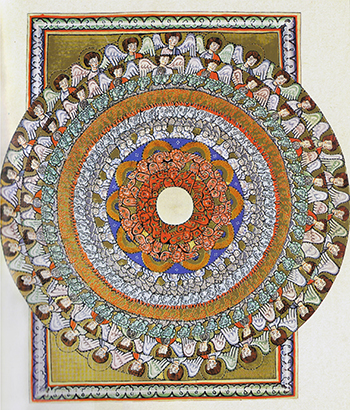
St. Hildegard von Bingen's depiction of
the nine choirs of Angels
In the Angelic Order, one can note that this principle of harmony is present. That is, we perceive a great uniformity in the way one choir descends from another, and there is a proportion in this process. That is to say, just as the highest Angels govern the others, the same occurs subsequently to the end. We have, therefore, a perfectly constituted hierarchy, a grand scale that obeys the rules of harmony intrinsic to each level.
Finally, let us remember the famous maxims of Fr. Henri Ramière that explain this so well: unity in variety, the extremes must be united by a true symmetry, etc. One finds that all the rules of Fr. Ramière adhere perfectly to this hierarchy of Angels.
God wants inequality, which is good & beautiful
What can be deduced from all this? Two things:
First, with regard to inequality, God desires inequality, and inequality finds its deepest meaning in the order of Providence.
Second, this inequality in itself is good and beautiful, and it is beautiful for reasons that also demonstrate the beauty of inequality in the Church and in the feudal order. Therefore, egalitarianism is evil, it is diabolical.
In the order of ideas, one question remains: Can we conclude that inequality is a good in itself? Is it good that creation in itself is unequal? Is inequality in itself a good thing? If this is true, then egalitarianism in itself is diabolical; if it is false, then egalitarianism is good.
St. Thomas analyzes this question, but in strictly philosophical terms. I will leave that for another article.
Continued
Posted May 25, 2026



______________________
______________________
 |
 |
 |