Theology of History
 |
 |
 |
 |
 |
 |
 |
Egalitarianism - XV
Heaven Is the Kingdom of Inequality
Note: Prof. Plinio gave this series of classes in 1957; today in 2026 we see how the egalitarianism in each of the fields he pointed out has increased and come to dominate almost completely. TIAReviewing what we have studied about egalitarianism, we can divide the matter into several parts.
In the first part, we considered the fact that we are facing a Revolution that wants absolute equality in all things because it considers inequality an evil. It is a Revolution that has given rise to political, economic and social achievements, but it is fundamentally inspired by a philosophical-religious thought. This thinking is against inequality as inequality, and in favor of equality as equality. It sees in all equality a good in itself, and sees in all manifestations of inequality an evil in itself.
I then went on to state the opposite thesis, that is, that God instituted inequality in Creation, and that, therefore, inequality, to the extent and in the sense that it was established by God, is a good in itself. This inequality fulfills the ends of Creation and, therefore, must be desired by man as something desired by God Himself.
Inequality in the Angelic Choirs
To justify this thesis, I made a description of inequality in Creation and noted what this inequality has to do with good.
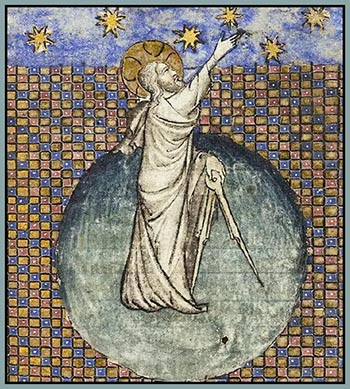
God the Son creating the stars
Thinking itself has three aspects; the operation, which is the work itself, is comprised of four aspects. St. Thomas noted how the three choirs of superior Angels are attuned to the three aspects of thinking; the four choirs of lower Angels are attuned to the stages of the operation.
Because of this, we have an organization, which is an organization with a capital "O," the Organization of Angels par excellence, attuned to the essence of thinking and the essence of action. Further, the Angels are not creatures placed in these various stages merely by a conventional designation of God.
Let us imagine that I needed some persons here to learn radio-telegraphy. I could choose them, and then the chosen ones could accept. So, I would have three radio-telegraphers who were not appointed for this work by virtue of an internal postulate of nature, which considers radio-telegraphy essential, but rather they were appointed due to circumstances of the moment.
Now then, with the Angels this does not happen. The Angel, by its nature, is made for the particular task that corresponds to his choir. Therefore, let us say that the Cherubim, by its nature and essence, is the one who performs the task of the Cherubim. He does not do another work: he "cherubizes." Each Angel has his proper and intrinsically essential task. With this we have an idea of how the inequality of the task is joined to the inequalities of beings considered in themselves.
Internal inequalities inside each Angelic Choir
It is easy to have a very incomplete idea of this inequality of the Angels.
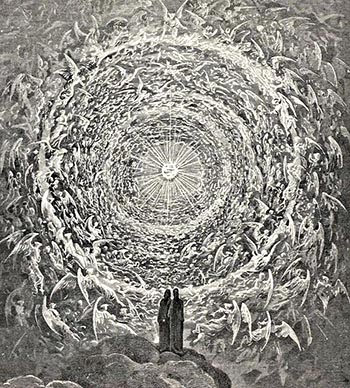
Gustave Doré presented the Nine Choirs in concentric circles; but he did not distinguish the immense differences inside each Choir
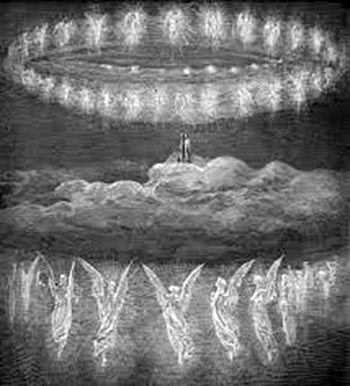
But he did not express the internal inequality existing within the various choirs of Angels. It would be an illusion to imagine that all the Seraphims are equal to one another. Even within these different circles, already so different from one another, there is inequality. This inequality, if it were not celestial, could be described as brutally striking.
The inequality that extends from man to man is an accidental inequality. In our essence we are all the same. That is not the case with the Angels. Each Angel is a species, and each Angel is different from another. It is not in the way a man is different from another, one race is different from another, one insect from another, or, even more radically, in the way that an insect differs from a plant.
Imagine a man who was alone in the human race. He would be different from all other beings. It is in this way that each Angel is different from the others. St. Thomas demonstrates that this inequality is necessary among the Angels.
In a species, by removing or adding something to it, the species changes. For example, let us consider the spoon as an object with a cavity and a handle, intended for introducing liquid food into the mouth. If I associate the spoon with a "shell," the result is that every time I use the shell like a spoon, it will no longer be a shell. If I imagine an object with a shell but no handle, this is not a spoon but a shell. If I imagine a handle without a shell, it could be anything except a shell since I removed one of the essential characteristics of the spoon, which it needs to be a spoon.
The same can be said of other objects. A mechanical clock, for example, is a device designed to mark time by means of a mechanism. If I imagine something that has the shape of a clock but has no mechanism, it is a kind of children's clock that moves when the child moves it, but stops when he puts it down. It is no longer a clock.
It has the appearance of a clock, but one of the essential elements has been removed: the ability to tell time. It becomes but a child’s toy, but not a clock. Imagine another object that tells time but has no mechanism, the sundial, for example. This could be a clock, but not a mechanical clock because it lacks one of the essential elements.
When I remove an essential element from a species, it transforms into another. And the Angels, each being a different species, certainly have something less or more than one another. Therefore, they cannot be equal, even the Angels inside the same choir.
Heaven, the realm of inequality
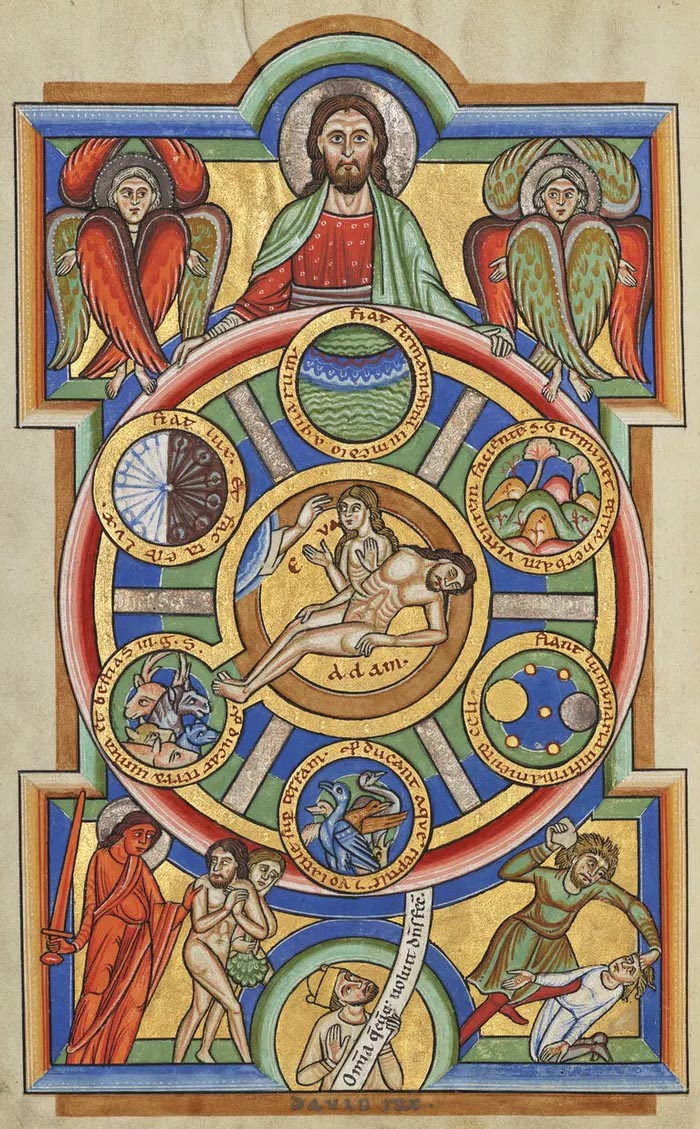
The six days of Creation & the Original Sin’s consequences
Below Heaven we have the earth, and below the Angels, men, who can be considered at the same time far below the Angels and, at the same, a little below them.
We find both expressions in the words of the Saints or in Holy Scriptures. The Holy Scripture says that man was placed just below the Angels. He has a very high dignity. On the other hand, when men see Angels, even those of the lowest category, they have an impression of such majesty that they feel far below them.
A problem we could raise is this: How would this inequality that I described among the Angels be established among men? That is, does this system of dividing the Angels by thought and action also prevail to establish inequalities among men?
We will enter into these questions in the next article.
Continued
Posted June 8-, 2026



______________________
______________________
 |
 |
 |