Traditionalist Issues
 |
 |
 |
 |
 |
 |
 |
Dialogue Mass - CLVI
True versus False Liturgical Reform
The Liturgical Movement did not derive from Dom Prosper Guéranger’s principles. His principles differed sharply from the 20th-century liturgical reformers on three key points:
“Translations of the Mass and of the Office in the vernacular are of a nature to cause this inconvenience that they isolate the faithful from the public prayer, under the pretext of associating them to it more intimately.” 2
Whether Dom Guéranger was correct in this particular or not, is not the issue here; but the grounds on which his opinion was based were indisputably true – that a vernacular rendering of the sublime mysteries celebrated in the liturgy is not essential to enable the faithful to participate spiritually in the Church’s public worship. To love the Faith of the Church is the indispensable requirement.
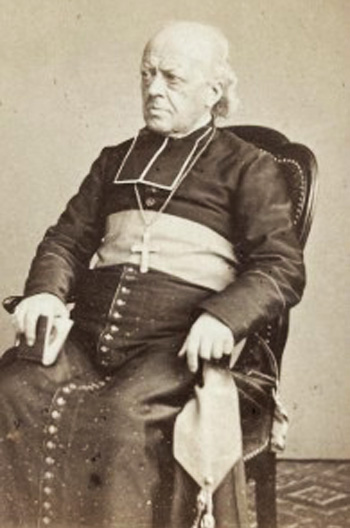 To this effect, he quoted from a letter written by Msgr. Parisis, Bishop of Langres, in 1846 on the participation of the faithful:
“What would be best for the faithful to do, whilst the priest sings, would be to adhere interiorly to his words, even without understanding them; to ask what he asks, even without knowing it; this is all that the first Christians did, first during all the centuries when the liturgy was transmitted only by oral tradition, and then for years afterward. It is the reason why, to the mysterious prayers recited in silence by the priest, they answered: Amen, so be it! an act of faith sublime in its simplicity.
“As if they had said: ‘We know not what is most desirable for us, but God knows; we know not what best glorifies the Lord, but the Church knows; now, it is the Church which has spoken, for it is in her name and as her special representative that the priest has spoken; it is the Church which has placed on his lips the prayers just said; we hold to them, whatever they be, for we cannot ask anything better than what the Church asks, we cannot say anything better than what the Church says: So be it, so be it! Amen! Amen!” 3
This fundamental principle of Catholic worship is no longer understood by the majority of Catholics today.
Pastoral solution
Unlike later reformers, Dom Guéranger did not consider the use of the vernacular to be an indispensable medium of comprehension; nor did he see Latin as an impediment to participation by those who did not understand the language. In his day, literal translations of the liturgical texts were neither permissible nor considered necessary. There were other alternatives with which to convey the meaning of the liturgy to the faithful, including his own pastoral initiative:
“In order to conform with the wishes of the Holy See, we do not give, in any of the volumes of our Liturgical Year, the literal translation of the Ordinary and Canon of the Mass; and have, in its place, endeavored to give, to such of the laity as do not understand Latin, the means of uniting, in the closest possible manner, with everything that the Priest says and does at the altar.” 4
True versus false renewal
To sum up, Dom Guéranger undertook a true renewal. He built up whereas neo-modernists tore down. He denounced Protestantism (“the sects”) as a false religion, but the progressivists worked toward assimilation with them. He facilitated the declaration of the Immaculate Conception and the decree on papal supremacy, whereas some of the influential reformers at Vatican II promoted Marian “minimalism” and collegiality. He promoted strict adherence to the official rubrics, but the progressivist reformers undid his work by promoting rubrical laxity, inculturation and diversity.
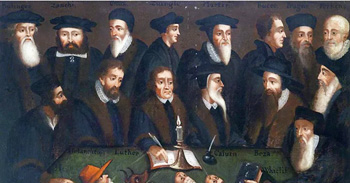 As we shall see in the following pages, the history of the Liturgical Movement from the beginning of the 20th century to the eve of Vatican II gives evidence that progressivist reformers followed an agenda of their own that had little, if anything, in common with the thought and work of Dom Guéranger. Even his insistence on the indispensable requirement for Gregorian Chant – which was the pride and joy of his founding work at Solesmes – found little echo among the neo-modernist reformers, apart from the few in the first half of the 20th century who merely paid it lip-service while conniving at its demise.
Paul VI’s endorsement quoted in a previous article when we started this analysis is not only a strain on our reasoning powers, but a betrayal of our inherited patrimony. For it was the triumph of the Liturgical Movement, enabled by Paul VI, wherein Tradition was sacrificed in the name of modernity, that brought about the self-destruction of Catholic liturgical life and piety which the same Pope famously remarked upon with these words:
“The Church finds herself in an hour of anxiety, a disturbed period of self-criticism, or what would even better be called self-demolition. It is an interior upheaval, acute and complicated.” 5
Continued

- As he explained in the Preface to his Défense des Institutions Liturgiques (1844), his aim was to restore the unity of the Roman Rite throughout France with the use of a single language of worship that excluded the Babel of vernacular versions. But that liturgical unity was shattered when Latin was replaced by a multiplicity of languages giving expression to the feelings of modern man; 1
- Dom Guéranger restored Gregorian Chant to its original and authentic form through the production of facsimiles of original manuscripts found in libraries throughout Europe. But all the painstaking and meticulous research was undertaken in vain as far as later reformers were concerned who pandered to modern tastes for mundane and sensuous music;
- He rejected the use of bi-lingual Missals in the hands of the laity ‒ a feature which ranked prominently in the demands of the later Benedictine reformers who produced vast quantities of them from their monasteries in Belgium.
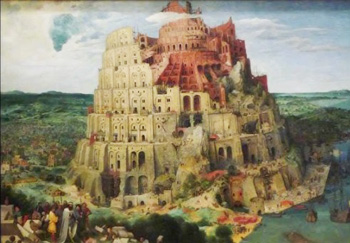
To abandon the Latin & adopt the vernacular
creates a Babel of languages
“Translations of the Mass and of the Office in the vernacular are of a nature to cause this inconvenience that they isolate the faithful from the public prayer, under the pretext of associating them to it more intimately.” 2
Whether Dom Guéranger was correct in this particular or not, is not the issue here; but the grounds on which his opinion was based were indisputably true – that a vernacular rendering of the sublime mysteries celebrated in the liturgy is not essential to enable the faithful to participate spiritually in the Church’s public worship. To love the Faith of the Church is the indispensable requirement.
Bishop Pierre Louis Parisis
“What would be best for the faithful to do, whilst the priest sings, would be to adhere interiorly to his words, even without understanding them; to ask what he asks, even without knowing it; this is all that the first Christians did, first during all the centuries when the liturgy was transmitted only by oral tradition, and then for years afterward. It is the reason why, to the mysterious prayers recited in silence by the priest, they answered: Amen, so be it! an act of faith sublime in its simplicity.
“As if they had said: ‘We know not what is most desirable for us, but God knows; we know not what best glorifies the Lord, but the Church knows; now, it is the Church which has spoken, for it is in her name and as her special representative that the priest has spoken; it is the Church which has placed on his lips the prayers just said; we hold to them, whatever they be, for we cannot ask anything better than what the Church asks, we cannot say anything better than what the Church says: So be it, so be it! Amen! Amen!” 3
This fundamental principle of Catholic worship is no longer understood by the majority of Catholics today.
Pastoral solution
Unlike later reformers, Dom Guéranger did not consider the use of the vernacular to be an indispensable medium of comprehension; nor did he see Latin as an impediment to participation by those who did not understand the language. In his day, literal translations of the liturgical texts were neither permissible nor considered necessary. There were other alternatives with which to convey the meaning of the liturgy to the faithful, including his own pastoral initiative:
“In order to conform with the wishes of the Holy See, we do not give, in any of the volumes of our Liturgical Year, the literal translation of the Ordinary and Canon of the Mass; and have, in its place, endeavored to give, to such of the laity as do not understand Latin, the means of uniting, in the closest possible manner, with everything that the Priest says and does at the altar.” 4
True versus false renewal
To sum up, Dom Guéranger undertook a true renewal. He built up whereas neo-modernists tore down. He denounced Protestantism (“the sects”) as a false religion, but the progressivists worked toward assimilation with them. He facilitated the declaration of the Immaculate Conception and the decree on papal supremacy, whereas some of the influential reformers at Vatican II promoted Marian “minimalism” and collegiality. He promoted strict adherence to the official rubrics, but the progressivist reformers undid his work by promoting rubrical laxity, inculturation and diversity.
If progressivists were consistent, they should adapt to each of the 51,314 Protestant sects existing today
Paul VI’s endorsement quoted in a previous article when we started this analysis is not only a strain on our reasoning powers, but a betrayal of our inherited patrimony. For it was the triumph of the Liturgical Movement, enabled by Paul VI, wherein Tradition was sacrificed in the name of modernity, that brought about the self-destruction of Catholic liturgical life and piety which the same Pope famously remarked upon with these words:
“The Church finds herself in an hour of anxiety, a disturbed period of self-criticism, or what would even better be called self-demolition. It is an interior upheaval, acute and complicated.” 5
Continued
- To reinforce his point, he quoted Gen. 11:1: "Erat autem terra labiis unius et sermonum eorundem!" (And the earth was of one tongue and the same speech). P. Guéranger, Défense des Institutions: Lettre à Mgr. l'Archêveque de Toulouse, Le Mans: Fleuriot, 1844, p. xiii.
- P. Guéranger, Institutions Liturgiques, Paris: Société Générale de Librairie Catholique, vol. 3, 1883, p. 167.
- Ibid.
- P. Guéranger, The Liturgical Year, Vol. 1, Advent, Dublin: James Duffy, 1870, p. 16.
- Paul VI, Address to Lombard Seminary, December 7, 1968, in Insegnamenti di Paolo VI (Teachings of Paul VI), Rome: Tipografia Poliglotta Vaticana, 1968, vol. VI, pp. 1188-1189.
Posted December 15, 2025


______________________
______________________
 Volume I |
 Volume II |
 Volume III |
 Volume IV |
 Volume V |
 Volume VI |
 Volume VII |
 Volume VIII |
 Volume IX |
 Volume X |
 Volume XI |
 Special Edition |