Traditionalist Issues
 |
 |
 |
 |
 |
 |
 |
Dialogue Mass - CLVII
The Sillon – Blueprint for Vatican II
In 1893, a group of college students, some still in their teens, their hearts afire with aspirations to change society, met regularly in the basement of Stanislas College which was run by the Marianist Order in Paris. The meetings, encouraged by two members of the Order, Fr. Joseph Leber and Brother Louis Cousin, were characterized by a mixture of politics and religion, but of a sort that would exclude, in principle, the traditional Catholic concept of an alliance of throne and altar. 1
Nothing less than Global Democracy was their aim, to be achieved through application of the revolutionary principles of “Liberty, Equality and Fraternity.”
Marc Sangnier’s adolescent army
Already we can see adumbrated the development of a type of civic and ecclesiastical government that would be canonized at Vatican II under the labels of Religious Liberty and separation of Church and State, both condemned by the previous Magisterium. Because of the atmosphere of secrecy in which their underground discussions were held, few people foresaw the looming danger in the plans they formulated which would involve the Church in the reorganization of the social and ecclesiastical order. Together, the radical group set up Study Circles among students and young workers, with priests in attendance, all participating on a basis of equality and learning from one another.
 In 1894, one of the original group, Paul Renaudin, inaugurated the Review, Le Sillon. Soon after, their Movement was launched in the public domain and took the name of the homonymous journal.
Marc Sangnier, an exceptionally talented speaker and organizer who came from a wealthy and privileged French Catholic family, emerged as their de facto leader. His charismatic personality, his oratorical skills and pretentious aspirations expressed in inflated rhetoric, his exceptional ability to engage and persuade his listeners, his unbounded zeal for a new Christendom, moved crowds of workers as well as intellectuals who heard him speak, and even moved some Bishops to give him their support.
From his own self-portrait as a young man totally consumed by an insatiable thirst for “Social Justice,” he came across as a Quixotic figure, tilting at the windmills of modern society in an effort to right the wrongs of the world. It is undeniable that he depicted himself, in a language spiced with unrestrained rodomontades and rhetorical flights of fantasy, as someone with a unique and significant destiny, setting out to conquer the world. It appears that Sangnier and his companions floated on a wave of self-congratulating emotionalism that stifled any intelligent doubts about the wisdom of their actions.
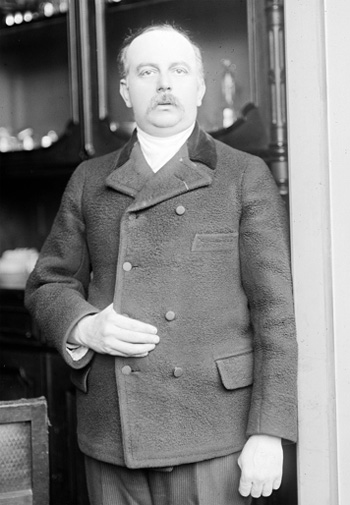 It was not long before troubling symptoms of overweening ambition bordering on megalomania soon made themselves felt. The Sillon group formed a quasi-military Jeune Garde (Young Guard) – the name was reminiscent of that of Napoleon’s shock troops, an elite, highly disciplined regiment of soldiers who would do the Emperor’s bidding. Anyone acquainted with Sangnier’s autobiographical sketches about his role as a political leader and social educator may be forgiven for wondering if he had delusions of grandeur prompting him to think of himself as a latter-day Napoleon in terms of leadership ability.
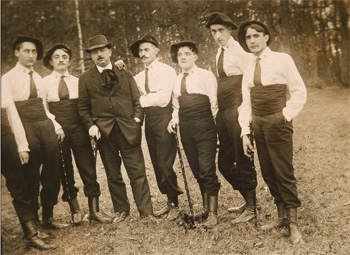
The Young Guards were distinguishable by a uniform black beret, white shirt, a sash (symbol of honor, loyalty, dedication and unity), a metal-tipped swordstick and a club. They beat the drums and paraded the flags of “Social Justice” and Democracy in an effort to arouse enthusiasm for their cause within the Church and the wider community. (Today, their propagandistic efforts would be termed a “psy-op”). They spoke of possessing a “common soul,” which facilitated a bonding and networking process among themselves.
Of the Sillon, for the Sillon, by the Sillon
There is evidence to show that the Young Guards were the victims of an aggressive propaganda campaign by Sangnier who demanded a blind faith in his vision of the perfect society. He also required a total commitment of their lives to the Sillon as the only means to achieve it. (This held true even after the Sillon was closed down by order of Pius X for, as we shall see, the organization simply carried on under another name).
What this vision entailed was set out in Sangnier’s book, L’Esprit Démocratique (The Spirit of Democracy), published in 1905. In the perfect society that he envisages, the people will forgo any motive of personal gain and will work solely for the common good, under the banner of “solidarité humaine” (human solidarity) to the point where there is no distinction between private and public interests, between one class and another, between workers and employers, and where all are “égaux et frères” (equal and brothers). 2
The link with the French revolutionary slogan Liberty, Equality and Fraternity is too obvious to pass unnoticed. It is important to note here that the Church has never taught these ideas and that Pius X, in his condemnation of the Sillon, warned that such an arrangement, if implemented in society, would “bring Socialism in its train.”
Continued

Nothing less than Global Democracy was their aim, to be achieved through application of the revolutionary principles of “Liberty, Equality and Fraternity.”
Marc Sangnier’s adolescent army
Already we can see adumbrated the development of a type of civic and ecclesiastical government that would be canonized at Vatican II under the labels of Religious Liberty and separation of Church and State, both condemned by the previous Magisterium. Because of the atmosphere of secrecy in which their underground discussions were held, few people foresaw the looming danger in the plans they formulated which would involve the Church in the reorganization of the social and ecclesiastical order. Together, the radical group set up Study Circles among students and young workers, with priests in attendance, all participating on a basis of equality and learning from one another.
Marc Sangnier, center, with the Sillon Jeune Garde
Marc Sangnier, an exceptionally talented speaker and organizer who came from a wealthy and privileged French Catholic family, emerged as their de facto leader. His charismatic personality, his oratorical skills and pretentious aspirations expressed in inflated rhetoric, his exceptional ability to engage and persuade his listeners, his unbounded zeal for a new Christendom, moved crowds of workers as well as intellectuals who heard him speak, and even moved some Bishops to give him their support.
From his own self-portrait as a young man totally consumed by an insatiable thirst for “Social Justice,” he came across as a Quixotic figure, tilting at the windmills of modern society in an effort to right the wrongs of the world. It is undeniable that he depicted himself, in a language spiced with unrestrained rodomontades and rhetorical flights of fantasy, as someone with a unique and significant destiny, setting out to conquer the world. It appears that Sangnier and his companions floated on a wave of self-congratulating emotionalism that stifled any intelligent doubts about the wisdom of their actions.
Sangnier had delusions of grandeur, thinking of himself as a latter-day Napoleon
The Young Guards were distinguishable by a uniform black beret, white shirt, a sash (symbol of honor, loyalty, dedication and unity), a metal-tipped swordstick and a club. They beat the drums and paraded the flags of “Social Justice” and Democracy in an effort to arouse enthusiasm for their cause within the Church and the wider community. (Today, their propagandistic efforts would be termed a “psy-op”). They spoke of possessing a “common soul,” which facilitated a bonding and networking process among themselves.
Of the Sillon, for the Sillon, by the Sillon
There is evidence to show that the Young Guards were the victims of an aggressive propaganda campaign by Sangnier who demanded a blind faith in his vision of the perfect society. He also required a total commitment of their lives to the Sillon as the only means to achieve it. (This held true even after the Sillon was closed down by order of Pius X for, as we shall see, the organization simply carried on under another name).
What this vision entailed was set out in Sangnier’s book, L’Esprit Démocratique (The Spirit of Democracy), published in 1905. In the perfect society that he envisages, the people will forgo any motive of personal gain and will work solely for the common good, under the banner of “solidarité humaine” (human solidarity) to the point where there is no distinction between private and public interests, between one class and another, between workers and employers, and where all are “égaux et frères” (equal and brothers). 2
The link with the French revolutionary slogan Liberty, Equality and Fraternity is too obvious to pass unnoticed. It is important to note here that the Church has never taught these ideas and that Pius X, in his condemnation of the Sillon, warned that such an arrangement, if implemented in society, would “bring Socialism in its train.”
Continued
- Louis Cousin, Vie et Doctrine du Sillon, Lyon: Emmanuel Vitte, 1906, p. 6.
- Marc Sangnier, L’Esprit Démocratique, Paris: Perrin, 1905, pp. 164-165.Marc Sangnier, L’Esprit Démocratique, Paris: Perrin, 1905, pp. 164-165.
Posted January 9, 2026


______________________
______________________
 Volume I |
 Volume II |
 Volume III |
 Volume IV |
 Volume V |
 Volume VI |
 Volume VII |
 Volume VIII |
 Volume IX |
 Volume X |
 Volume XI |
 Special Edition |